





























































































How Industrial Policies Reshaped Global Economies (2000–2025) | World Biz Magazine
A deep global analysis of industrial policy revival, manufacturing growth, key countries, industries, and future economic impact.

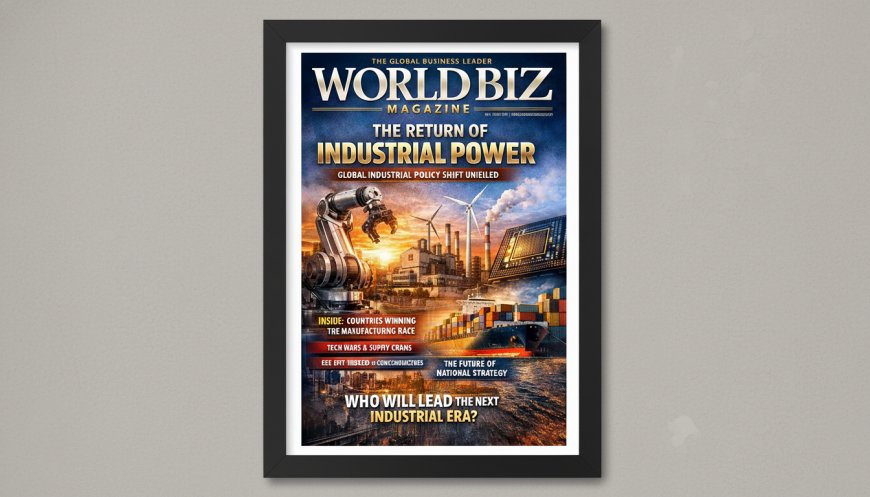
The Return of Industrial Power: How Global Industrial Policies Have Transformed Economies Over the Last 25 Years
World Biz Magazine | Global Economy & Industry
For much of the late 20th century, industrial policy was considered outdated a relic of state-controlled economies and protectionist thinking. Markets, globalization, and private capital were expected to allocate resources more efficiently than governments ever could.
That assumption has now been decisively overturned.
Over the last 25 years, and especially after the 2008 financial crisis, COVID-19, and rising geopolitical tensions, industrial policy has returned as a central pillar of national economic strategy. From the United States and China to Southeast Asia, the Middle East, and emerging economies, governments are once again shaping industries not just to grow faster, but to secure supply chains, control technology, create jobs, and protect national interests.
This is the story of how industrial policies changed, which countries won, which struggled, and what the future holds.
Over the last quarter-century, industrial policy has evolved dramatically. Once considered a relic of mid-20th-century economic strategy, it returned in force driven by globalization, geopolitical rivalry, technological shifts, and sustainability goals. Governments that once favored laissez-faire economics are now intensively using policy levers to shape where industries invest, what technology they adopt, and how national economies compete internationally.
From Free Markets to Strategic States
The Early 2000s: Globalization First
Between 2000 and 2008, most countries followed a similar playbook:
· Trade liberalization
· WTO-led integration
· Outsourcing and offshoring
· Minimal direct state intervention
Industrial growth was driven largely by cost efficiency, not strategic planning.
Post-2008: Cracks in the System
The global financial crisis exposed vulnerabilities:
· Overdependence on global supply chains
· Loss of domestic manufacturing capacity
· Rising inequality and job displacement
Industrial policy began to re-emerge cautiously at first.
2020s: Full-Scale Industrial Revival
COVID-19, semiconductor shortages, energy shocks, and geopolitical rivalry triggered a decisive shift:
Industrial policy became a tool of economic security, not just growth.
What Is Industrial Policy?
Industrial policy refers to government interventions designed to influence the industrial sector from subsidies and tax incentives to trade protection, regulation, and strategic sector support. These policies aim to boost growth, create jobs, foster innovation, enhance competitiveness, and sometimes promote national security.
Globally, the use of industrial policy has increased significantly; interventions were relatively rare in the early 2000s but surged after the 2008 financial crisis, the COVID-19 pandemic, supply-chain tensions, and rising strategic competition among major powers.
Major Countries & Industrial Policy Evolution (2000–2025+)
China: From ‘World’s Factory’ to High-Tech Supremacy
China’s industrial policy over the past 25 years has been one of the most ambitious in history.
2000s–2010s:
After joining the WTO in 2001, China became the global manufacturing powerhouse through export-oriented growth led by low-cost production and special economic zones.
2015 Onwards:
In 2015, China launched Made in China 2025 (MIC2025) a sweeping strategy to transform its industry from low-end assembly to high-tech manufacturing in sectors like semiconductors, robotics, aerospace, and AI. It aimed for high domestic content and technological self-sufficiency by 2025.
2020s Impact:
China’s manufacturing output accounts for the largest share globally (28% of global manufacturing) significantly ahead of peers. Strategic sectors like EVs, batteries, and renewables have surged; electric vehicle leaders like BYD now rival Tesla, and China produces more industrial robots than any other country.
Present/Future:
Export growth remains robust even as firms navigate weak household consumption. Policy is shifting toward consumption-driven growth and deeper commitment to clean tech and high-value industries through next iterations like Made in China 2035.
United States: Incentives to Re-Industrialize
2000s-2010s:
Policy was characterized by free trade and outsourcing, with no major central industrial strategy, but was later challenged by global competition, especially from China.
2020s Pivot:
The U.S. made a decisive shift with large incentive programmes:
- CHIPS and Science Act (2022) $106 billion in subsidies/tax incentives to boost domestic semiconductor manufacturing.
- Combined with the Inflation Reduction Act (IRA), the U.S. has directed hundreds of billions toward clean energy, high tech, and strategic industries.
Impact:
This has led to renewed investment in chip fabs in Arizona, Texas, and elsewhere and renewed manufacturing activity, though value added and output remain well below China’s scale.
Future:
Industrial policy in the U.S. will likely stay focused on semiconductors, green tech, and advanced manufacturing clusters balancing competitive pressures with inflation and trade dispute concerns.
European Union: Balancing Regulation and Industrial Support
Industrial policy in Europe has wide variation:
- Traditional strength in machinery, chemicals, automotive, and precision engineering.
- Regulatory emphasis (e.g., the Green Deal) has increased but also placed cost burdens on energy-intensive sectors leading to job and capacity losses in chemicals and other industries.
- Germany and Italy have launched a pro-industry alliance to streamline EU policies, cut red tape, and secure supply chains.
Impact/Future:
Europe’s industrial policy will likely play dual roles promoting sustainability and competitiveness while trying to preserve traditional industrial sectors under global competitive pressure.
India: Gradual Shift to Manufacturing & Strategic Support
India long pursued liberalization with relatively weak targeted industrial policy until the 2010s. Since 2014, major policy shifts include:
- Make in India (2014): Aimed to increase manufacturing’s share of GDP.
- Production Linked Incentive (PLI) schemes: Offer outcome-based incentives to boost sectors like electronics, automotive, EV components, and white goods, generating substantial investment and employment.
2025 Industrial Growth:
Industrial output in India grew strongly towards the end of 2025, driven by manufacturing. New deregulation efforts aim to help manufacturing exports reach $1.3 trillion by 2035.
Future:
India’s strategy is leaning toward a mix of deregulation and targeted incentives to attract global supply chains and boost domestic manufacturing competitiveness.
Brazil: Stalled Industrialization and Re-Industrialization Efforts
Brazil’s industrial base peaked decades ago, then deindustrialized, with manufacturing’s share of GDP falling sharply.
Recent policy “Nova Indústria Brasil” aims to reverse this trend by focusing on agroindustry, health, IT, bioeconomy, and defence by 2033.
Future:
The success of Brazil’s re-industrialization depends heavily on policy consistency and investment execution.
Malaysia
Policy Shift:
- 2000s: Export-oriented electronics manufacturing (E&E), heavy reliance on FDI
- 2010s: Industrial Master Plan (IMP3) - move toward higher value manufacturing
- 2020s: New Industrial Master Plan 2030 (NIMP 2030) focusing on Industry 4.0, green tech, semiconductors
Major Industries:
- Semiconductors & electronics
- Medical devices
- Palm oil downstream processing
Impact:
- Manufacturing 23% of GDP
- Electronics exports USD 120B annually
- Strong position in global chip packaging & testing
Future Outlook:
Malaysia aims to become a regional advanced manufacturing hub rather than low-cost assembler.
Vietnam
Policy Shift:
- 2000–2010: Low-cost labor manufacturing, WTO accession (2007)
- 2010–2020: FDI-driven industrial parks
- Post-2020: Supply-chain diversification from China
Major Industries:
- Electronics (Samsung, Intel supply chains)
- Textiles & garments
- Consumer electronics
Impact:
- Manufacturing 25% of GDP
- Industrial exports USD 370B
- One of the fastest-growing manufacturing economies
Future Outlook:
Vietnam is shifting from assembly to component and value-added manufacturing.
Saudi Arabia
Policy Shift:
- Pre-2016: Oil-dependent industrial structure
- Post-2016: Vision 2030 - aggressive industrial diversification
Major Industries:
- Petrochemicals (SABIC)
- Mining & metals
- Defense manufacturing
- Renewable energy
Impact:
- Industrial output USD 300B
- Non-oil GDP share rising steadily
Future Outlook:
Saudi Arabia aims to become a Middle East industrial & logistics super-hub, reducing oil dependency.
Turkey
Policy Shift:
- 2000s: Customs Union with EU boosts manufacturing
- 2010s: Import substitution, export incentives
- 2020s: Defense & automotive localization
Major Industries:
- Automotive
- Defense & aerospace
- White goods
- Textiles
Impact:
- Manufacturing 22% of GDP
- Industrial exports USD 250B
Future Outlook:
Turkey positions itself as a bridge manufacturing economy between Europe and Asia.
Pakistan
Policy Shift:
- 2000s: Textile-centric industrial policy
- 2015–2020: CPEC-driven industrial zones
- 2020s: Mixed progress due to macro instability
Major Industries:
- Textiles & apparel
- Cement
- Fertilizers
- Food processing
Impact:
- Manufacturing13% of GDP
- Industrial exports USD 35–40B
Future Outlook:
Requires energy reform, export diversification, and technology upgrade to regain competitiveness.
Bangladesh
Policy Shift:
- 2000s-2010s: Garment export dominance
- Post-2015: Export Processing Zones (EPZs) expansion
Major Industries:
- Ready-Made Garments (RMG)
- Leather & footwear
- Pharmaceuticals
Impact:
- RMG exports USD 45B
- Manufacturing 20% of GDP
Future Outlook:
Transitioning from low-cost apparel to value-added textiles & pharma.
Sri Lanka
Policy Shift:
- 2000s: Apparel-centric exports
- 2010s: Limited diversification
- 2020s: Crisis-driven restructuring
Major Industries:
- Apparel
- Rubber products
- Tea processing
Impact:
- Manufacturing16% of GDP
- Export-dependent but constrained by debt crisis
Future Outlook:
Industrial recovery depends on stability, FDI, and export diversification.
Thailand
Policy Shift:
- 2000s: Automotive export hub
- 2010s: Thailand 4.0 strategy
- 2020s: EV manufacturing transition
Major Industries:
- Automotive & EVs
- Electronics
- Food processing
Impact:
- Manufacturing 30% of GDP
- Industrial exports USD 280B
Future Outlook:
Thailand is positioning as ASEAN’s EV and smart manufacturing hub.
United Arab Emirates
Policy Shift:
- 2000s: Trade & logistics-centric
- 2010s: Free zones + industrial diversification
- 2020s: Operation 300bn industrial strategy
Major Industries:
- Aluminum (EMAL)
- Aerospace
- Defense
- Advanced manufacturing
Impact:
- Industrial contribution targeted at USD 82B+ by 2031
Future Outlook:
UAE aims to be a high-tech industrial and export platform for MENA.
Brazil
(Already covered earlier, summarized for continuity)
- Manufacturing turnover USD 1.3 trillion
- Focus on re-industrialization via green & agro-industry
Argentina
Policy Shift:
- Cyclical industrial policy with import substitution
- Heavy state involvement
Major Industries:
- Agriculture machinery
- Automotive
- Energy equipment
Impact:
- Manufacturing 17% of GDP
- Industrial instability due to inflation
Future Outlook:
Industrial growth hinges on macro-economic reforms.
Canada
Policy Shift:
- 2000s: Resource-heavy industry
- 2020s: Clean tech, EV supply chains
Major Industries:
- Automotive
- Aerospace
- Clean energy
- Mining
Impact:
- Manufacturing 10% of GDP
- Strong EV battery investments
Future Outlook:
Canada is positioning as a critical minerals & clean manufacturing leader.
Russia
Policy Shift:
- 2000s: Energy-led industrial growth
- Post-2014 & 2022: Import substitution due to sanctions
Major Industries:
- Defense
- Energy equipment
- Heavy machinery
Impact:
- Manufacturing 14% of GDP
- Isolation reshaped industrial structure
Future Outlook:
Domestic industrialization continues, but global integration limited.
Taiwan
Policy Shift:
- Long-term tech-centric industrial planning
Major Industries:
- Semiconductors (TSMC)
- Electronics
Impact:
- Semiconductor exports USD 180B
- Backbone of global chip supply
Future Outlook:
Taiwan remains strategically critical in global tech supply chains.
Japan
Policy Evolution:
- 2000s: Mature industrial economy, focus on efficiency and global exports
- 2010s: Response to China’s rise; automation and high-precision manufacturing
- 2020s: Economic security laws, semiconductor reshoring, supply-chain resilience
Major Industries:
- Automotive (Toyota, Honda)
- Robotics & industrial automation
- Electronics & advanced materials
Impact:
- Manufacturing 20% of GDP
- Industrial turnover USD 1.5 trillion
- World leader in robotics and machine tools
Future Outlook:
Japan is reinforcing high-end, precision manufacturing, with strong emphasis on AI-driven factories and strategic technology autonomy.
South Korea
Policy Evolution:
- 2000s: Export-led growth via chaebols (Samsung, Hyundai)
- 2010s: Heavy investment in semiconductors and shipbuilding
- 2020s: K-Semiconductor Strategy, green & battery industries
Major Industries:
- Semiconductors
- Shipbuilding
- EV batteries
- Consumer electronics
Impact:
- Manufacturing 27% of GDP
- Semiconductor exports USD 130B
- One of the most innovation-intensive economies
Future Outlook:
South Korea is positioning itself as a global technology manufacturing powerhouse, especially in chips, batteries, and smart mobility.
Mexico
Policy Evolution:
- 2000s: NAFTA-driven industrial integration with the U.S.
- 2010s: Automotive and electronics cluster expansion
- 2020s: Nearshoring boom under USMCA
Major Industries:
- Automotive & auto parts
- Electronics
- Aerospace components
Impact:
- Manufacturing 19% of GDP
- Industrial exports USD 500B
- Key supplier to North American value chains
Future Outlook:
Mexico is emerging as the biggest nearshoring beneficiary, though energy and infrastructure reforms remain critical.
Indonesia
Policy Evolution:
- 2000s: Commodity-based industrial structure
- 2010s: Resource nationalism & downstream processing
- 2020s: EV supply chain industrialization
Major Industries:
- Nickel & mineral processing
- EV battery materials
- Palm oil downstream products
Impact:
- Manufacturing 18% of GDP
- Nickel industry turnover USD 30B
Future Outlook:
Indonesia is transforming from raw-material exporter to strategic EV materials hub, critical for global energy transition.
Egypt
Policy Evolution:
- 2000s: State-led manufacturing
- 2010s: Industrial zones & infrastructure megaprojects
- 2020s: Export-oriented manufacturing strategy
Major Industries:
- Construction materials
- Chemicals
- Textiles
- Food processing
Impact:
- Manufacturing 16% of GDP
- Growing exports to Africa and Middle East
Future Outlook:
Egypt aims to become a regional manufacturing and logistics gateway connecting Africa, Europe, and Asia.
Italy
Policy Evolution:
- 2000s: SME-driven industrial clusters
- 2010s: Productivity stagnation
- 2020s: Industry 4.0 incentives & EU recovery funds
Major Industries:
- Machinery
- Automotive components
- Fashion & luxury manufacturing
Impact:
- Manufacturing 15% of GDP
- Industrial exports USD 650B
Future Outlook:
Italy focuses on high-value niche manufacturing, digitalization, and sustainable production.
France
Policy Evolution:
- 2000s: State-supported industrial champions
- 2010s: Industrial decline concerns
- 2020s: France 2030 investment plan
Major Industries:
- Aerospace (Airbus)
- Defense
- Nuclear & energy equipment
Impact:
- Manufacturing 13% of GDP
- Strong export-oriented industrial base
Future Outlook:
France emphasizes strategic sovereignty in aerospace, defense, and clean energy technologies.
United Kingdom
Policy Evolution:
- 2000s: Services-led economy, weak industrial focus
- Post-2016: Brexit-driven industrial rethinking
- 2020s: Advanced manufacturing & life sciences focus
Major Industries:
- Aerospace
- Pharmaceuticals
- Automotive (EV transition)
Impact:
- Manufacturing 10% of GDP
- Industrial exports USD 400B
Future Outlook:
UK industrial policy targets high-tech manufacturing clusters, though labor and trade challenges persist.
Australia
Policy Evolution:
- 2000s: Resource-heavy economy
- 2010s: Decline in domestic manufacturing
- 2020s: Critical minerals & defense manufacturing
Major Industries:
- Mining equipment
- Defense manufacturing
- Green hydrogen
Impact:
- Manufacturing 6% of GDP
- Key global supplier of lithium and rare minerals
Future Outlook:
Australia is moving up the value chain from mining to industrial processing and clean-energy manufacturing.
Key Global Insight (Last 25 Years)
Across all these countries, one pattern is clear:
Industrial policy has shifted from “cheap labor + exports” - “strategic industries + technology + resilience + sustainability.”
Countries that aligned policy + capital + skills + infrastructure succeeded; those that relied only on protection or subsidies struggled.
Sectoral Shifts & Policy Priorities
Industrial policies in the 2000s prioritized export-driven manufacturing and low-cost production. Since the 2010s, priorities have shifted towards:
Technology & Innovation
- Governments push high tech: semiconductors (U.S. CHIPS), robotics, AI, and next-gen IT.
Green Transition
- Policies increasingly tie industrial support to environmental goals (e.g., renewable energy, EVs).
Horizontal vs Sector-Specific Support
- Support has evolved from narrow sector subsidies to broader R&D, investment incentives, and green transition focus.
Industrial Output & Economic Impact
Here’s a snapshot of how manufacturing and industrial policy correlate with output (2025 data):
|
Country |
Manufacturing Share / Output (2023/25) |
Key Industries |
|
China |
28% of global output |
EVs, electronics, renewables, steel |
|
United States |
$2.8 trillion manufacturing value added |
semiconductors, aerospace, machinery |
|
Germany |
$845 billion |
automotive, engineering |
|
Japan |
Major producer despite declining share |
automotive, electronics |
|
India |
rapidly growing, auto $250B |
automotive, electronics, chemicals |
Industrial policy has boosted specific sectors but results vary China’s state-driven model delivered rapid scale; U.S. incentives are reviving technology sectors; India’s production incentives are attracting investment; Europe grapples with regulation vs industrial efficiency.
Risks & Lessons
Industrial policy offers benefits, innovation, jobs, and strategic autonomy but also carries risks:
- Resource misallocation if poorly targeted.
- Higher consumer prices.
- Trade tensions or retaliation.
Success depends on strong institutions, careful design, and alignment with broader economic reforms.
What Changed in Industrial Policy?
Then (2000s)
- Low-cost labor
- Export dependency
- Minimal state intervention
Now (2020s)
- Strategic industries
- Technology sovereignty
- Supply-chain resilience
- Green transition
Industrial policy today is not about protection, it is about positioning.
Who Wins, Who Loses
Winning Economies
- China
- South Korea
- Taiwan
- Vietnam
- Germany (select sectors)
Struggling Economies
- Those with inconsistent policies
- Energy and infrastructure bottlenecks
- Weak innovation ecosystems
The Next 25 Years: What Lies Ahead
Industrial policy will increasingly focus on:
- Artificial intelligence & automation
- Clean energy & EV ecosystems
- Semiconductors & advanced materials
- Defense and space industries
The competition will not be about who produces more, but who controls technology, standards, and supply chains.
Looking Ahead: 2025 and Beyond
Global industrial policy will continue adapting to:
• Geopolitical competition: especially U.S. - China rivalry over tech sectors.
• Green transition imperatives: balancing climate goals with industrial competitiveness.
• Digital transformation: AI, automation, smart manufacturing systems.
• Resilient supply chains: reducing dependency on single sources.
Industrial policy is no longer just about subsidies, it’s about strategic vision, innovation ecosystems, workforce development, and international competitiveness.
World Biz Magazine Insight
Industrial policy has re-emerged as a defining force of economic power.
Nations that align policy, capital, skills, and innovation will dominate the global economy those that don’t will remain dependent.
The last 25 years proved one lesson clearly:
Markets alone do not build industrial leadership. Strategy does.
Conclusion
Over the past 25 years, industrial policy has transitioned from passive supportive roles to central strategic instruments in national economic planning.
- China emerged as the global manufacturing leader.
- U.S. pivoted towards targeted high-tech incentives.
- EU strives to balance regulation and industrial growth.
- India accelerated manufacturing through targeted incentives.
Despite different models, all major economies now use industrial policy proactively to foster growth, tackle global competition, and navigate technological and environmental transitions illustrating that industrial strategy remains a cornerstone of economic power in the 21st century.
Disclaimer
This article is published by World Biz Magazine for informational purposes only. The content reflects editorial analysis based on publicly available data and industry research at the time of publication and does not constitute financial, legal, investment, or policy advice.
All figures, estimates, and forward-looking statements are indicative and subject to change. While every effort is made to ensure accuracy, World Biz Magazine makes no guarantees regarding completeness or precision.
References to countries, companies, policies, or institutions are for editorial context only and do not imply endorsement or affiliation. Readers should conduct independent research or consult professionals before making business or investment decisions.
What's Your Reaction?
 Like
0
Like
0
 Dislike
0
Dislike
0
 Love
0
Love
0
 Funny
0
Funny
0
 Angry
0
Angry
0
 Sad
0
Sad
0
 Wow
0
Wow
0