


































































































































































































How Green Energy Technology Is Transforming the Global Economy
Explore sustainability technology in green energy, global market growth, leading countries, renewable innovations, and economic impact shaping the future energy economy.

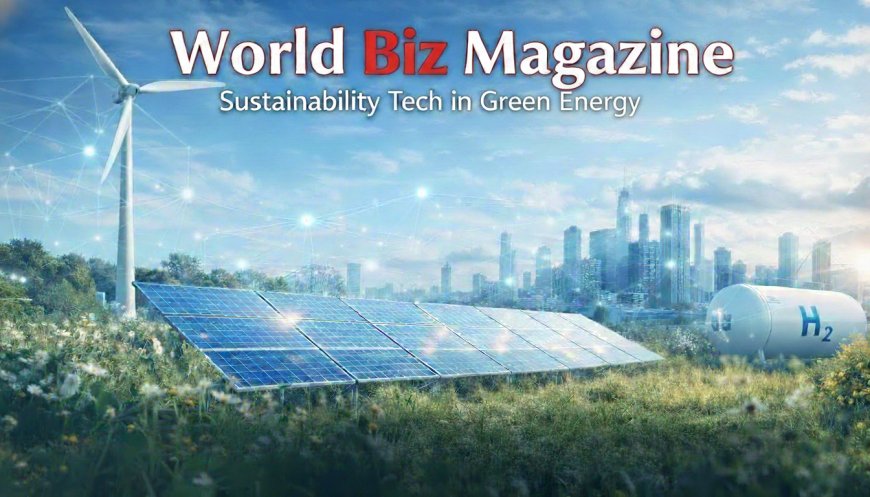
Sustainability Tech in Green Energy: Powering a Cleaner, Smarter Future
World Biz Magazine: Sustainability & Technology
The Global Green Transition Takes Center Stage
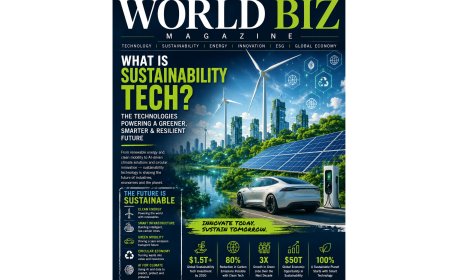
The global economy is navigating one of the most profound structural transformations in history: the transition from a fossil-fuel-dependent model to a decentralized, low-carbon infrastructure. By 2026, this shift is no longer merely a response to climate imperatives; it has become the primary engine of industrial competitiveness and national security.
Sustainability technology encompassing everything from AI-optimized smart grids to green hydrogen clusters is redefining how nations generate and trade value. In this new era, energy resilience is synonymous with economic sovereignty.
Market Landscape: Growth Drivers and Regional Dynamics
The global green technology and sustainability market is experiencing a period of hyper-growth. Recent data for 2025–2026 indicates the market is expanding at a CAGR of approximately 12.3%, with total industry valuation expected to surge from $1.4 Trillion in 2026 to nearly $3.8 Trillion by 2035.
Key Growth Catalysts:
· Declining Levelized Cost of Energy (LCOE): Renewables are now the cheapest source of new power in over 90% of the world.
· The AI Surge: Hyperscale data centers are driving a massive, immediate demand for 24/7 carbon-free energy (CFE), accelerating the deployment of small modular reactors (SMRs) and advanced storage.
· Policy & Industrial Strategy: Frameworks like the U.S. Inflation Reduction Act (IRA) and the EU’s "Fit for 55" have shifted the focus from climate "goals" to industrial "races" for factory capacity.
Regional Market Share (2026 Estimates):
|
Region |
Share |
Strategic Focus |
|
Asia-Pacific |
~38% |
Manufacturing scale, rapid urbanization, and hydrogen pilots. |
|
North America |
~32% |
AI energy optimization, private VC, and domestic onshoring. |
|
Europe |
~24% |
Offshore wind leadership and cross-border grid integration. |
|
Rest of World |
~6% |
Solar-rich regions in the Middle East & Africa and hydropower in LATAM. |
Global Leaders: Strategies for a Decarbonized World
China: The Manufacturing Hub
China continues to dominate the global supply chain, producing over 80% of the world’s solar PV and a majority of its lithium-ion batteries. In 2025, China added record volumes of renewable capacity, leveraging state-backed "gigafactories" to export sustainability tech globally.
United States: The Innovation Engine
The U.S. strategy focuses on "Clean Tech 2.0"the software and intelligence layer of energy. With over 90% of global hyperscaler energy contracts hosted in the U.S., the focus has shifted to grid-edge software, virtual power plants (VPPs), and diversifying mineral supply chains away from foreign entities of concern.
European Union: The Policy Pioneer
Europe is the leader in offshore wind and "green hydrogen corridors." Countries like Germany (solar/wind integration) and Denmark (88% renewable power share) serve as blueprints for total grid decarbonization.
India: The Expansion Powerhouse
India is the world’s fastest-growing renewable market, having invested over $100 Billion in clean energy in 2025 alone. Projects like the Dhirubhai Energy Complex, scheduled to go fully operational in 2026, aim to integrate solar, battery, and electrolyzer manufacturing in a single ecosystem.
Brazil: The Renewable Grid Blueprint
Brazil boasts one of the world's cleanest energy matrices, with over 80% of its electricity derived from renewables.
· Hydro-Wind Synergy: Brazil is pioneering the integration of reservoir hydropower with rapid wind expansion (which reached 21% of the mix in 2025). This allows hydro plants to act as a "giant battery," preserving water during high wind periods.
· Bioenergy Leadership: As a global leader in biofuels, Brazil is now pivoting toward Sustainable Aviation Fuel (SAF) and green diesel to decarbonize heavy transport.
· Equatorial Margin: By 2026, Brazil is intensifying offshore wind research along its massive coastline, aiming to become a top exporter of green hydrogen to Europe.
Australia: The "Renewable Energy Superpower" Strategy
Australia is transforming from a fossil fuel exporter to a green energy hub, leveraging its vast landmass and record-breaking solar exposure.
· The Hydrogen Export Race: The 2024 National Hydrogen Strategy is now in full swing. Australia is building massive "hubs" to export liquid hydrogen and ammonia to Japan and South Korea.
· State-Level Ambition: South Australia reached a milestone in late 2025, consistently hitting 85%–100% net renewables on its grid.
· Critical Minerals: Australia is onshoring the processing of lithium, cobalt, and rare earths, ensuring it controls the "upstream" supply chain for global EV batteries.
Japan: The Hydrogen & Offshore Wind Pioneer
Japan is overcoming its geographic constraints through advanced R&D and marine technology.
· Offshore Wind Focus: With limited land, Japan is betting on floating offshore wind technology. By 2026, the government has accelerated auctions to reach its 10 GW target by 2030.
· The Hydrogen Society: Japan is the first nation to implement a comprehensive "Hydrogen Strategic Plan," integrating hydrogen into everything from residential heating to heavy industry.
· Next-Gen Solar: Japan is a leader in Perovskite solar cells flexible, lightweight panels that can be draped over buildings where traditional heavy silicon panels cannot go.
Saudi Arabia & UAE: The Gulf’s Green Pivot
The Middle East is reinvesting oil wealth into a "Post-Oil" future, utilizing the world's cheapest solar costs.
· Mega-Scale Solar: Projects like the NEOM Green Hydrogen Project ($5B) and the Mohammed bin Rashid Al Maktoum Solar Park are setting global records for the lowest price per kilowatt-hour.
· Nuclear & Solar Integration: The UAE’s Barakah nuclear plant, combined with massive solar arrays, allows the nation to run its heavy industry on 100% carbon-free power.
· Desalination Tech: Both nations are pioneering solar-powered desalination, a critical sustainability tech for water-scarce regions.
Kenya & Morocco: Africa’s Green Gateways
· Kenya: A global success story in Geothermal Energy. By 2026, geothermal and hydro provide over 85% of Kenya’s generation. Kenya is now exporting this technical "know-how" across the East African Rift.
· Morocco: Home to the Noor Ouarzazate Solar Complex, Morocco is using Concentrated Solar Power (CSP) to provide energy even after the sun sets. It is currently building the "Xlinks" undersea cable to provide 8% of the UK’s electricity directly from Moroccan wind and solar.
Vietnam & Indonesia: Southeast Asia’s Manufacturing Shift
· Vietnam: Has seen the fastest solar growth in Southeast Asia, surpassing many developed nations in total installed capacity. It is now focusing on Grid Modernization to handle the influx of decentralized power.
· Indonesia: Utilizing its vast volcanic activity, Indonesia is aiming to become the world's largest geothermal producer while transitioning its massive nickel reserves into a domestic EV battery industry.
Summary of Emerging Regional Strategies (2026–2030)
|
Region |
Primary Tech Driver |
Leading Countries |
Strategic Goal |
|
Latin America |
Hydro + Biofuels |
Brazil, Uruguay, Chile |
Grid resilience & green fuels export |
|
Middle East |
Utility Solar + H2 |
Saudi Arabia, UAE, Oman |
Pivot from Oil to Green Ammonia exports |
|
Africa |
Geothermal + CSP |
Kenya, Morocco, Ethiopia |
Energy access & industrial decarbonization |
|
Southeast Asia |
Solar + Nickel/EVs |
Vietnam, Indonesia, Thailand |
Manufacturing hub for the global battery supply |
|
Oceania |
Solar + Hydrogen |
Australia, New Zealand |
Global "Green Energy Superpower" status |
A Multi-Polar Energy Future
The green transition is no longer a Western-led initiative. We are entering a multi-polar energy era where Brazil’s bio-innovation, Australia’s mineral wealth, and the Middle East’s solar scale are just as influential as U.S. or European policy.
Technological Pillars: The Innovations of 2026
1. Next-Gen Solar (Perovskites & Bifacial): New tandem cells are breaking the 30% efficiency barrier, while bifacial panels which capture light from both sides are increasing utility-scale output by up to 15%.
2. Long-Duration Energy Storage (LDES): Moving beyond 4-hour lithium batteries, the 2026 market is embracing Iron-Air and Flow Batteries capable of 100+ hours of discharge, providing true grid stability.
3. Green Hydrogen (H2): Utilizing Proton Exchange Membrane (PEM) electrolyzers, green hydrogen is finally penetrating "hard-to-abate" sectors like steel manufacturing and heavy shipping.
4. AI & Digital Twins: AI now manages real-time demand response, predicting weather patterns to optimize wind turbine orientation and reducing equipment downtime by up to 70% via predictive maintenance.
Economic Impact and the Labor Market
The transition is a massive job creator. As of early 2026, over 35 million people are employed in the clean energy sector surpassing fossil fuel employment for the third consecutive year.
· Energy Security: Transitioning to domestic renewables is estimated to save advanced economies billions in fuel import costs.
· The "Green Premium" Flip: In many regions, building new solar-plus-storage is now cheaper than continuing to run existing coal or gas plants.
Challenges: Navigating the "Messy" Middle
The transition faces significant headwinds as it scales:
· Grid Infrastructure: Global transmission lines need to double by 2050 to handle the renewable load. Currently, "interconnection queues" remain a major bottleneck for new projects.
· Critical Minerals: The race for lithium, copper, and rare earth elements has created a new geopolitical map, with nations scrambling to onshore refining and recycling.
· Social Acceptance: "Permitting reform" has become a central political issue as local communities negotiate the placement of massive wind farms and transmission towers.
Conclusion: A Path Powered by Intelligence
Sustainability technology has transitioned from a niche moral pursuit to the foundational layer of the global economy. By 2030, the goal of tripling renewable capacity is within reach, provided that grid modernization and capital flow to emerging markets remain priorities.
The future belongs to the nations and corporations that treat energy not as a commodity to be burned, but as a digital, renewable asset to be managed with intelligence.
Editorial Insight
The most successful players in 2026 are those who focus on Execution over Ambition. The world no longer needs more net-zero pledges; it needs more substations, more high-voltage lines, and more gigafactories.
Disclaimer
This article is published by World Biz Magazine for informational and analytical purposes only. It does not constitute financial, investment, legal, or policy advice. Market estimates and forecasts are based on publicly available data, industry reports, and editorial analysis at the time of publication.
What's Your Reaction?
 Like
0
Like
0
 Dislike
0
Dislike
0
 Love
0
Love
0
 Funny
0
Funny
0
 Angry
0
Angry
0
 Sad
0
Sad
0
 Wow
0
Wow
0