











































































































































































Malaysia vs Thailand Property Market: Investment Comparison & 2026 Outlook
Investor-focused analysis of Malaysia and Thailand property markets with long-term outlook and strategic insights.

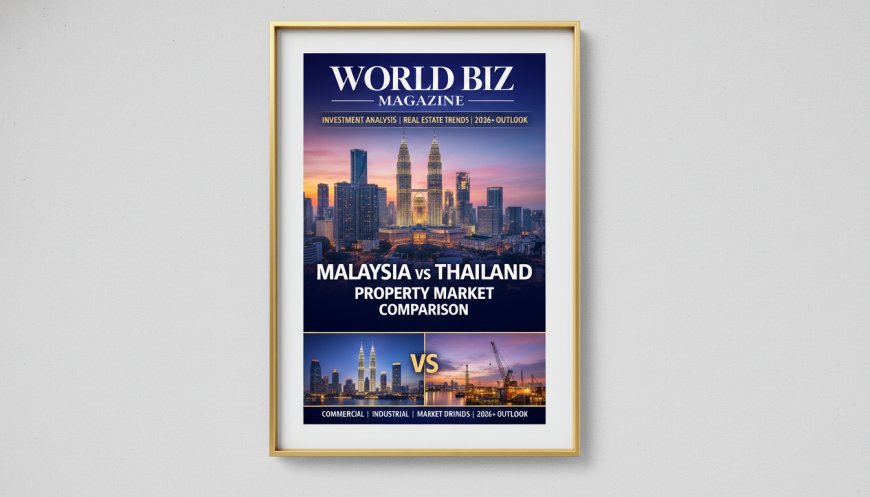
Malaysia vs Thailand Property Market Comparison
Investment Trends, Market Dynamics & Outlook Beyond 2026
World Biz Magazine | Global Real Estate Insights
Southeast Asia continues to attract global real estate investors seeking a balance of growth, affordability, and long-term urban expansion. Among the region’s most closely compared markets are Malaysia and Thailand two countries with distinct economic structures, investor profiles, and property market dynamics.
This article presents a comprehensive comparison of Malaysia and Thailand’s property markets, examining past performance, current sectoral strengths, and forward-looking assumptions from 2026 onwards, covering commercial, industrial, and residential real estate.
Macro Overview: Two Regional Property Hubs
Malaysia
Malaysia’s property market is shaped by:
· Political and regulatory stability
· Strong infrastructure planning
· A diversified economy (manufacturing, finance, services, technology)
· A transparent legal framework for foreign property ownership
Kuala Lumpur, Selangor, and Penang form the backbone of commercial and industrial real estate activity.
Thailand
Thailand’s property market benefits from:
· A globally recognized tourism economy
· Strong domestic consumption
· Expanding logistics and industrial manufacturing base
· Large urban population centers
Bangkok, Eastern Economic Corridor (EEC), and Phuket dominate property investment flows.
Historical Performance: Market Evolution
Malaysia - Stable, Policy-Driven Growth
Historically, Malaysia’s property market has followed a measured growth trajectory:
· Rapid urban expansion during the 1990s and early 2000s
· Cooling measures post-2014 to control speculation
· Strong post-pandemic recovery driven by infrastructure and industrial demand
Malaysia is known for lower volatility, especially in commercial and industrial segments.
Thailand - Cyclical, Tourism-Linked Growth
Thailand’s property market has experienced:
· Strong booms aligned with tourism and foreign inflows
· Periodic corrections following political or global disruptions
· Rapid recovery in hospitality and mixed-use developments
Residential and hospitality assets show higher volatility, but also faster rebounds.
Commercial Property Comparison
Malaysia Commercial Real Estate
· Steady demand for Grade-A offices in Kuala Lumpur and Cyberjaya
· Growing emphasis on ESG-compliant and green buildings
· Retail transitioning toward experiential and mixed-use formats
Strength: Predictable yields and strong domestic corporate tenancy.
Thailand Commercial Real Estate
· Bangkok remains Southeast Asia’s most active office market
· Retail strongly linked to tourism and lifestyle consumption
· Mixed-use mega-projects dominate urban centers
Strength: High footfall, international brand presence, and consumer spending.
Industrial & Logistics Property
Malaysia
Malaysia is a regional manufacturing and logistics hub:
· Electronics, semiconductors, automotive, and halal manufacturing
· Strong industrial parks in Selangor, Johor, Penang
· Rising demand for warehouses and last-mile logistics
Thailand
Thailand’s industrial real estate is anchored by:
· Automotive and electronics manufacturing
· Government-backed Eastern Economic Corridor (EEC)
· Strong port, road, and rail connectivity
Comparison Insight:
Malaysia offers regulatory clarity and cost efficiency, while Thailand offers scale and export-oriented industrial clusters.
Residential Property Market
Malaysia Residential
· Affordable pricing compared to regional peers
· Strong owner-occupier base
· Foreign buyers focused on urban high-rise units
Thailand Residential
· Strong condominium market driven by foreign buyers
· High exposure to tourism and short-term rentals
· Premium pricing in Bangkok and resort cities
Foreign Investment & Regulations
|
Factor |
Malaysia |
Thailand |
|
Foreign Ownership |
Allowed with thresholds |
Restricted (condos primarily) |
|
Market Transparency |
High |
Moderate |
|
Entry Cost |
Medium |
Medium–High |
|
Currency Stability |
Relatively stable |
More volatile |
|
Institutional Capital |
Moderate |
Strong in hospitality |
2026+ Outlook & Growth Assumptions
Malaysia (2026 Onwards)
· Continued industrial and logistics expansion
· Stable commercial office demand
· Smart city and transit-oriented development growth
· Moderate but consistent capital appreciation
Thailand (2026 Onwards)
· Tourism-driven property resurgence
· Expansion of EEC-linked industrial assets
· Continued demand for branded residences and mixed-use projects
· Higher cyclical upside with greater volatility
Risk Assessment
Malaysia Risks
· Oversupply in certain residential segments
· Dependence on export-driven industries
· Slower speculative gains
Thailand Risks
· Political uncertainty cycles
· Heavy reliance on tourism inflows
· Regulatory complexity for foreign investors
Investor Strategy Comparison
· Malaysia suits long-term, income-focused investors prioritizing stability and regulatory clarity.
· Thailand suits growth-oriented and opportunistic investors comfortable with market cycles and tourism exposure.
A diversified Southeast Asia strategy often combines Malaysia’s stability with Thailand’s growth potential.
Conclusion
The Malaysia vs Thailand property comparison highlights two mature yet distinct real estate ecosystems. Malaysia offers predictable growth, affordability, and industrial strength, while Thailand delivers scale, tourism-driven demand, and cyclical upside.
From 2026 onwards, both markets will benefit from ASEAN economic integration, infrastructure investment, and regional mobility but investor success will depend on risk tolerance, asset selection, and time horizon.
Disclaimer
This article is published by World Biz Magazine for informational purposes only. It does not constitute financial, legal, or investment advice. Market conditions, regulations, and economic assumptions may change without notice.
What's Your Reaction?
 Like
0
Like
0
 Dislike
0
Dislike
0
 Love
0
Love
0
 Funny
0
Funny
0
 Angry
0
Angry
0
 Sad
0
Sad
0
 Wow
0
Wow
0