





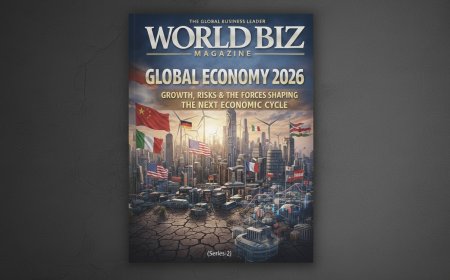














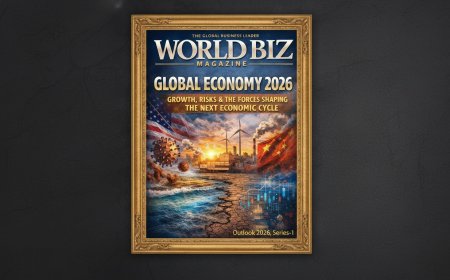




































































































































































Global Economy 2026: Outlooks, Risks & the Forces Reshaping Global Growth
An in-depth look at the global economy in 2026, analyzing risks, policy shifts, climate disruptions, and new growth drivers.

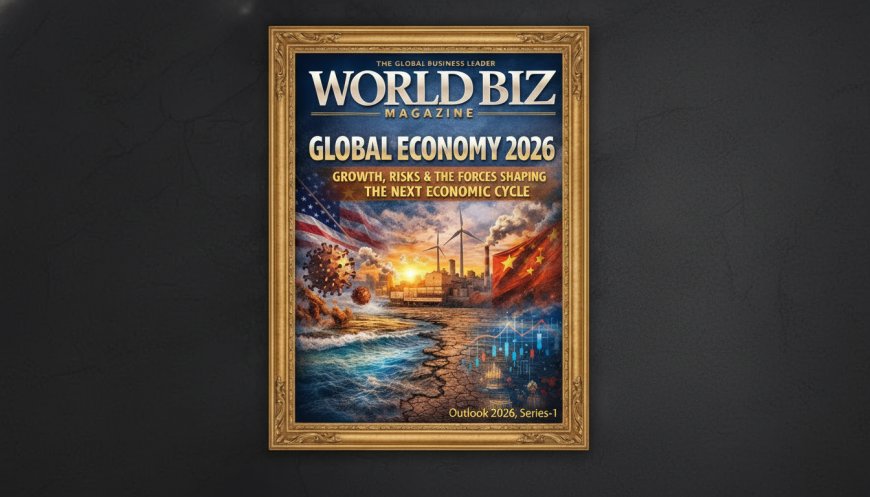
World Economic Outlook 2026: Inflation, Geopolitics & the Future of Growth
World Biz Magazine | Global Economy Outlook Series-1 2026
Outlooks, Risks, and the Forces Reshaping Growth Across the World
As the world enters 2026, the global economy stands at a complex crossroads. The post-pandemic rebound has faded, inflationary shocks have moderated but not vanished, geopolitical fractures persist, and climate-driven disruptions are becoming structural rather than exceptional.
Unlike previous cycles, the global economy in 2026 is not defined by a single crisis or boom, but by overlapping pressures: shifting government policies, extreme weather events, health risks, technological disruption, and diverging growth paths between advanced and emerging economies.
This report provides a holistic outlook of the global economy in 2026, analyzing future impacts across regions, key economic indicators, and how current conditions differ from the past five years.
Global Growth Snapshot: 2026 Outlook
Key Themes Defining 2026
· Moderate but uneven global growth
· Slower advanced economies, resilient emerging markets
· Persistent climate and supply-chain risks
· Strategic government intervention shaping markets
Estimated Global GDP Growth (2026):
· World: 2.8–3.1%
· Advanced Economies: 1.5–1.8%
· Emerging & Developing Economies: 4.0–4.5%
This marks a stabilization phase, not a return to pre-2020 globalization-led expansion.
Comparing 2026 With Previous Years
|
Indicator |
2020–21 |
2022–23 |
2024–25 |
2026 Outlook |
|
Global Growth |
Shock & rebound |
Inflation slowdown |
Stabilization |
Moderate, uneven |
|
Inflation |
Low → spike |
Very high |
Declining |
Sticky but controlled |
|
Interest Rates |
Near zero |
Aggressive hikes |
Peak & pause |
Gradual easing |
|
Trade |
Disrupted |
Weak recovery |
Fragmented |
Regionalized |
|
Investment |
Uncertain |
Defensive |
Selective |
Strategic |
Advanced Economies: Slower, Older, More Cautious
United States
2026 Outlook
· Growth moderates amid high debt and fiscal constraints
· Strong consumer spending softens
· Manufacturing supported by industrial policy
Key Impacts
· Interest rates likely ease gradually
· Labor market cools but avoids collapse
· AI-driven productivity gains offset slowdown
Difference from Past
· Shift from monetary dominance - fiscal and industrial tools
· Less globalization, more domestic investment focus
Europe
2026 Outlook
· Weak growth but reduced recession risk
· Energy costs stabilize
· Export competitiveness under pressure
Key Impacts
· Aging demographics weigh on productivity
· Climate regulations raise costs
· Industrial restructuring accelerates
Difference from Past
· From crisis management to structural adjustment
· More fiscal coordination, less austerity
Japan
2026 Outlook
· Stable but low growth
· Wage increases modestly revive consumption
Key Impacts
· Currency volatility
· Heavy reliance on automation
Difference from Past
· Transition from deflation control to inflation management
Emerging Markets: Growth With Fragility
China
2026 Outlook
· Moderate growth, lower than historical averages
· Industrial exports remain strong
· Domestic consumption recovery uneven
Key Impacts
· Property sector drag
· Strong EV, renewable, and tech manufacturing
Difference from Past
· From hyper-growth - managed, strategic growth
· From global openness - selective engagement
India
2026 Outlook
· One of the fastest-growing major economies
· Manufacturing and services both expanding
Key Impacts
· Infrastructure investment boosts productivity
· Demographic dividend supports consumption
Difference from Past
· From services-only growth - balanced industrial expansion
Brazil & Mexico
· Brazil: Commodity-linked recovery with industrial ambitions
· Mexico: Major nearshoring beneficiary
Difference from Past
· More integration into regional supply chains
Climate & Weather Impacts: A Structural Economic Force
By 2026, climate is no longer a “risk scenario” - it is an economic baseline.
Economic Channels Affected
· Agriculture yields disrupted by heat and floods
· Energy demand volatility
· Insurance costs surge
· Infrastructure repair burdens public finances
Regional Impacts
· South Asia & Africa: food inflation risk
· Europe: heatwaves reduce productivity
· North America: extreme storms impact logistics
Difference from Past
· From episodic shocks - continuous cost factor
Virus & Health Risks: Lower Panic, Higher Preparedness
While no COVID-scale pandemic dominates 2026, health risks remain economically relevant.
Impacts
· Localized outbreaks affect travel and supply chains
· Healthcare spending remains elevated
· Workforce productivity disruptions possible
Difference from Past
· Less economic shutdown risk
· Faster policy response and adaptation
Government Policy Impacts: The Era of Active States
Monetary Policy
· Rate-cut cycles begin cautiously
· Inflation remains a constraint
Fiscal Policy
· High debt limits spending flexibility
· Targeted subsidies replace broad stimulus
Industrial Policy
· Strategic sectors prioritized:
o Semiconductors
o Clean energy
o Defense
o Food security
Difference from Past
· Governments act as economic architects, not just regulators
Key Economic Indicators in 2026
Inflation
· Lower than 2022-23 peaks
· Services inflation remains sticky
Employment
· Tight labor markets ease
· Automation offsets job losses
Trade
· Growth slower but more resilient
· Regional trade blocs strengthen
Investment
· Shift from speculative - strategic
· Focus on resilience and technology
Winners and Losers in 2026
Likely Winners
· Economies with:
o Policy stability
o Industrial strategy
o Young demographics
o Climate adaptation investment
Examples: India, Vietnam, Mexico, UAE
Likely Challenged
· High debt, low productivity economies
· Climate-vulnerable regions without buffers
Global Risks to Watch in 2026
· Escalation of geopolitical conflicts
· Extreme climate events
· Financial market instability
· Policy missteps amid high debt
World Biz Magazine Outlook
The global economy in 2026 is not fragile - but it is constrained.
Growth will continue, but it will be harder won, more uneven, and increasingly shaped by policy choices, climate realities, and strategic competition rather than pure market forces.
The defining difference from past decades is clear:
Resilience now matters as much as growth.
Countries that invest in adaptability, productivity, and policy coherence will outperform. Those that delay reforms or underestimate structural risks will struggle even in a growing world.
Disclaimer
This article is published by World Biz Magazine for informational and educational purposes only. The analysis, forecasts, and opinions expressed are based on publicly available data, industry research, and prevailing economic conditions as of the time of publication. They do not constitute financial, investment, legal, or policy advice. Economic conditions and market dynamics may change without notice, and readers are encouraged to conduct their own independent research or consult qualified professionals before making any financial or strategic decisions. World Biz Magazine and its contributors disclaim any liability for actions taken based on the content of this article.
What's Your Reaction?
 Like
0
Like
0
 Dislike
0
Dislike
0
 Love
0
Love
0
 Funny
0
Funny
0
 Angry
0
Angry
0
 Sad
0
Sad
0
 Wow
0
Wow
0