














































































































































































































Success Stories of Leading E-Commerce Platforms: Growth, Strategy & Future Outlook
A World Biz Magazine analysis of top e-commerce companies, their growth strategies, revenue expansion, and future outlook.

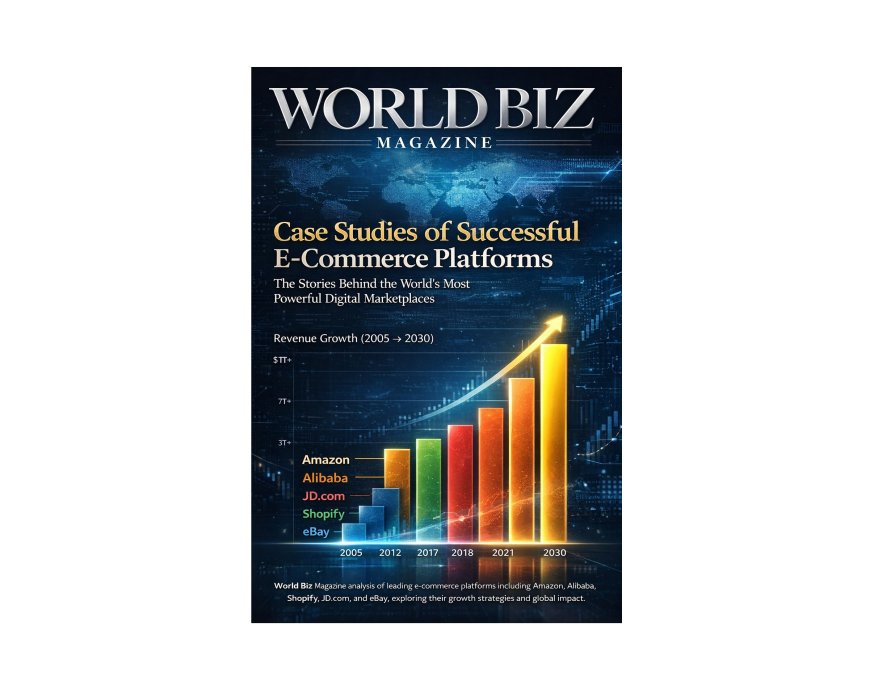
Case Studies of Successful E-Commerce Platforms
The Stories Behind the World’s Most Powerful Digital Marketplaces
World Biz Magazine | Retail Innovation & Digital Economy
The rise of e-commerce has reshaped the global retail industry. Over the last two decades, digital platforms have transformed how consumers shop, how businesses sell, and how supply chains operate worldwide. What began as simple online storefronts has evolved into complex global ecosystems powered by advanced technology, logistics networks, data analytics, and digital payments.
Today, leading platforms such as Amazon, Alibaba Group, Shopify, JD.com, and eBay dominate digital commerce in different regions and market segments.
These companies have built platforms capable of supporting millions of sellers and billions of customers globally. Their success stories provide valuable lessons for entrepreneurs, technology companies, and policymakers interested in the future of digital retail.
This World Biz Magazine analysis explores the case studies of the most successful e-commerce platforms, examining their origins, growth strategies, technological innovations, and future outlook.
The Evolution of Global E-Commerce
The e-commerce industry has grown dramatically since the early 2000s. Global online retail sales increased from approximately $1 trillion in 2012 to more than $6 trillion in 2024, making digital commerce one of the fastest-growing sectors in the global economy.
Several factors have fueled this growth:
- widespread smartphone adoption
- secure digital payment systems
- global logistics networks
- cloud computing infrastructure
- AI-powered recommendation engines
Successful e-commerce platforms typically combine technology innovation, customer experience optimization, and supply chain efficiency.
Case Study 1: Amazon - Building the Global Marketplace
Early Beginnings (1994-2000)
Amazon was founded in 1994 by Jeff Bezos as an online bookstore. The company initially focused on selling books because they were easy to catalog and ship.
Within a few years, Amazon expanded into other product categories, including electronics, toys, and household goods.
By the late 1990s, Amazon had become one of the largest online retailers in the United States.
Expansion and Innovation (2000-2010)
During the early 2000s, Amazon introduced several innovations that transformed the e-commerce industry.
Key milestones included:
- launching the Amazon Marketplace for third-party sellers
- introducing Amazon Prime membership
- developing advanced recommendation algorithms
These initiatives turned Amazon into a platform ecosystem rather than just an online store.
Infrastructure and Technology (2010-2020)
Amazon invested heavily in logistics and cloud computing infrastructure.
The company launched Amazon Web Services, which became one of the largest cloud computing platforms globally.
At the same time, Amazon built an extensive network of fulfillment centers and last-mile delivery systems.
Growth Timeline
|
Year |
Revenue |
|
2005 |
$8.5B |
|
2010 |
$34B |
|
2015 |
$107B |
|
2020 |
$386B |
|
2024 |
$575B+ |
Amazon’s success demonstrates the power of combining technology infrastructure with logistics innovation.
Case Study 2: Alibaba - China’s Digital Commerce Empire
Founding and Vision
Alibaba Group was founded in 1999 by Jack Ma in Hangzhou, China.
The company initially focused on connecting Chinese manufacturers with global buyers through an online B2B marketplace.
Building the Ecosystem
Alibaba expanded its ecosystem through several major platforms:
- Taobao (consumer marketplace)
- Tmall (premium brand marketplace)
- AliExpress (international retail platform)
The company also launched Ant Group, which developed the digital payment platform Alipay.
Growth Strategy
Alibaba’s success relied on several strategic advantages:
- mobile commerce adoption in China
- integrated digital payment systems
- logistics infrastructure through Cainiao Network
Revenue Growth
|
Year |
Revenue |
|
2010 |
$1.4B |
|
2015 |
$12B |
|
2020 |
$72B |
|
2024 |
$130B+ |
Alibaba has become one of the largest digital commerce ecosystems in the world.
Case Study 3: Shopify - Empowering Online Entrepreneurs
Platform Model
Unlike Amazon and Alibaba, Shopify does not operate as a marketplace. Instead, it provides software that enables businesses to create their own online stores.
The company was founded in 2006 by Tobias Lütke.
Platform Growth
Shopify’s cloud-based platform allows merchants to:
- build online stores
- manage inventory
- process payments
- integrate logistics and marketing tools
By focusing on merchant empowerment rather than retail operations, Shopify created a new category of commerce infrastructure.
Growth Timeline
|
Year |
Revenue |
|
2015 |
$205M |
|
2018 |
$1B |
|
2020 |
$2.9B |
|
2024 |
$7B+ |
Today Shopify powers millions of online stores globally.
Case Study 4: JD.com - Logistics-Driven Commerce
JD.com is one of China’s largest e-commerce companies.
Founded in 1998 by Richard Liu, JD.com built its competitive advantage through direct logistics infrastructure.
Unlike marketplace platforms, JD operates its own delivery network.
This allows the company to provide:
- faster shipping
- product authenticity verification
- supply chain control
JD’s logistics capabilities have made it a dominant player in China’s e-commerce market.
Case Study 5: eBay - The Pioneer Marketplace
Founded in 1995 by Pierre Omidyar, eBay was one of the earliest global e-commerce platforms.
Its auction-based marketplace allowed individuals and businesses to sell products online.
Although competition increased in later years, eBay remains a significant global marketplace.
Comparing the Leading E-Commerce Platforms
|
Platform |
Business Model |
Key Strength |
|
Amazon |
Marketplace + retail |
Logistics infrastructure |
|
Alibaba |
Marketplace ecosystem |
Mobile commerce |
|
Shopify |
Commerce software |
Merchant empowerment |
|
JD.com |
Direct retail |
Logistics network |
|
eBay |
Online marketplace |
Peer-to-peer commerce |
Each platform represents a different strategic approach to digital retail.
Revenue Growth Chart for Major E-Commerce Companies (2005-2030)
Key Platforms Covered
- Amazon
- Alibaba Group
- JD.com
- Shopify
- eBay
Global Revenue Growth Timeline (2005-2030)
|
Year |
Amazon |
Alibaba |
JD.com |
Shopify |
eBay |
|
2005 |
$8.5B |
— |
— |
— |
$4.5B |
|
2010 |
$34B |
$1.4B |
$1.3B |
— |
$9.1B |
|
2015 |
$107B |
$12B |
$28B |
$0.2B |
$8.6B |
|
2018 |
$232B |
$39B |
$69B |
$1.1B |
$10.7B |
|
2020 |
$386B |
$72B |
$108B |
$2.9B |
$8.9B |
|
2022 |
$514B |
$126B |
$155B |
$5.6B |
$9.7B |
|
2024 |
$638B |
$130B |
$160B |
$7B |
$10B |
|
2026* |
$730B |
$150B |
$175B |
$9B |
$11B |
|
2028* |
$820B |
$170B |
$195B |
$12B |
$12B |
|
2030* |
$950B |
$200B |
$220B |
$16B |
$14B |
*Forecast estimates based on industry growth trends.
Revenue Growth Example: Amazon (2005-2024)
|
Year |
Revenue |
|
2005 |
$8.49B |
|
2010 |
$34.2B |
|
2015 |
$107B |
|
2018 |
$232B |
|
2020 |
$386B |
|
2024 |
$637.9B |
Amazon’s revenue expanded from $8.49 billion in 2005 to more than $637 billion in 2024, reflecting the rapid growth of global online retail.
JD.com Growth Example
|
Year |
Revenue |
|
2015 |
$28.69B |
|
2018 |
$69.25B |
|
2020 |
$108.95B |
|
2022 |
$154.72B |
|
2024 |
$160.8B |
JD.com’s growth reflects China’s expanding e-commerce ecosystem and the company’s investment in logistics infrastructure.
eBay Revenue Trend
|
Year |
Revenue |
|
2005 |
$4.55B |
|
2010 |
$9.15B |
|
2015 |
$8.59B |
|
2018 |
$10.7B |
|
2022 |
$9.79B |
While eBay pioneered online marketplaces, its growth has stabilized compared with newer platforms that emphasize logistics and platform ecosystems.
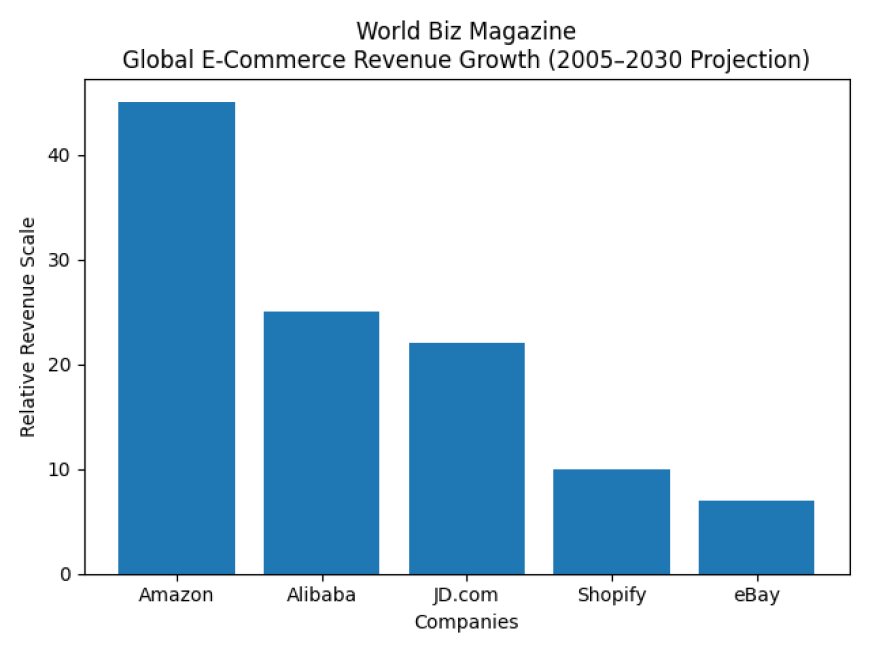
Amazon clearly dominates the global e-commerce revenue landscape.
Industry Growth Insights
1. Platform Ecosystems Drive Growth
Companies like Amazon and Alibaba expanded by building ecosystems including logistics, payments, and cloud services.
2. Logistics Infrastructure Is Critical
Platforms such as JD.com gained market share by investing heavily in warehouses and delivery networks.
3. SaaS Commerce Is Growing
Shopify represents a new category commerce infrastructure platforms that power millions of independent merchants.
Global E-Commerce Market Context
The broader e-commerce industry grew from roughly $1 trillion in global online sales in 2012 to over $6 trillion in 2024, making it one of the fastest-growing sectors in the digital economy.
Forecasts suggest global e-commerce could exceed $8-9 trillion by 2030.
2030 Competitive Outlook
Likely Market Leaders
- Amazon
- Alibaba
- JD.com
Fastest Growth Potential
- Shopify (merchant infrastructure model)
- new social commerce platforms
Emerging Threats
- social commerce platforms
- AI-powered retail platforms
- global marketplace aggregators
Future Outlook of E-Commerce Platforms
The next phase of e-commerce growth will likely focus on:
Artificial Intelligence
AI-driven personalization will enhance customer experiences.
Social Commerce
Platforms such as TikTok and Meta Platforms are integrating shopping features directly into social networks.
Automation and Robotics
Warehouse automation will improve fulfillment efficiency.
Global Cross-Border Commerce
Digital marketplaces will continue expanding into emerging markets.
World Biz Magazine Industry Insights
Successful e-commerce platforms share several common characteristics:
- strong technology infrastructure
- scalable cloud platforms
- integrated logistics systems
- data-driven customer experience optimization
Companies that combine these elements effectively are more likely to dominate the future of digital commerce.
Conclusion
The success stories of Amazon, Alibaba, Shopify, JD.com, and eBay illustrate the transformative power of digital commerce platforms.
Each company followed a different strategy, but all leveraged technology and innovation to build scalable global ecosystems.
As e-commerce continues to expand worldwide, new platforms and business models will emerge. However, the lessons learned from these pioneering companies will continue shaping the future of global retail.
Disclaimer
World Biz Magazine provides business analysis, research insights, and industry commentary for informational purposes only. Financial figures, company performance data, and market projections discussed in this article are based on publicly available information and should not be interpreted as financial or investment advice. Businesses and investors should conduct independent research before making strategic or financial decisions.
What's Your Reaction?
 Like
0
Like
0
 Dislike
0
Dislike
0
 Love
0
Love
0
 Funny
0
Funny
0
 Angry
0
Angry
0
 Sad
0
Sad
0
 Wow
0
Wow
0