



























































































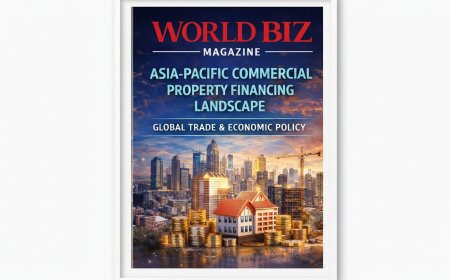





































































Asia-Pacific Commercial Property Financing Landscape: Markets, Capital & Trends
An in-depth analysis of Asia-Pacific commercial property financing, covering key markets, lenders, asset classes, loan structures, and future trends.

Asia-Pacific Commercial Property Financing Landscape
Capital Flows, Lending Structures, and the Future of Real Estate Investment
World Biz Magazine | Global Real Estate Insights
The Asia-Pacific (APAC) region represents one of the most dynamic and diverse commercial property markets in the world. Spanning developed financial hubs such as Japan, Singapore, Australia, Hong Kong, and fast-growing emerging economies including Vietnam, Malaysia, Indonesia, and the Philippines, the region attracts trillions of dollars in institutional and private capital.
At the core of this growth lies a sophisticated and evolving commercial property financing ecosystem one that blends traditional banking, institutional lending, capital markets, sovereign investment, and alternative financing structures. As interest rate cycles shift and global capital reallocates, APAC has emerged as both a capital destination and capital exporter in commercial real estate.
This article examines the complete Asia-Pacific commercial property financing landscape, including asset classes, financing structures, key markets, lenders, eligibility frameworks, risk considerations, and future trends.
What Is Commercial Property Financing?
Commercial property financing refers to debt and structured capital solutions used to acquire, develop, refinance, or reposition income-producing real estate assets. Unlike residential mortgages, commercial financing is primarily evaluated based on:
· Asset cash flow
· Tenant quality
· Market fundamentals
· Sponsor strength
In APAC, financing structures vary widely depending on regulatory maturity, capital market depth, and investor sophistication.
Major Commercial Property Asset Classes in Asia-Pacific
1. Office Assets
· CBD office towers
· Business park campuses
· Co-working and flex offices
Key Markets: Tokyo, Singapore, Sydney, Hong Kong, Seoul, Kuala Lumpur
2. Retail & Mixed-Use
· Shopping malls
· High-street retail
· Integrated mixed-use developments
Key Markets: China, India, Thailand, Malaysia, Indonesia
3. Industrial & Logistics
· Warehousing
· Distribution centers
· Cold storage
· Data-enabled logistics parks
Fastest-growing segment across APAC due to e-commerce and supply chain restructuring.
4. Hospitality & Leisure
· Hotels
· Resorts
· Serviced apartments
Financing often structured with higher risk premiums and revenue-linked covenants.
5. Alternative Commercial Assets
· Data centers
· Life sciences facilities
· Student housing
· Healthcare real estate
Rapidly gaining institutional financing support.
Key Asia-Pacific Financing Markets
Japan
· Ultra-low interest rate environment
· Highly liquid debt market
· Strong bank and institutional lender participation
Japanese banks are among the largest cross-border real estate lenders globally.
China
· Large domestic banking system
· Strong state influence on financing
· Capital controls impact foreign borrowing
Shift toward asset-backed and policy-guided financing.
Singapore
· Regional financial hub
· Transparent regulatory system
· REIT-driven financing ecosystem
Preferred base for cross-border real estate structuring.
Australia
· Highly developed commercial mortgage market
· Strong pension fund (superannuation) participation
· Active CMBS market
Emerging Southeast Asia
· Vietnam, Philippines, Indonesia, Thailand, Malaysia
· Higher yields but increased risk premiums
· Growing role of development finance institutions (DFIs)
Primary Sources of Commercial Property Financing
1. Commercial Banks
· Senior secured loans
· Construction financing
· Refinancing facilities
Typical LTV: 50%-70%
2. Institutional Investors
· Pension funds
· Insurance companies
· Sovereign wealth funds
Provide long-tenor, low-volatility debt capital.
3. Real Estate Investment Trusts (REITs)
· Equity and debt financing
· Sale-leaseback structures
· Portfolio-level financing
APAC REIT markets are strongest in Japan, Singapore, Australia, and Hong Kong.
4. Private Credit & Alternative Lenders
· Mezzanine debt
· Bridge financing
· Structured real estate credit
Growing rapidly due to banking regulations.
5. Multilateral & Development Finance Institutions
· Asian Development Bank (ADB)
· IFC (World Bank Group)
· Export credit agencies
Support sustainable and infrastructure-linked commercial assets.
Typical Financing Structures
· Senior secured mortgage loans
· Construction & development loans
· Mezzanine financing
· Preferred equity
· CMBS (Commercial Mortgage-Backed Securities)
· Sale-leaseback transactions
Loan Eligibility & Approval Criteria
Lenders across APAC evaluate:
· Asset location and class
· Lease profile and WALE
· Tenant credit quality
· Debt Service Coverage Ratio (DSCR)
· Sponsor track record
· Regulatory compliance
Loan Limits & Financing Terms
|
Metric |
Typical Range |
|
Loan-to-Value (LTV) |
50% - 70% |
|
Loan Tenure |
5 - 20 years |
|
Interest Structure |
Fixed / Floating |
|
DSCR Requirement |
1.25x - 1.5x |
Emerging markets may see lower LTVs and higher pricing.
Cross-Border Financing in APAC
Asia-Pacific is a hub for cross-border commercial property financing, especially involving:
· Japanese banks funding offshore assets
· Singapore-based funds lending regionally
· Middle Eastern and Western capital entering Asia
Currency hedging and regulatory approvals are critical components.
Risk Factors in APAC Commercial Financing
· Interest rate volatility
· Currency risk
· Regulatory changes
· Political and policy intervention
· Market oversupply
Risk pricing varies significantly across jurisdictions.
Technology & ESG in Financing Decisions
Lenders increasingly assess:
· ESG compliance
· Green building certifications
· Energy efficiency
· Smart building integration
Green financing instruments are expanding rapidly.
Future Outlook
Key trends shaping the APAC commercial financing landscape:
· Expansion of private credit
· Growth of green and sustainability-linked loans
· REIT-driven capital recycling
· Data centers and logistics as core assets
· Increased cross-border capital integration
Asia-Pacific is expected to remain one of the most attractive global regions for commercial real estate financing over the next decade.
Conclusion
The Asia-Pacific commercial property financing landscape is defined by diversity, scale, and rapid evolution. With deep banking systems, expanding capital markets, and rising institutional participation, the region offers robust financing solutions across asset classes and risk profiles.
As global capital reallocates toward growth regions and alternative assets, APAC stands at the center of the future of commercial real estate finance.
Disclaimer
This article is published by World Biz Magazine for general informational purposes only. It does not constitute financial, investment, legal, or real estate advice. Financing terms, regulations, and market conditions vary by country and are subject to change. Readers are advised to consult licensed professionals and official regulatory sources before making investment or financing decisions.
What's Your Reaction?
 Like
0
Like
0
 Dislike
0
Dislike
0
 Love
0
Love
0
 Funny
0
Funny
0
 Angry
0
Angry
0
 Sad
0
Sad
0
 Wow
0
Wow
0