














































































































































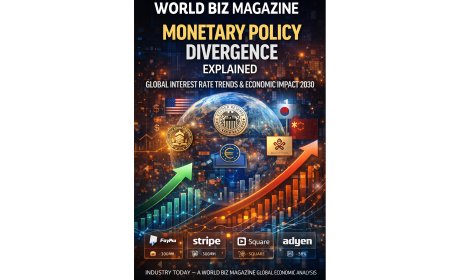




























Monetary Policy Divergence Explained: Global Interest Rate Trends & Economic Impact 2030
A detailed analysis of global monetary policy divergence including central bank decisions, currency markets, inflation trends, investment implications, and future economic forecasts.

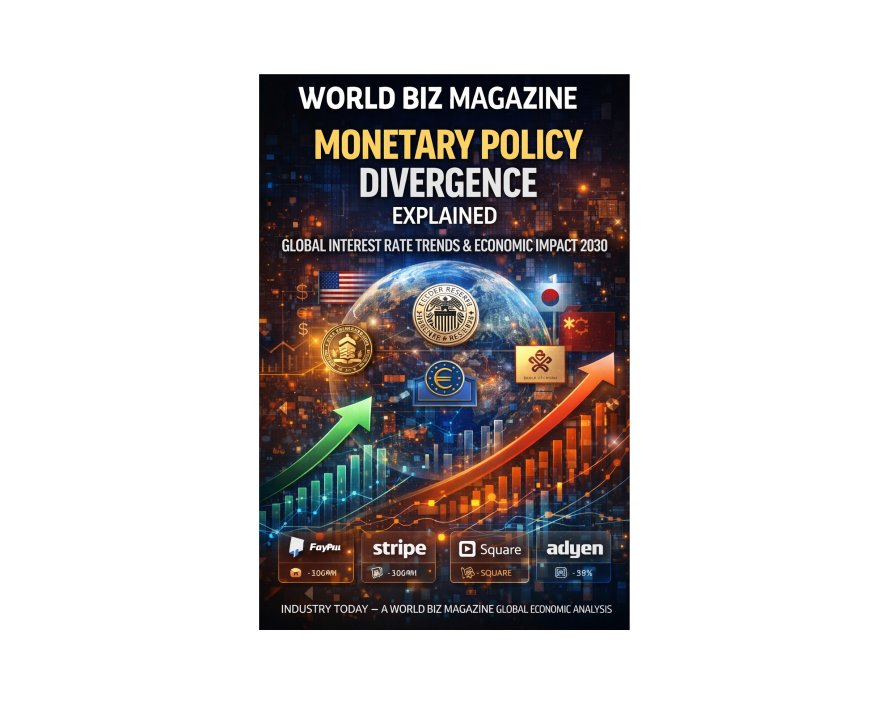
Global Monetary Policy Divergence: Central Bank Strategies, Currency Shifts & Market Outlook
How Global Interest Rate Differences Are Reshaping Capital Flows, Currencies, and Economic Stability
Industry Today - World Biz Magazine Global Economic Analysis
Monetary policy divergence has emerged as one of the most influential forces shaping the modern global economy. As central banks around the world adopt different strategies to combat inflation, stimulate growth, or stabilize financial systems, the divergence in interest rates and liquidity policies has profound implications for currency markets, international capital flows, trade balances, and investment strategies.
This World Biz Magazine deep-dive report examines the drivers behind monetary policy divergence, its economic impact across regions, policy frameworks, investment implications, global market reactions, and forecasts through 2030.
Understanding Monetary Policy Divergence
Monetary policy divergence occurs when central banks pursue different policy directions at the same time.
Examples include:
• One country raising interest rates to control inflation
• Another cutting rates to stimulate economic growth
• Some central banks tightening liquidity while others expand money supply
These policy differences create imbalances in financial conditions across countries, influencing exchange rates, capital flows, and international investment decisions.
The Role of Central Banks
Central banks manage monetary policy through several tools:
Interest Rate Adjustments
Central banks raise or lower benchmark rates to influence borrowing and spending.
Quantitative Easing (QE)
Large-scale asset purchases inject liquidity into the financial system.
Quantitative Tightening (QT)
Central banks reduce their balance sheets by selling assets or allowing bonds to mature.
Forward Guidance
Communication strategies shape market expectations regarding future policy decisions.
Major central banks influencing global monetary policy include:
- U.S. Federal Reserve
- European Central Bank (ECB)
- Bank of Japan (BoJ)
- Bank of England (BoE)
- People's Bank of China (PBoC)
Because these institutions manage the world’s largest economies, their policy decisions reverberate across global financial markets.
Historical Context of Policy Divergence
Monetary policy divergence has occurred several times in modern economic history.
Post-2008 Financial Crisis
Most central banks adopted ultra-loose policies including zero interest rates and quantitative easing.
2015-2018 Normalization Phase
The U.S. Federal Reserve began tightening policy while Europe and Japan maintained stimulus.
Pandemic Era (2020-2021)
Central banks globally introduced unprecedented liquidity to support economic recovery.
Inflation Shock (2022-2024)
Central banks diverged again as inflation levels differed across countries.
Some economies aggressively raised rates, while others prioritized growth support.
Drivers of Monetary Policy Divergence
Several macroeconomic factors drive policy differences among central banks.
Inflation Differences
Countries experiencing higher inflation often tighten monetary policy earlier.
Economic Growth Variations
Weak economies may maintain lower interest rates to stimulate investment and consumption.
Labor Market Conditions
Strong labor markets often allow central banks to maintain higher interest rates.
Fiscal Policy Interaction
Government spending policies can influence monetary policy decisions.
Exchange Rate Management
Some countries adjust policies to stabilize currencies or support exports.
Global Interest Rate Landscape
Interest rate differences across major economies illustrate policy divergence.
|
Economy |
Monetary Policy Trend |
|
United States |
Aggressive tightening cycles |
|
Eurozone |
Moderate tightening |
|
Japan |
Ultra-low interest rates |
|
China |
Stimulus-focused policies |
|
United Kingdom |
Inflation-driven tightening |
These divergent policy paths influence capital allocation and global financial stability.
Currency Market Impacts
Monetary policy divergence directly affects currency markets.
Stronger Currency Effects
Higher interest rates typically attract foreign capital, strengthening a country’s currency.
Weaker Currency Effects
Lower interest rates often weaken currencies, boosting export competitiveness.
Example impacts include:
• U.S. dollar strengthening during Federal Reserve tightening cycles
• Yen depreciation during prolonged low-rate policies in Japan
• Emerging market volatility during global tightening cycles
Currency fluctuations influence global trade, commodity prices, and international debt servicing.
Capital Flows and Global Investment
When central banks diverge in policy, capital flows tend to shift toward economies offering higher returns and greater stability.
Global Investment Trends
Investors typically move funds toward:
• Countries with higher interest rates
• Stable political environments
• Strong financial markets
Conversely, economies with loose monetary policy or weaker currencies may experience capital outflows.
This dynamic significantly affects emerging market stability.
Impact on Emerging Markets
Emerging economies are often highly sensitive to global monetary policy divergence.
Risks
• Currency depreciation
• Capital flight
• Higher borrowing costs
• Inflation pressure
Opportunities
Countries with strong fiscal management and stable policies may attract investment seeking higher yields.
Emerging markets must carefully balance exchange rate stability with domestic economic growth.
Commodity Market Effects
Monetary policy divergence also influences commodity prices.
Strong Dollar Effects
A stronger U.S. dollar often leads to lower commodity prices globally.
Weak Currency Effects
Countries with weaker currencies may experience higher import costs for commodities.
Key commodities affected include:
• Oil
• Gold
• Industrial metals
• Agricultural products
Commodity markets are therefore highly sensitive to global interest rate cycles.
Political and Policy Dimensions
Monetary policy is technically independent in many countries, but political considerations can influence central bank decisions.
Governments may pressure central banks to:
• Stimulate economic growth
• Support employment levels
• Stabilize financial markets
• Prevent currency crises
Political developments therefore interact with monetary policy, shaping global economic outcomes.
Investment Implications
Monetary policy divergence creates both risks and opportunities for investors.
Opportunities
• Currency trading opportunities
• Bond market yield differentials
• International equity allocation strategies
Risks
• Exchange rate volatility
• Global liquidity shocks
• Financial market instability
Institutional investors often adjust portfolios based on expected central bank policy shifts.
Winners and Losers in Divergence Cycles
Countries Benefiting
Countries with higher interest rates and stable financial systems often attract capital.
Examples include:
• United States
• Canada
• Australia
• Singapore
Countries Facing Pressure
Economies with weaker currencies or fragile financial systems may struggle during tightening cycles.
Examples may include:
• Highly indebted emerging markets
• Countries dependent on foreign capital inflows
Policy credibility becomes crucial in maintaining investor confidence.
Monetary Policy Divergence and Inflation
Inflation trends differ significantly across countries due to factors such as:
• Energy prices
• Supply chain disruptions
• Labor market conditions
• Fiscal stimulus levels
These differences explain why central banks respond differently, creating divergence in policy paths.
Long-Term Economic Outlook
Looking ahead to 2030, several trends will shape global monetary policy.
Structural Inflation Pressures
Demographic shifts, energy transitions, and geopolitical tensions may influence inflation dynamics.
Digital Currency Systems
Central bank digital currencies (CBDCs) may alter monetary transmission mechanisms.
Global Financial Fragmentation
Geopolitical shifts may lead to regional financial blocs with different monetary policies.
Technological Disruption
Artificial intelligence and fintech innovations may influence economic productivity and inflation trends.
World Biz Magazine Insight
Monetary policy divergence will remain a defining feature of the global economic landscape. As inflation patterns, demographic trends, and geopolitical developments vary across regions, central banks will continue to pursue policies tailored to domestic conditions.
However, in an interconnected financial system, divergence can amplify volatility across currencies, capital flows, and investment markets.
Understanding these dynamics is essential for policymakers, investors, and global businesses.
Conclusion
Monetary policy divergence reflects the complex realities of the modern global economy. While central banks pursue national economic objectives, their decisions influence international financial stability, trade flows, and capital allocation.
In an era of increasing economic complexity, navigating policy divergence will remain a central challenge for governments, investors, and financial institutions worldwide.
As global economies continue to evolve, monetary policy will remain one of the most powerful tools shaping the future of economic growth and stability.
Disclaimer
This article is intended for informational and analytical purposes only. Economic forecasts, policy analysis, and market projections are based on publicly available research and current economic trends at the time of publication. They do not constitute financial, investment, or legal advice. Readers should conduct independent research and consult qualified financial professionals before making investment or economic decisions. World Biz Magazine assumes no responsibility for financial outcomes resulting from reliance on this analysis.
What's Your Reaction?
 Like
0
Like
0
 Dislike
0
Dislike
0
 Love
0
Love
0
 Funny
0
Funny
0
 Angry
0
Angry
0
 Sad
0
Sad
0
 Wow
0
Wow
0