










































































































































E-Commerce Warehousing Strategies: Dark Stores vs Distribution Centers vs Micro-Fulfillment
How e-commerce warehouses work, from large distribution centers to micro-fulfillment hubs enabling same-day delivery.

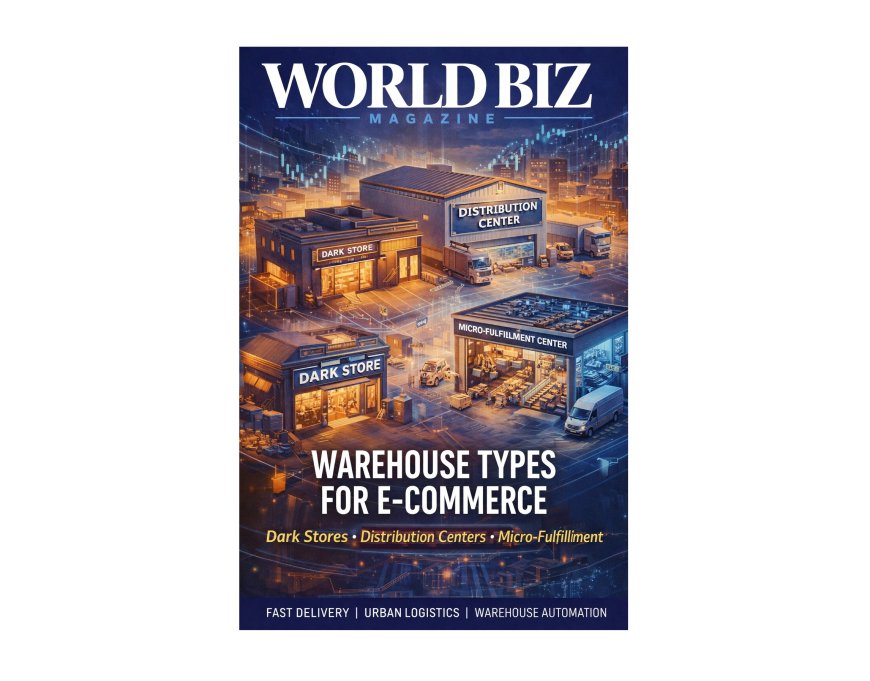
Warehouse Types for E-Commerce: Dark Stores, Distribution Centers & Micro-Fulfillment
Redefining Logistics Infrastructure in the Age of Instant Commerce
World Biz Magazine | Industry Today Special Report
Delivering global insights on the trends shaping tomorrow’s economy.
The New Backbone of Digital Commerce
As e-commerce continues to reshape global retail, the spotlight has shifted from storefronts to fulfillment infrastructure. Behind every “Buy Now” button lies a sophisticated logistics network designed to deliver products faster, cheaper, and more efficiently than ever before.
At the core of this transformation are three key warehouse models dark stores, distribution centers, and micro-fulfillment centers (MFCs). Each plays a unique role in enabling modern e-commerce, from rapid last-mile delivery to large-scale inventory management.
In an era defined by same-day delivery expectations and hyper-local demand, warehouse strategy has become a critical competitive differentiator.
The Evolution of Warehousing in E-Commerce
Traditional warehousing was once focused on bulk storage and periodic distribution. However, the rise of e-commerce has forced a fundamental shift toward:
- Speed and proximity to customers
- Real-time inventory management
- Automation and robotics
- Omnichannel integration
Today’s warehouses are no longer static storage facilities they are dynamic fulfillment hubs powered by technology and data.
Distribution Centers: The Core of Supply Chain Operations
Distribution centers are the large-scale backbone of e-commerce logistics, designed to store vast quantities of inventory and distribute products across regions.
Key Characteristics:
- Located strategically near transportation hubs
- Handle bulk inventory and large order volumes
- Serve multiple retail channels (online and offline)
- Equipped with advanced sorting and shipping systems
Role in E-Commerce:
Distribution centers act as central nodes, receiving goods from manufacturers and redistributing them to smaller facilities or directly to customers.
Advantages:
- Economies of scale
- Efficient inventory management
- Strong integration with global supply chains
Limitations:
- Longer delivery times compared to local fulfillment models
- Higher transportation costs for last-mile delivery
Despite these limitations, distribution centers remain essential for scaling operations globally.
Dark Stores: Retail Spaces Turned Fulfillment Engines
Dark stores are retail outlets converted into fulfillment centers, designed exclusively for online order processing rather than walk-in customers.
Key Characteristics:
- Located within urban or suburban areas
- Optimized for fast picking and packing
- Focused on high-demand products
- Often integrated with grocery and quick-commerce platforms
Role in E-Commerce:
Dark stores bridge the gap between warehouses and consumers, enabling ultra-fast delivery (often within hours).
Advantages:
- Proximity to customers
- Faster delivery times
- Lower last-mile logistics costs
Limitations:
- Limited storage capacity
- High operational costs in urban areas
Dark stores are particularly effective in sectors like grocery, food delivery, and quick commerce, where speed is critical.
Micro-Fulfillment Centers (MFCs): Automation Meets Local Delivery
Micro-fulfillment centers represent the next evolution in warehousing small, highly automated facilities located close to end consumers.
Key Characteristics:
- Compact facilities in urban areas
- High level of automation (robots, AI systems)
- Optimized for rapid order processing
- Integrated with e-commerce platforms
Role in E-Commerce:
MFCs enable same-day or even one-hour delivery, making them ideal for high-density urban markets.
Advantages:
- Ultra-fast fulfillment
- Reduced labor costs through automation
- High efficiency in order processing
Limitations:
- High initial investment
- Complex technology integration
MFCs are at the forefront of next-generation logistics, combining speed, efficiency, and innovation.
Comparative Overview
|
Feature |
Distribution Centers |
Dark Stores |
Micro-Fulfillment Centers |
|
Size |
Large |
Medium |
Small |
|
Location |
Regional |
Urban |
Urban |
|
Speed |
Moderate |
Fast |
Ultra-fast |
|
Automation |
Medium |
Low-Medium |
High |
|
Cost |
Economical |
Moderate |
High (initial) |
Strategic Importance in Modern E-Commerce
The combination of these warehouse types creates a layered logistics network:
- Distribution centers - bulk storage and regional supply
- Dark stores - local fulfillment
- MFCs - ultra-fast delivery
This multi-tier system enables e-commerce companies to balance cost, speed, and scalability.
Risks and Challenges
High Infrastructure Costs
Building and maintaining multiple warehouse types requires significant investment.
Operational Complexity
Managing inventory across different facilities increases complexity.
Technology Integration
Automation systems require seamless integration and maintenance.
Urban Constraints
Limited space and high costs in cities affect dark stores and MFCs.
Demand Volatility
Fluctuating demand can disrupt inventory planning.
Mitigation Strategies
- Use data analytics for demand forecasting
- Optimize warehouse network design
- Invest in scalable automation technologies
- Diversify fulfillment strategies
- Partner with third-party logistics providers
These approaches help businesses maintain efficiency while managing risks.
The Role of Technology in Warehouse Transformation
Modern warehouses are powered by:
- Artificial Intelligence (AI) - demand forecasting and optimization
- Robotics & Automation - faster picking and packing
- IoT (Internet of Things) - real-time tracking
- Cloud Systems - centralized inventory management
Technology is transforming warehouses into intelligent fulfillment ecosystems.
Future Outlook: Warehousing in 2035
The future of e-commerce warehousing will be defined by:
Hyper-Local Fulfillment Networks
Expansion of MFCs in urban centers.
Fully Automated Warehouses
Minimal human intervention through robotics.
Sustainable Logistics
Energy-efficient facilities and eco-friendly operations.
AI-Driven Optimization
Real-time decision-making across supply chains.
Integration with Smart Cities
Warehouses becoming part of urban infrastructure.
World Biz Magazine Insights
- Warehouse strategy is a core driver of e-commerce success
- Speed and proximity define competitive advantage
- Automation and AI are reshaping logistics infrastructure
- The future belongs to integrated, multi-layered fulfillment networks
Conclusion: Logistics as a Competitive Advantage
In the digital economy, warehousing is no longer a backend function it is a strategic asset.
Companies that invest in the right mix of distribution centers, dark stores, and micro-fulfillment centers will gain a decisive edge in speed, efficiency, and customer satisfaction.
Because in modern e-commerce, the race is not just about selling it’s about delivering faster than ever before.
Disclaimer
This article is for informational purposes only and does not constitute business, logistics, or investment advice. Readers should conduct independent research before making operational decisions.
What's Your Reaction?
 Like
0
Like
0
 Dislike
0
Dislike
0
 Love
0
Love
0
 Funny
0
Funny
0
 Angry
0
Angry
0
 Sad
0
Sad
0
 Wow
0
Wow
0