















































































































































































































Financial Services Digital Benchmark 2025 - Global Banking & Fintech Transformation Insights
Financial Services Digital Benchmark 2025, analyzing banking transformation, fintech innovation, and global digital maturity trends shaping financial markets.

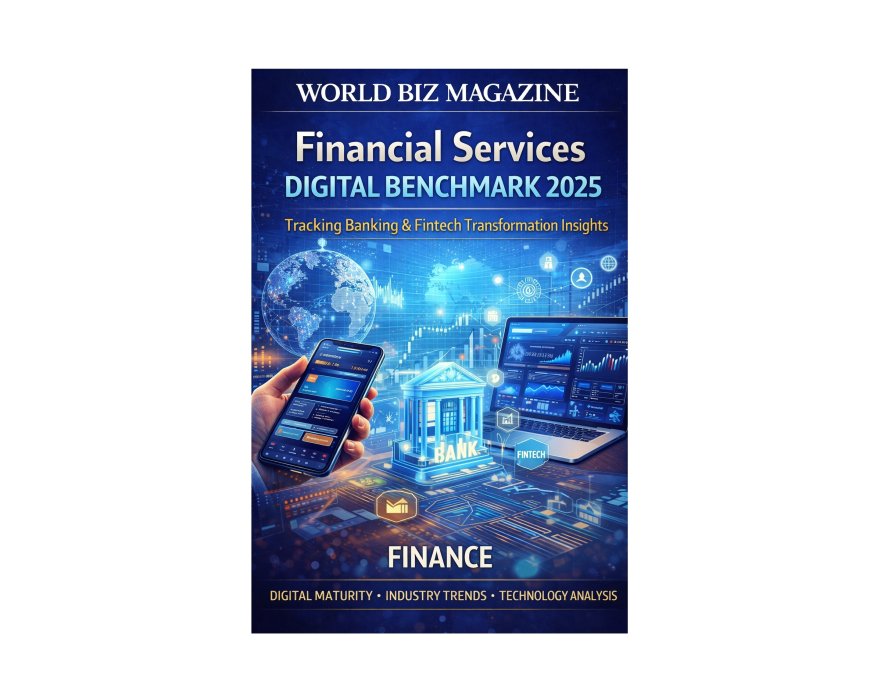
Financial Services Digital Benchmark 2025
Measuring Transformation, Maturity, and Competitive Advantage Across Global Banking & Fintech
World Biz Magazine | Industry Today Special Report
Digital channels are now central to customer engagement: online banking adoption, AI-driven personalization, and automation are no longer optional they are core performance indicators shaping market competitiveness and profitability.
Industry Context: Why Digital Benchmarking Matters
Digital benchmarking compares institutions against peers using metrics such as channel adoption, data capability, and customer satisfaction. These insights guide investment decisions and highlight performance gaps.
- Global fintech investment reached about $113.7 billion in 2023, signaling continued digital innovation despite market volatility.
- Worldwide digital payments users are expected to exceed 5.48 billion by 2027, showing sustained expansion of digital financial behavior.
- Digital banking usage in major markets continues rising, with mobile banking adoption surpassing half of consumers in multiple regions.
These indicators underpin benchmarking frameworks organizations compare digital performance to industry averages to maintain relevance.
Core Benchmark Categories (2025)
Digital benchmark models typically evaluate institutions across five dimensions:
1️. Customer Experience & Engagement
- Mobile usability and onboarding speed
- Omnichannel interaction consistency
- Personalization through analytics
Customers increasingly prioritize seamless digital journeys. Studies show customer satisfaction improves when onboarding and account management are simplified via mobile channels.
2️. Digital Channel Adoption
- Percentage of transactions via mobile/web
- Digital account openings
- Self-service engagement
Digital banking transactions have become dominant in many markets, with online channels replacing branch visits for routine services.
3️. Data & AI Capability
- Predictive analytics
- Fraud detection automation
- AI-powered customer insights
Financial institutions increasingly invest in analytics and AI technologies to enhance risk assessment and personalization, aligning with broader enterprise AI adoption trends.
4️. Operational Efficiency
- Automation and workflow digitization
- Cost-to-income ratio improvements
- Cloud migration maturity
Digitization and automation can significantly reduce operating costs and increase processing efficiency, making them central benchmarking indicators.
5️. Innovation & Ecosystem Integration
- API and open banking deployment
- Partnerships with fintech startups
- Embedded finance capabilities
Open banking frameworks and collaborative ecosystems have become competitive differentiators as financial services evolve beyond traditional institutional boundaries.
Key Findings from 2025 Benchmark Trends
Across global benchmark analyses, several themes dominate:
Digital Leaders vs Laggards
- Leaders prioritize platform modernization and customer-centric design
- Laggards often struggle with legacy infrastructure
Mobile-First Banking
Mobile usage continues rising becoming the primary interaction channel forcing institutions to optimize app-centric experiences.
AI and Automation Expansion
AI-enabled decisioning, chatbots, and fraud detection are mainstream transformation priorities across financial institutions.
Fintech Collaboration
Partnerships and ecosystem participation increasingly define digital innovation strategies.
Strategic Implications for Financial Institutions
Organizations aligning with benchmark leaders typically:
- Invest in scalable cloud infrastructure
- Strengthen cybersecurity and compliance frameworks
- Develop data-driven cultures
- Focus on continuous UX improvement
- Expand digital ecosystems
For emerging markets including South Asia benchmarking provides a roadmap to leapfrog legacy stages and accelerate digital inclusion.
Outlook Beyond 2025
Benchmark indicators suggest financial services will increasingly compete on:
- AI-driven personalization
- Embedded financial ecosystems
- Real-time payments infrastructure
- Sustainability reporting metrics
Digital maturity benchmarking will remain a key decision-making tool as competitive pressures intensify.
Conclusion
The Financial Services Digital Benchmark 2025 underscores a fundamental shift digital excellence is no longer measured solely by technology deployment, but by integrated ecosystem value and customer outcomes. Institutions that leverage benchmarking insights to close capability gaps are positioned to lead the next phase of financial innovation.
For policymakers, investors, and industry leaders, benchmarking offers both a diagnostic lens and strategic blueprint for navigating the evolving financial landscape.
Disclaimer
This article is published by World Biz Magazine for informational and analytical purposes only. The content does not constitute financial, investment, or regulatory advice. Readers should consult qualified professionals before making strategic or investment decisions.
What's Your Reaction?
 Like
0
Like
0
 Dislike
0
Dislike
0
 Love
0
Love
0
 Funny
0
Funny
0
 Angry
0
Angry
0
 Sad
0
Sad
0
 Wow
0
Wow
0