














































































































































































Government Policies for Startups: A Global Comparison of Regulations and Incentives
A detailed World Biz Magazine research analysis comparing startup-friendly policies, funding, and regulatory environments worldwide.

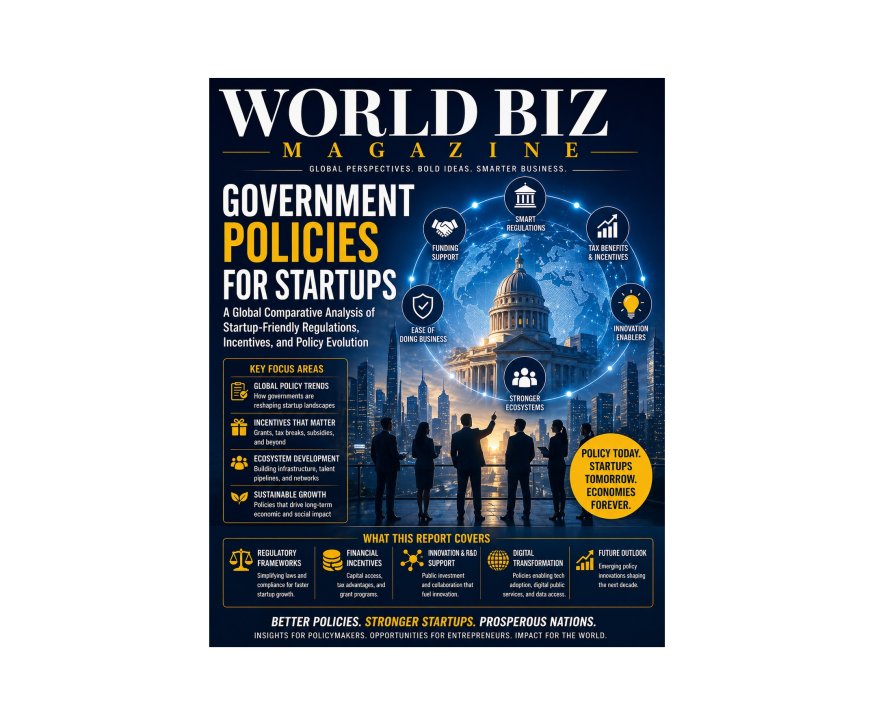
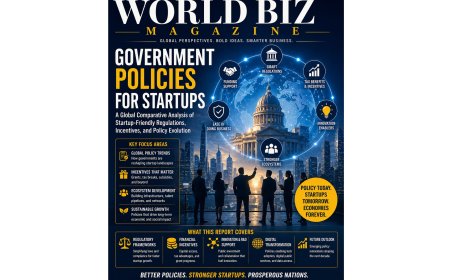
Government Policies for Startups
A Global Comparative Analysis of Startup-Friendly Regulations, Incentives, and Policy Evolution
World Biz Magazine | Public Policy & Startup Ecosystems | Global Regulatory Intelligence
“Published by World Biz Magazine, delivering in-depth analysis on global economic policies, startup ecosystems, investment trends, and digital transformation strategies. This article is part of World Biz Magazine’s Global Policy & Innovation Series, focusing on how government regulations, incentives, and institutional frameworks shape startup growth, investment flows, and long-term economic competitiveness across major global regions.”
Policy as the Backbone of Startup Ecosystems
Startups do not grow in isolation they are shaped by the policy environment in which they operate. Government policies determine how easily a company can be formed, funded, scaled, and exited. Over the past decade, countries worldwide have recognized startups as critical drivers of innovation, employment, and economic competitiveness, leading to a surge in pro-startup reforms, incentives, and regulatory frameworks.
However, not all policies are equal. Some countries foster innovation through flexibility and capital access, while others impose regulatory complexity and state control.
The Evolution of Startup Policies (Last 10 Years)
Over the past decade, startup policies globally have undergone a significant transformation:
- Shift from minimal regulation - active government support
- Rise of venture capital incentives and public funding
- Introduction of regulatory sandboxes
- Increased focus on technology sectors (AI, fintech, biotech)
- Growing emphasis on national competitiveness and tech sovereignty
Global competition especially between the United States and China has intensified policy innovation, with governments increasingly using industrial and startup policies as strategic tools.
Today, startup policy is no longer just economic it is geopolitical.
Regional Policy Analysis
United States: Market-Driven & Venture Capital Powerhouse
The United States follows a market-driven, innovation-first policy model.
Key Features
- Minimal regulatory barriers
- Strong intellectual property protection
- Deep venture capital ecosystem
- Startup hubs like Silicon Valley
Historically, the U.S. promoted limited regulation of tech and startups, allowing rapid experimentation and growth.
Recent Policy Shifts
- Increased regulation of Big Tech
- Strategic investments in AI and semiconductors
- Focus on domestic innovation competitiveness
Assessment
Highly favorable for startups
Best for scaling and funding
Increasing regulatory scrutiny in tech
European Union: Structured but Fragmented
The European Union offers strong institutional support but regulatory complexity.
Key Policies
- Grants and funding programs
- Startup tax incentives
- Public-private investment funds
Recent initiatives include:
- €10B+ Scaleup Europe Fund to support startups
- Simplified startup creation frameworks (EU Inc model)
Challenges
- Fragmented regulations across member states
- Limited late-stage venture capital
Assessment
Strong policy support
Good for early-stage startups
Scaling is harder than in the U.S.
China: State-Driven Innovation Model
China operates a government-led startup ecosystem.
Key Policies
- Massive government incentives
- Focus on strategic sectors (AI, semiconductors, biotech)
- Strong alignment with national industrial goals
China has created:
- One of the largest startup ecosystems globally
- The second-highest number of unicorns
Policy Approach
- Heavy state involvement
- Strong funding support
- Regulatory control
Assessment
Strong funding and infrastructure
Fast scaling in domestic market
Regulatory risks and state control
East Asia (Japan & South Korea): Structured Support Systems
East Asian economies have implemented targeted government programs:
- Japan: Regulatory sandboxes
- South Korea: Startup incubator programs
These policies are designed to address structural economic challenges and boost entrepreneurship.
Assessment
Strong institutional support
Government-backed innovation
Less risk-taking culture compared to the U.S.
South & Southeast Asia: Emerging Startup Policy Frameworks
Emerging markets have adopted startup-friendly reforms:
Key Policies
- Tax exemptions for startups
- Simplified compliance
- Government-backed venture funds
- Fast-track patent systems
Trends
- Rapid digital adoption
- Growing investor interest
- Expansion of fintech and e-commerce
Assessment
High growth potential
Increasing government support
Infrastructure and funding gaps
Middle East: Aggressive Government-Led Growth
The Middle East, particularly Saudi Arabia and UAE, has emerged as a new startup hub.
Key Policies
- Sovereign wealth fund investments
- Startup visas and free zones
- Tax-free environments
- National innovation strategies
Trends
- Focus on diversification from oil
- Strong investment in AI and tech ecosystems
- Increasing global partnerships
Assessment
Highly supportive policies
Strong funding availability
Ecosystem still developing
Policy Comparison: Where Is It Easy vs Difficult?
Most Favorable Startup Environments
United States - Best for funding and scaling
UAE / Saudi Arabia - Best for incentives and tax benefits
Singapore (noted globally) - Best regulatory efficiency
Moderately Favorable
- European Union (strong but complex)
- South Korea / Japan (structured but less flexible)
More Challenging Environments
- China (due to regulatory control despite strong support)
- Some emerging markets (due to infrastructure gaps)
Key Policy Factors That Define Startup Success
Across all regions, successful startup ecosystems share:
Access to Capital
- Venture capital
- Government funding
- Angel investment
Ease of Doing Business
- Fast company registration
- Low compliance burden
Regulatory Flexibility
- Sandboxes for innovation
- Adaptive policies
Talent Development
- Education systems
- Skilled workforce
Market Access
- Domestic scale
- Global integration
Major Global Trends in Startup Policy
Rise of Tech Nationalism
Governments are prioritizing:
- Domestic innovation
- Strategic industries
Public-Private Collaboration
Startup ecosystems increasingly rely on:
- Government + venture capital partnerships
Focus on Deep Tech
Policies now prioritize:
- AI
- Semiconductors
- Climate tech
4. Increased Regulation
Especially in:
- Data privacy
- Platform control
- AI governance
World Biz Magazine Insight
At World Biz Magazine, our analysis highlights:
“The future of startup ecosystems will be determined not just by innovation but by how effectively governments enable, regulate, and scale that innovation.”
Conclusion: Policy as a Competitive Advantage
Startup success is no longer just about ideas it is about policy environments.
Countries that:
- Encourage innovation
- Reduce regulatory barriers
- Provide access to capital
……will dominate the global startup economy.
Final Thought
“In the global race for innovation, the most powerful startup advantage is not technology it is policy.”
Disclaimer
This article is intended for informational and educational purposes only and does not constitute legal, financial, investment, or policy advice. Government regulations and startup policies vary significantly across jurisdictions and are subject to continuous updates, reforms, and interpretations.
The analysis presented reflects general global trends, publicly available data, and research-based insights, which may differ depending on country-specific legal frameworks, economic conditions, and regulatory environments.
Readers, entrepreneurs, investors, and policymakers are advised to consult qualified legal advisors, regulatory experts, and financial professionals before making decisions related to business setup, investment, or compliance strategies.
World Biz Magazine does not guarantee the accuracy, completeness, or future outcomes of the information presented and shall not be held liable for any actions taken based on this content.
What's Your Reaction?
 Like
0
Like
0
 Dislike
0
Dislike
0
 Love
0
Love
0
 Funny
0
Funny
0
 Angry
0
Angry
0
 Sad
0
Sad
0
 Wow
0
Wow
0