

























































































































































































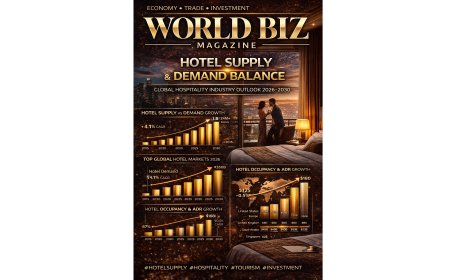




















Hotel Supply & Demand Balance: Global Hospitality Industry Outlook to 2030
A World Biz Magazine analysis of hotel supply and demand trends, covering global hospitality market growth, investments, pricing, and future outlook.


Hotel Supply & Demand Balance
Global Hospitality Industry Outlook 2026-2030
World Biz Magazine | Industry Today Special Report
The global hotel industry sits at the heart of the travel, tourism, and hospitality ecosystem. The balance between hotel room supply and travel demand determines occupancy levels, room pricing, investment returns, and long-term profitability across the sector.
In recent years, rising global tourism, expanding middle classes, and rapid urbanization have pushed hotel demand higher in many regions. However, supply growth varies widely depending on investment cycles, construction costs, and government policies.
This World Biz Magazine Industry Today report analyzes the global balance between hotel supply and demand, covering market size, key players, political influences, investment trends, price inflation, regional growth patterns, and long-term forecasts to 2030.
Global Hospitality Industry Overview
The hospitality industry includes:
- Hotels and resorts
- Boutique hotels
- serviced apartments
- luxury accommodations
- short-term rental platforms
- tourism infrastructure
The industry plays a major role in the global economy, supporting millions of jobs and generating large-scale tourism revenues.
Global Market Size
|
Year |
Market Size |
|
2024 |
$5.2 trillion |
|
2025 |
$5.75 trillion |
|
2030 (forecast) |
$8 trillion+ |
The global hospitality industry is projected to grow steadily as tourism demand increases worldwide.
Understanding Hotel Supply vs Demand
Hotel markets operate on a fundamental principle:
Demand = travelers needing rooms
Supply = available hotel rooms
If demand exceeds supply:
- occupancy increases
- room rates rise
- investment in new hotels accelerates
If supply exceeds demand:
- occupancy declines
- hotel profitability falls
- development slows
Global Occupancy Trends
Hotel occupancy is one of the key indicators of supply-demand balance.
|
Region |
Average Occupancy |
|
Global average |
68-70% |
|
United States |
63% |
|
Europe |
65% |
|
Asia |
70% |
Global hotel occupancy typically ranges between 65% and 70%, indicating a relatively balanced supply-demand environment.
Global Hotel Market Size
|
Year |
Market Value |
|
2024 |
$1.47 trillion |
|
2026 |
$2.19 trillion |
|
2030 |
$2.46 trillion |
The global hotel market is expected to grow significantly as tourism and business travel continue expanding worldwide.
Key Hotel Industry Players
The hotel industry is dominated by large global chains.
Major hotel groups include:
- Marriott International
- Hilton Worldwide
- InterContinental Hotels Group
- Accor
- Hyatt Hotels Corporation
These companies operate thousands of hotels across multiple countries.
Key Industry Contacts & Organizations
Global hospitality standards and industry policies are influenced by organizations such as:
- World Tourism Organization (UNWTO)
- World Travel & Tourism Council (WTTC)
- International Hotel & Restaurant Association
- national tourism boards
These organizations help shape tourism policies and global hospitality development.
Political and Policy Influence
Government policies strongly affect hotel supply and demand.
Key Policy Factors
- tourism visa policies
- travel regulations
- hotel taxation
- tourism infrastructure investments
- environmental regulations
Countries with strong tourism policies tend to experience faster hotel industry growth.
Investment Trends in the Hotel Industry
Hotel development requires significant capital investment.
Major Investors
- private equity firms
- real estate investment trusts (REITs)
- sovereign wealth funds
- global hotel chains
Investment flows are particularly strong in tourism-focused economies.
Countries Gaining Hotel Investment
Several countries are experiencing strong hotel investment growth.
Emerging Growth Markets
- India
- Saudi Arabia
- United Arab Emirates
- Vietnam
- Indonesia
For example, hotel chains are rapidly expanding in India as tourism demand rises.
Countries Losing Investment Momentum
Some markets face slower hotel investment growth due to economic or regulatory factors.
Examples include:
- regions with declining tourism
- countries with political instability
- high-cost real estate markets
Hotel investors generally prioritize stable economies with strong tourism demand.
Supply Constraints in Luxury Hotels
Luxury hotels often face supply shortages due to high development costs and limited prime locations.
In some markets, demand for luxury rooms exceeds supply, allowing operators to raise room rates and increase profitability.
Price Trends and Inflation
Hotel prices have increased significantly in recent years.
Drivers of Price Inflation
- higher construction costs
- rising labor costs
- energy price increases
- increased tourism demand
Average daily room rates (ADR) have steadily risen as hotels pass these costs on to consumers.
10-Year Price Flow (2015-2025)
|
Period |
Trend |
|
2015-2018 |
stable pricing |
|
2019 |
moderate growth |
|
2020 |
pandemic-driven decline |
|
2021-2023 |
strong recovery |
|
2024-2025 |
steady price increases |
Hotel revenue per available room (RevPAR) continues to improve as travel demand rebounds globally.
Emerging Industry Trends
Several trends are reshaping the hotel industry.
Boutique Hotels
Boutique hotels are becoming increasingly popular among travelers seeking personalized experiences.
The global boutique hotel market could reach $40 billion by 2030.
Technology in Hospitality
Hotels are investing in technology to improve guest experiences, including:
- digital check-in
- AI-powered pricing systems
- smart hotel rooms
Hotel Supply Expansion Projects
Large hotel development pipelines are underway globally.
Examples include:
- resort development in the Middle East
- tourism infrastructure projects in Asia
- urban hotel expansion in major global cities
Major hotel chains are expanding aggressively into emerging markets.
Comparison with Other Industries
|
Industry |
Market Size |
|
Global tourism |
$10+ trillion |
|
Hospitality |
$5+ trillion |
|
Hotels |
$2+ trillion |
|
Luxury hotels |
$100+ billion |
The hotel sector is one of the largest segments of the global tourism economy.
Forecast: Hotel Industry Outlook to 2030
Key Growth Drivers
- rising global tourism
- expanding middle-class travel demand
- business travel recovery
- luxury tourism growth
- digital transformation in hospitality
Market Forecast
|
Segment |
2030 Forecast |
|
Global hotel market |
$2.4 trillion |
|
Luxury hotels |
$156 billion |
|
Boutique hotels |
$40 billion |
The hotel industry is expected to maintain steady long-term growth.
World Biz Magazine Insights
The balance between hotel supply and demand will remain a critical factor shaping the hospitality industry.
Regions with growing tourism infrastructure and expanding middle-class travel markets will attract the majority of future hotel investments.
Successful hotel operators will focus on:
- asset-light expansion models
- digital transformation
- luxury and experiential travel markets
Conclusion
The global hotel industry continues to evolve as travel demand increases and tourism economies expand worldwide. Maintaining the right balance between hotel supply and traveler demand will determine profitability and investment opportunities.
As emerging markets continue building tourism infrastructure and global travel rebounds, the hospitality sector is expected to experience sustained growth through 2030.
The hotel industry will remain a key driver of the global tourism economy.
Disclaimer
The information presented in this article is for informational and educational purposes only. Market statistics, projections, and forecasts are based on publicly available industry data and analytical estimates at the time of publication. While every effort has been made to ensure accuracy, World Biz Magazine does not guarantee future market performance or investment outcomes. Readers should consult professional advisors before making business or financial decisions based on the information contained in this report. All trademarks and company names referenced remain the property of their respective owners.
What's Your Reaction?
 Like
0
Like
0
 Dislike
0
Dislike
0
 Love
0
Love
0
 Funny
0
Funny
0
 Angry
0
Angry
0
 Sad
0
Sad
0
 Wow
0
Wow
0