


























































































































































































Global Automotive Industry: Market Size, EV Shift, Investments & Forecast to 2030
Explore the global automotive industry: market size, EV growth, investments, policies, exports, pricing trends, and detailed forecast to 2030.


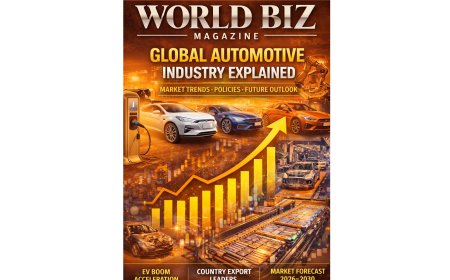
Global Automotive Industry Explained
Market Trends, Policy Impact, Investments & Competitive Outlook to 2030
World Biz Magazine - Industry Intelligence Feature
The automotive industry stands as one of the most economically significant and strategically transformative global sectors. Spanning passenger vehicles, commercial vehicles, electric mobility, parts, supply chains, and mobility services, the industry influences global employment, technological innovation, logistics, urban planning, and energy consumption.
From traditional internal combustion engines (ICE) to electrified and autonomous platforms, the automotive industry is undergoing its most profound transformation in decades driven by environmental policy, digitalization, regional competition, changing consumer behavior, and capital investment flows.
Industry Structure
The automotive sector is broadly divided into:
Vehicle Types
- Passenger Cars (PVs) - sedans, hatchbacks, SUVs
- Commercial Vehicles (CVs) - trucks, buses, delivery vans
- Electric Vehicles (EVs) - battery electric (BEV), plug-in hybrid (PHEV), hybrid (HEV)
- Emerging Mobility Platforms - shared fleets, autonomous prototypes
Supply Chain Tiers
- OEMs (Original Equipment Manufacturers) - vehicle assemblers
- Tier 1 Suppliers - major parts & systems suppliers
- Tier 2/3 Suppliers - components, raw materials, electronics
- Service & Aftermarket - maintenance, software, retail
Global Market Size & Forecast
Current Scale
- Estimated global automotive market value exceeded $3.5 trillion in 2025 with growing EV share.
- Annual production volumes have surpassed 90 million vehicles globally after recovery from pandemic disruptions.
Historical Trends (Last 10 Years)
- 2015-2019: Steady growth with ICE dominance.
- 2020: COVID-19 disruptions caused a sharp production and sales dip.
- 2021-2025: Recovery coupled with EV acceleration.
- Inflationary pressures (2022-2024) led to higher vehicle prices and component costs.
Forecast to 2030
Analysts project:
|
Metric |
2025 |
2030 Forecast |
|
Global Vehicle Sales |
90M units |
105-115M units |
|
EV Penetration |
25% of new sales |
40-50% of new sales |
|
Global Market Value |
$3.5T+ |
$4.5-5.0T |
|
Automotive Software & Digital Revenue |
$150B |
$300-400B |
Growth is driven by EV adoption, increased mobility services, and digital feature monetization embedded in modern vehicles.
Key Players
Major OEMs
- Toyota Motor Corporation (Japan)
- Volkswagen Group (Germany)
- General Motors (U.S.)
- Ford Motor Company (U.S.)
- Stellantis (EU/US)
- Hyundai-Kia (South Korea)
- Honda Motor Co. (Japan)
- Tesla, Inc. (U.S.)
Emerging EV Leaders
- BYD (China)
- SAIC Motor (China)
- Geely (China)
- NIO, Xpeng, Li Auto (China)
Tier 1 Suppliers
- Bosch (Germany), Denso (Japan), Continental (Germany), Magna International (Canada), ZF Friedrichshafen (Germany)
Policy Environment & Political Dynamics
Government policies dictate automotive competitive dynamics through:
Environmental Regulation
- Emission standards (Euro 7, CAFE, Bharat Stage VI) enforcing cleaner vehicles
- Zero-Emission Vehicle mandates in key markets
- Phase-out targets for ICE sales in EU, U.S., China
- Green procurement incentives and tax rebates
Trade & Tariff Policy
- Import duty regimes influencing global supply chain structuring
- Free trade agreements affecting regional manufacturing hubs
Infrastructure Policy
- EV charging networks funded by public investment
- Smart city and digital mobility planning
Safety & Compliance Standards
Stringent crash and safety norms requiring advanced engineering and testing.
Policies directly shift consumer choices (e.g., EV subsidies), corporate investment decisions, and long-term global competitiveness.
Key Contacts & Industry Bodies
- International Organization of Motor Vehicle Manufacturers (OICA) - global vehicle production data
- Alliance for Automotive Innovation - policy advocacy in North America
- European Automobile Manufacturers’ Association (ACEA) - EU industry standards
- China Association of Automobile Manufacturers (CAAM) - China production data
- National automotive regulators - DOT (U.S.), NHTSA (U.S.), Ministry of Transport (China), Transport Canada
These bodies influence regulation, harmonization, safety standards, and trade practices.
Country-by-Country Market Influences
China
World’s largest auto market by production and sales. Pioneering EV adoption with strong government support.
United States
Major automotive producer with strong technology and services orientation; significant EV and software investments.
European Union
Automotive hub with high regulatory standards and premium brands; accelerating EV manufacturing.
Japan & South Korea
Strong global brands and supplier ecosystems; significant hybrid legacy and EV shifts underway.
India
Rapidly expanding market with increasing domestic production and electrification policies.
Mexico & Brazil
Key export hubs for North America and LATAM respectively.
Countries investing heavily in EV infrastructure, digital platforms, and supply chain localization are gaining competitive traction.
Investment Landscape & Major Investors
Capital Flow Drivers
- EV battery technology and gigafactories
- Software and autonomous R&D
- Electrification supply chain (motors, power electronics)
- Digital services and connectivity platforms
Public & Private Investment Sources
- Automaker capital expenditure (CAPEX) for new plants
- Venture capital in EV & software startups
- Private equity in aftermarket and mobility services
- Government incentives for EV production and infrastructure
Major investors: Pension funds, sovereign wealth funds, major tech companies, and traditional auto OEM holdings.
New Projects & Emerging Players
- Gigafactories in U.S., Europe, India, Southeast Asia
- Battery recycling and second-life storage projects
- Digital mobility services (ride-hailing integration)
- Advanced autonomous prototype programs
Emerging players include mobility tech firms, EV challengers, battery innovators, and software platform providers.
E-Commerce & Digital Integration
Consumer car buying and servicing are increasingly digital:
- Online retailing of vehicles
- Contactless servicing and digital diagnostics
- AI-powered customer analytics
- Software over-the-air (OTA) updates
- Connected car services and subscriptions
Digital platforms reduce transaction friction and open new revenue segments.
Prices, Inflation & Market Volatility
Vehicle Pricing Trends
- Rising commodities costs (steel, aluminum, semiconductors) increased vehicle prices.
- EV component costs remain high but trend downward with scale and battery tech improvements.
Inflationary Impact
- Global inflation increased manufacturing and logistics costs.
- Input cost pressures led OEM price adjustments and lean supply strategies.
Forecast
- Price stabilization expected as supply chains normalize.
- EV price parity with ICE projected in mid-to-late 2020s due to battery cost declines.
Winners & Losers: Investment Shifts
Countries Attracting Investment
- China (EV ecosystem leader)
- U.S. (EV & digital mobility)
- Europe (strict environmental regulation incentivizing tech)
- India (expanding middle class demand + manufacturing incentives)
Countries Losing Investment
- Markets highly dependent on ICE legacy without supportive transition policies
- Nations with poor infrastructure and weak regulatory frameworks
- Regions losing export competitiveness due to tariffs or supply delays
Strategic policy alignments correlate strongly with capital inflows.
Comparison with Other Sectors
|
Sector |
Growth Drivers |
Structural Challenges |
|
Automotive |
Electrification, digital services, safety tech |
Supply chain complexity, policy shifts |
|
Oil & Gas |
Energy demand, geopolitics |
Energy transition pressure |
|
Pharma |
Healthcare needs, innovation |
Regulatory costs, pricing pressure |
|
Tech |
Data growth, AI platforms |
Privacy & regulation |
Automotive’s convergence of traditional manufacturing with high-tech systems positions it uniquely among global sectors.
Future Outlook
Technological Frontiers
- Solid-state batteries and next-gen energy storage
- Full autonomy and AI-powered driving systems
- Vehicle-to-everything (V2X) connectivity
- Modular and shared mobility platforms
Market Evolution
EV market share expected to approach 40-50% of global sales by 2030, driven by incentives, regulation, consumer adoption, and cost declines.
Advanced driver-assistance systems (ADAS) and software-as-a-service (SaaS) will unlock new recurring revenue streams.
World Biz Magazine Insight
The global automotive industry today is a dynamic, high-stakes ecosystem where manufacturing meets software, energy transition meets policy mandates, and consumer expectations reshape legacy business models.
The winners in the next decade will be nations and companies that:
- Champion technological innovation
- Invest strategically in supply chain resilience
- Align with environmental policy and electrification goals
- Embrace digital retail and connected services
Conclusion
The automotive industry is not just about vehicles;
it is about mobility solutions for the future smart, electrified, connected, and sustainable. Its evolution will be defined by policy frameworks, investment flows, technology convergence, and global competitive positioning.
As the world transitions toward a greener, more digital age, the automotive industry is a crucial frontier shaping economies, infrastructure, and human mobility well into 2030 and beyond.
Disclaimer
This publication is intended for informational and editorial purposes only. The analysis presented reflects market research, industry data, and economic interpretation available at the time of publication.
This article does not constitute financial, investment, legal, engineering, or policy advice. Readers should conduct independent due diligence and consult licensed professionals before making investment, corporate, or strategic decisions related to the automotive or mobility sector.
Market forecasts, growth projections, and economic assumptions referenced herein are based on analytical modeling and industry trends. Actual results may vary due to macroeconomic shifts, regulatory changes, geopolitical developments, supply chain disruptions, commodity price volatility, technological breakthroughs, or other unforeseen factors.
World Biz Magazine does not accept liability for any business or investment decisions made based on the information provided in this article.
What's Your Reaction?
 Like
0
Like
0
 Dislike
0
Dislike
0
 Love
0
Love
0
 Funny
0
Funny
0
 Angry
0
Angry
0
 Sad
0
Sad
0
 Wow
0
Wow
0