













































































































































































































Payment Failures and Risks: Global Digital Payments Industry Outlook to 2030
A World Biz Magazine analysis of payment system failures and financial risks, covering digital payments growth, fintech innovation, and global market outlook.

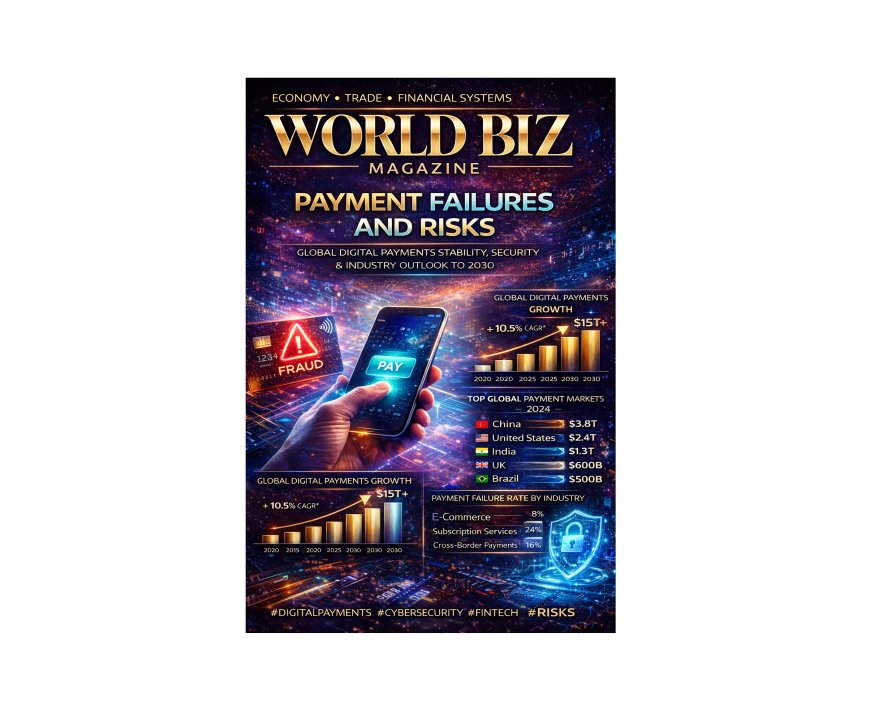
Payment Failures and Risks
Global Digital Payments Stability, Financial System Risks & Industry Outlook to 2030
World Biz Magazine | Industry Today Special Report
As the global economy rapidly shifts toward digital transactions, the stability and reliability of payment systems have become critical to modern financial infrastructure. From online commerce and banking transfers to mobile wallets and cross-border settlements, digital payments now power trillions of dollars in global economic activity each day.
However, the growing complexity of payment ecosystems has also introduced new risks. Payment failures, transaction errors, cybersecurity threats, and system outages can disrupt businesses, damage customer trust, and create systemic financial risks.
This World Biz Magazine Industry Today report examines payment failures and risks in the global financial system, including industry size, key stakeholders, regulatory policies, technological vulnerabilities, market trends, and forecasts through 2030.
Global Digital Payments Industry Overview
Digital payments encompass a wide range of financial transaction technologies:
- credit and debit card payments
- mobile wallet transactions
- real-time bank transfers
- online payment gateways
- cross-border digital settlements
The global digital payments industry has expanded rapidly with the growth of e-commerce and fintech innovation.
Global Digital Payments Market Size
|
Year |
Market Value |
|
2015 |
$3.2 trillion |
|
2020 |
$5.4 trillion |
|
2024 |
$9.4 trillion |
|
2030 (forecast) |
$15 trillion+ |
Digital payments now represent one of the fastest-growing segments of the global financial services sector.
What Are Payment Failures?
Payment failures occur when a financial transaction cannot be successfully completed.
Common types include:
- transaction declines
- network failures
- authorization errors
- insufficient funds
- payment gateway disruptions
These failures can occur across card payments, bank transfers, and digital wallets.
Causes of Payment Failures
Payment failures typically arise from several technical and financial factors.
Technical Failures
- payment gateway outages
- server infrastructure failures
- API connectivity problems
- network disruptions
Financial Failures
- insufficient account balance
- card expiration
- fraud detection triggers
- bank authorization declines
Human Errors
- incorrect payment details
- currency mismatches
- duplicate transactions
Payment failures often involve complex interactions between banks, payment processors, merchants, and financial networks.
Key Players in the Global Payment Ecosystem
The global payments infrastructure includes multiple stakeholders.
Payment Networks
Major global payment networks include:
- Visa
- Mastercard
- American Express
- UnionPay
Payment Processors
Leading payment processors include:
- Stripe
- PayPal
- Adyen
- Square
Financial Institutions
Banks and financial institutions remain central to payment authorization and settlement systems.
Market Size of Payment Infrastructure
The digital payments infrastructure market includes:
|
Segment |
Market Value |
|
Payment processing |
$500B+ |
|
Payment gateways |
$40B+ |
|
Cross-border payments |
$190T annual flows |
Cross-border payments represent one of the largest financial markets globally.
Economic Impact of Payment Failures
Payment failures can have significant economic consequences.
For Businesses
- lost revenue
- increased transaction costs
- customer dissatisfaction
For Consumers
- delayed transactions
- financial uncertainty
- security concerns
For Financial Systems
Large-scale payment system failures could potentially disrupt financial markets.
Payment Fraud and Cybersecurity Risks
Cybersecurity threats represent one of the biggest risks to digital payment systems.
Common threats include:
- phishing attacks
- card data breaches
- account takeover fraud
- payment gateway attacks
Financial institutions invest billions annually in fraud detection and cybersecurity systems.
Global Payment Failure Rates
Average payment failure rates vary by industry.
|
Sector |
Failure Rate |
|
E-commerce |
5-15% |
|
Subscription services |
20-40% |
|
cross-border payments |
10-20% |
Reducing payment failure rates is a major priority for fintech companies.
Regulatory and Policy Influence
Government policies play a crucial role in payment system stability.
Key Regulations
- anti-money laundering laws (AML)
- payment security standards
- banking regulations
- data protection laws
International organizations such as central banks and financial regulators oversee payment system integrity.
Major Investors in Payment Technology
Investment in payment infrastructure has surged in recent years.
Key Investors
- venture capital firms
- financial institutions
- technology companies
- sovereign wealth funds
Fintech startups focusing on payments have attracted billions in funding globally.
Countries Leading the Digital Payments Revolution
Some countries are leading global payment innovation.
Leading Markets
- United States
- China
- India
- United Kingdom
- Singapore
These countries have developed advanced digital payment ecosystems.
Countries Facing Payment Infrastructure Challenges
Some regions still struggle with payment infrastructure development.
Examples include:
- emerging economies with limited banking access
- countries with outdated financial infrastructure
- regions with weak cybersecurity protections
Improving payment systems is a key priority for financial development.
Price Inflation in Payment Processing
Payment processing costs have evolved over time.
Typical Payment Fees
|
Payment Type |
Fee Range |
|
Credit card payments |
2-3% |
|
Digital wallets |
1-3% |
|
bank transfers |
0-1% |
Competition among fintech providers is gradually reducing transaction costs.
Emerging Technologies in Payment Systems
Several technologies are transforming payment infrastructure.
Real-Time Payments
Instant payment networks enable transactions within seconds.
Blockchain Payments
Blockchain technology could reduce cross-border payment costs.
Artificial Intelligence
AI systems improve fraud detection and payment authorization accuracy.
Comparison with Other Financial Sectors
|
Sector |
Market Size |
|
global banking |
$180 trillion assets |
|
global payments |
$15 trillion transaction value |
|
fintech |
$200B+ industry |
Payments are becoming one of the most dynamic areas within financial services.
Industry Outlook to 2030
Key Growth Drivers
- expanding e-commerce markets
- mobile payment adoption
- fintech innovation
- cross-border digital trade
- financial inclusion initiatives
Market Forecast
|
Segment |
2030 Forecast |
|
global digital payments |
$15T+ |
|
fintech payment platforms |
rapid growth |
|
real-time payment networks |
widespread adoption |
Payment infrastructure will become increasingly digital and interconnected.
World Biz Magazine Insights
Payment systems represent the backbone of the digital economy. As transaction volumes continue rising, the reliability and security of payment infrastructure will become even more important.
Financial institutions, fintech companies, and regulators must work together to minimize payment failures and strengthen cybersecurity protections.
Conclusion
The growth of digital payments has transformed the global financial system, enabling faster, more convenient transactions for businesses and consumers. However, the increasing complexity of payment networks also introduces new risks and vulnerabilities.
Addressing payment failures and strengthening system resilience will be essential for maintaining trust in the digital financial ecosystem as global payments continue expanding through 2030 and beyond.
Disclaimer
The information presented in this article is for informational and educational purposes only. Market statistics, projections, and forecasts are based on publicly available industry data and analytical estimates at the time of publication. While every effort has been made to ensure accuracy, World Biz Magazine does not guarantee future market performance or investment outcomes. Readers should consult professional advisors before making financial or strategic decisions based on the information contained in this report. All trademarks and company names mentioned belong to their respective owners.
What's Your Reaction?
 Like
0
Like
0
 Dislike
0
Dislike
0
 Love
0
Love
0
 Funny
0
Funny
0
 Angry
0
Angry
0
 Sad
0
Sad
0
 Wow
0
Wow
0