














































































































































































































How Venture Capitalists Evaluate Startups: A Complete Fundraising & Due Diligence Guide
A detailed guide on VC decision-making, startup valuation, due diligence, and intellectual property assessment for tech founders.

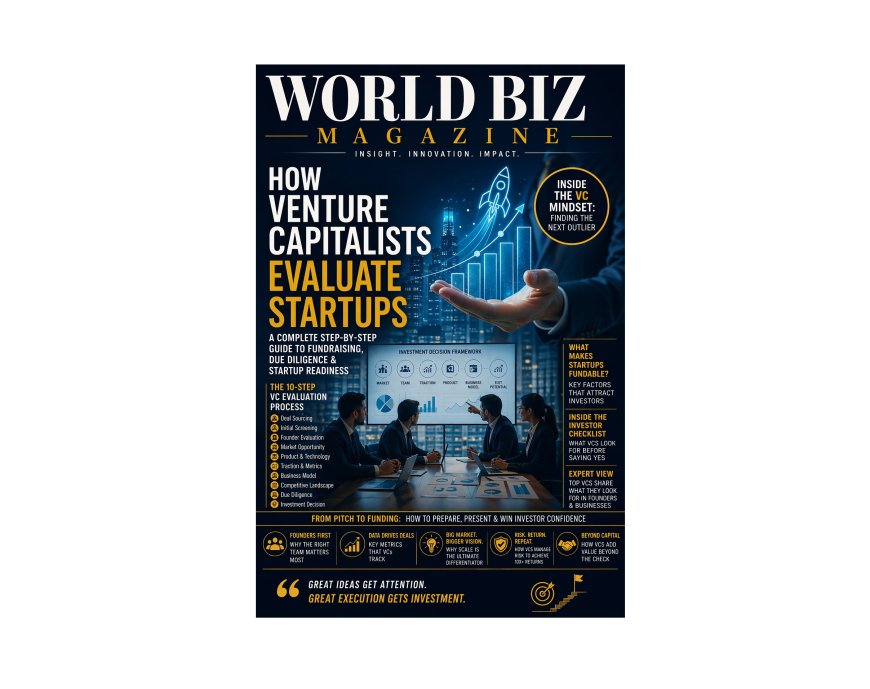
How Venture Capitalists Evaluate Startups
A Complete Step-by-Step Guide to Fundraising, Due Diligence & Startup Readiness
By World Biz Magazine Marker Research Team
The VC Lens
Venture Capital (VC) firms do not invest in ideas they invest in scalable, defensible, and high-growth businesses. Every pitch is filtered through a rigorous evaluation framework designed to answer one core question:
“Can this startup return 10x-100x on our investment?”
Understanding how VCs think is not optional it is the difference between funding success and rejection.
Step-by-Step: How VCs Evaluate Startups
1. Problem & Market Opportunity
VCs first analyze whether the startup is solving a real, painful, and scalable problem.
They evaluate:
- Market size (TAM, SAM, SOM)
- Urgency of the problem
- Existing alternatives
- Customer willingness to pay
A startup targeting a $10B+ market has far higher chances of funding.
2. Business Model & Revenue Potential
A great idea without monetization is a red flag.
VCs examine:
- Revenue streams (subscription, SaaS, marketplace, ads)
- Unit economics (CAC vs LTV)
- Pricing strategy
- Scalability of revenue
Strong startups demonstrate clear paths to profitability, even if not immediately profitable.
3. Product & Technology
Here, VCs assess:
- Product uniqueness
- Technology advantage
- Development stage (MVP, beta, scaling)
- Product-market fit indicators
For tech startups, this is where intellectual property (IP) becomes critical.
4. Founding Team
Often the #1 deciding factor.
VCs evaluate:
- Founder expertise & background
- Execution capability
- Industry knowledge
- Team balance (technical + business)
A strong team can pivot a weak idea but a weak team cannot execute a strong idea.
5. Traction & Growth Metrics
Data speaks louder than vision.
Key metrics:
- Monthly recurring revenue (MRR)
- User growth rate
- Retention & churn
- Customer acquisition cost (CAC)
- Lifetime value (LTV)
Even early traction significantly increases valuation.
6. Competitive Landscape
VCs analyze:
- Direct and indirect competitors
- Barriers to entry
- Differentiation strategy
If your startup has no competition, it’s often seen as a risk, not an advantage.
7. Exit Potential
VCs invest with exits in mind:
- IPO potential
- Acquisition targets
- Industry consolidation trends
No clear exit --- no investment.
VC Due Diligence: The Deep Dive
Once initial interest is established, VCs conduct comprehensive due diligence, which includes:
Financial Due Diligence
- Revenue verification
- Financial statements (P&L, balance sheet, cash flow)
- Burn rate and runway
- Forecast validation
Legal Due Diligence
- Company registration documents
- Shareholding structure (cap table)
- Contracts and agreements
- Regulatory compliance
Technical Due Diligence (Critical for IT Startups)
- Code quality and architecture
- Scalability of system
- Security audits
- Technical documentation
Commercial Due Diligence
- Market validation
- Customer interviews
- Sales pipeline verification
Team & HR Due Diligence
- Founder background checks
- Employee contracts
- ESOP structure
Startup Preparation Before Fundraising
Before approaching VCs, startups must be investment-ready.
1. Build a Strong Pitch Deck
Must include:
- Problem & solution
- Market size
- Product demo
- Business model
- Traction metrics
- Financial projections
- Team
- Funding ask
2. Organize a Data Room
A digital repository containing all key documents.
3. Validate Product-Market Fit
- Active users
- Paying customers
- Positive feedback loops
4. Strengthen Financial Discipline
- Clear revenue model
- Controlled burn rate
- Realistic projections
5. Legal & Compliance Readiness
- Proper company registration
- Clean cap table
- IP ownership clarity
Documents Required for VC Fundraising
Corporate Documents
- Certificate of incorporation
- Memorandum & Articles of Association
- Shareholder agreements
Financial Documents
- Profit & Loss statements
- Cash flow statements
- Financial projections (3-5 years)
Operational Documents
- Business plan
- Pitch deck
- Product roadmap
Legal Documents
- Contracts (vendors, clients)
- Employment agreements
- NDAs
Cap Table
- Equity distribution
- Investor history
Industry-Wise Evaluation Approach
IT / Software Startups (SaaS, AI, Platforms)
VC focus areas:
- Scalability of software
- Recurring revenue (SaaS metrics)
- Code ownership & IP
- Security & data compliance
Fintech
- Regulatory compliance
- Risk management systems
- Transaction scalability
Healthcare
- Clinical validation
- Regulatory approvals
- Long-term scalability
E-commerce / Marketplace
- Unit economics
- Supply chain efficiency
- Customer acquisition cost
How to Value Intellectual Property (IP) in Software Startups
For IT startups, code = core asset.
1. Methods to Value Software IP
a. Cost-Based Approach
- Total development cost
- Engineering salaries
- Infrastructure investment
b. Market-Based Approach
- Comparison with similar startups
- Industry benchmarks
c. Income-Based Approach (Most Important)
- Future revenue generated by software
- Discounted cash flow (DCF)
2. What VCs Look for in Software IP
- Proprietary algorithms
- Unique architecture
- Scalability
- Integration capabilities
3. Required IP Documents
- Source code repository ownership (e.g., Git records)
- IP assignment agreements (developers - to - company)
- Licensing agreements
- Patent filings (if applicable)
- Technical architecture documentation
4. Protecting Software IP
- Ensure all developers sign IP transfer agreements
- Avoid using unlicensed third-party code
- Maintain version control history
- File patents where applicable
Common Mistakes Startups Make
- Overestimating valuation without traction
- Weak financial projections
- Ignoring legal/IP structure
- Lack of focus on unit economics
- Pitching too early without validation
Industry Insights
The global venture capital ecosystem has evolved significantly over the past decade, driven by rapid digital transformation, AI adoption, and cross-border capital flows.
- Shift Toward Profitability: Post-2022, VCs increasingly prioritize unit economics and sustainable growth over aggressive scaling.
- AI & SaaS Dominance: Startups in AI, SaaS, and automation continue to attract the largest share of VC funding globally.
- Emerging Market Growth: Regions like South Asia, Southeast Asia, and Africa are witnessing increased VC attention due to high-growth digital adoption.
- Due Diligence Tightening: Investors are conducting deeper technical and financial audits, especially for early-stage startups.
- Founder Quality Over Idea: The market strongly favors execution-focused teams with domain expertise rather than just innovative ideas.
World Biz Magazine Insights
At World Biz Magazine, our editorial analysis highlights a critical shift in venture capital dynamics:
“The era of storytellin-only fundraising is over. Today’s founders must combine vision with verifiable data, defensible technology, and operational discipline.”
WBM Insights identify three defining trends shaping startup funding success:
1. Data-Driven Fundraising
Investors now expect startups to present:
- Real traction metrics
- Cohort analysis
- Revenue predictability
2. IP as a Core Asset
For technology startups, intellectual property is becoming the new currency of valuation, especially in:
- AI models
- Proprietary algorithms
- Scalable SaaS architectures
3. Globalization of Capital
Startups are no longer limited to local investors. Platforms like Sequoia Capital and Andreessen Horowitz are actively investing across borders, making global readiness essential.
Final Insight: What Truly Wins VC Funding
At its core, VC decision - making boils down to:
Team + Market + Traction + Scalability
A startup that demonstrates:
- A massive opportunity
- A capable team
- Real traction
- Strong defensibility
……will always stand out.
Conclusion: Fundraising is a Process, Not an Event
Raising venture capital is not about a single pitch it is about building a credible, investable company over time.
Startups that prepare thoroughly, understand investor psychology, and present data-driven narratives are the ones that secure funding and scale globally.
Disclaimer
This article is intended for informational and educational purposes only and does not constitute financial, legal, or investment advice. Venture capital investments involve significant risk, and readers are advised to consult qualified financial advisors, legal professionals, and investment experts before making any funding or business decisions.
World Biz Magazine and its associates do not guarantee funding outcomes, valuations, or investor interest based on the strategies discussed. All examples, frameworks, and valuation approaches are indicative and may vary depending on market conditions, geography, and investor preferences.
What's Your Reaction?
 Like
0
Like
0
 Dislike
0
Dislike
0
 Love
0
Love
0
 Funny
0
Funny
0
 Angry
0
Angry
0
 Sad
0
Sad
0
 Wow
0
Wow
0