










































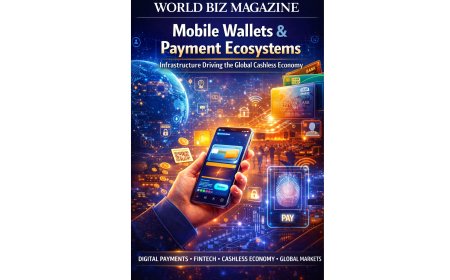
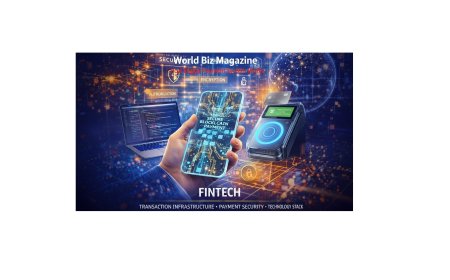




































































































































Mobile Wallets & Payment Ecosystems - Infrastructure Driving the Global Cashless Economy
Comprehensive analysis of mobile wallet technologies, payment platforms, and digital financial ecosystems driving the global transition to cashless economies.


Mobile Wallets & Payment Ecosystems
The Infrastructure Powering the Global Cashless Economy
World Biz Magazine | Digital Payments & FinTech | Industry Feature
The global payments landscape is undergoing one of the most significant transformations in modern economic history. Mobile wallets once simple tools for peer-to-peer transfers have evolved into comprehensive financial ecosystems integrating banking, commerce, lending, investment, identity, and lifestyle services.
From QR payments in Southeast Asia to real-time transfers in India and super-app ecosystems in China, mobile wallets are redefining how individuals and businesses transact. These platforms are now central to financial inclusion, e-commerce expansion, and digital economic growth worldwide.
By the mid-2020s, billions of consumers rely on smartphones as their primary financial interface, supported by advancements in cloud infrastructure, AI, biometrics, and regulatory frameworks promoting digital payment adoption.
Industry Overview
Mobile wallets are digital applications that store payment credentials and enable transactions through:
- NFC contactless payments
- QR-code scanning
- Online checkout integration
- Peer-to-peer transfers
- Embedded financial services
They operate within broader payment ecosystems, which include:
- Banks and card networks
- Payment processors
- Fintech platforms
- Merchants
- Telecom providers
- Government infrastructure
This interconnected environment forms the backbone of digital commerce and financial data exchange.
Market Adoption & Global Scale
Global Usage Trends
- Mobile phones are increasingly central to daily financial management, enabling users to handle transactions through multifunctional apps.
- Smartphone penetration exceeding roughly 80% globally has accelerated mobile payment adoption and ecosystem integration.
- Emerging research indicates billions of users globally are adopting digital wallets as “super-app” models expand services beyond payments.
Regional Highlights
Asia-Pacific - Global Innovation Hub
- Malaysia, Singapore, India and UAE show among the highest mobile wallet usage rates in surveyed populations.
- India’s digital infrastructure demonstrates massive scale, with digital payments accounting for nearly all transaction volume in recent data.
- Real-time payment rails like UPI process hundreds of millions of daily transactions, shaping global interoperability trends.
Europe & North America - Mature Infrastructure
- Contactless, biometric, and tap-to-pay technologies are key adoption drivers.
- Cash usage is declining in advanced economies, with digital payments dominating transaction share in some markets.
Africa & Latin America - Inclusion-led Growth
- Mobile money adoption thrives where banking access is limited, with significant portions of populations using mobile financial accounts.
Technology Stack Behind Mobile Wallet Ecosystems
Core Payment Technologies
- NFC proximity payments
- QR-code transaction systems
- Tokenization & encryption
- Biometric authentication
- Real-time settlement networks
These technologies enable fast, secure, low-friction payments across channels.
AI & Data Intelligence Integration
Modern platforms integrate AI for:
- Fraud detection
- Spending insights
- Credit risk modeling
- Automated budgeting
- Personalized offers
AI-driven financial assistance is becoming a defining feature of next-generation wallets.
Embedded Finance Expansion
Mobile wallets increasingly provide:
- Digital lending
- Micro-investments
- Insurance
- Buy Now Pay Later (BNPL)
- Subscription management
This evolution transforms wallets into financial service hubs rather than simple payment tools.
Business Model Architecture
Revenue streams include:
- Transaction fees
- Merchant service charges
- Financial product commissions
- Data analytics monetization
- Advertising & promotions
- Cross-border remittance spreads
Large ecosystems benefit from network effects, increasing profitability as users and merchants scale.
Competitive Landscape
Platform Types
Big Tech Wallets
- Ecosystem-driven (Apple, Google, Tencent-style models)
Bank-led Wallets
- Trust and regulatory integration advantage
Telecom-led Mobile Money
- Financial inclusion leadership
Fintech-native Platforms
- Rapid innovation cycles
Regulatory & Security Considerations
Security Challenges
- Malware
- Identity theft
- Network attacks
Encryption, authentication layers, and firewall protections remain essential safeguards.
Regulatory Drivers
Governments encourage digital payment adoption through:
- Financial inclusion policies
- Cashless initiatives
- Interoperability standards
- Digital ID integration
Regulatory clarity strongly influences ecosystem expansion and innovation.
Strategic Impact on the Global Economy
Mobile wallets contribute to:
- Formalization of financial transactions
- SME market participation
- E-commerce growth
- Tax transparency
- Cross-border trade facilitation
- Consumer data-driven innovation
They are increasingly viewed as digital infrastructure rather than optional services.
Future Outlook
Key trajectories shaping the next decade:
- Biometric-only authentication
- Central Bank Digital Currency integration
- Cross-border wallet interoperability
- AI financial copilots
- Web3 identity/payment convergence
- Offline payment capability expansion
Mobile wallets are expected to transition from payment tools into digital identity and economic participation platforms.
Conclusion
Mobile wallets and payment ecosystems represent the foundational architecture of the digital economy. Their evolution reflects broader shifts toward platform-driven financial services, embedded commerce, and data-powered economic participation.
The convergence of fintech innovation, regulatory modernization, and consumer behavior transformation positions mobile wallets as strategic assets shaping future global markets.
Rather than simply replacing cash, these systems are redefining financial access, commerce engagement, and economic inclusion worldwide.
Disclaimer
This article is published by World Biz Magazine for informational and analytical purposes only. Industry insights and projections are based on available research and should not be interpreted as financial or investment advice. Readers are encouraged to conduct independent evaluation before making strategic decisions.
What's Your Reaction?
 Like
0
Like
0
 Dislike
0
Dislike
0
 Love
0
Love
0
 Funny
0
Funny
0
 Angry
0
Angry
0
 Sad
0
Sad
0
 Wow
0
Wow
0