




























































































































































































Retail Banking Industry Trends: Digital Transformation and Consumer Banking
Understand the future of retail banking, including neobanks, digital payments, cybersecurity, financial inclusion, and modern banking innovation.

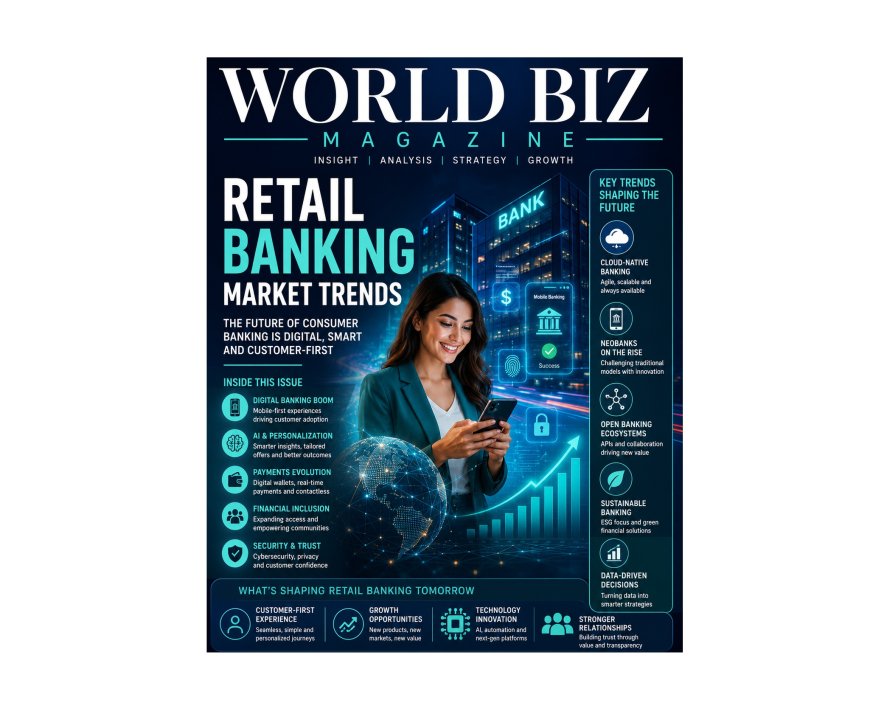
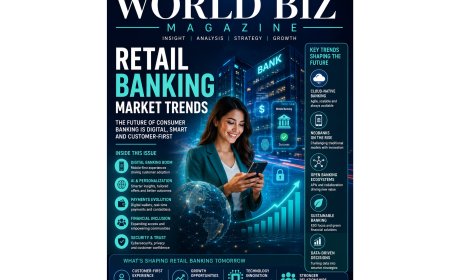
Retail Banking Market Trends
How Consumer Banking Is Transforming in the Digital Financial Era
World Biz Magazine | Global Financial Intelligence | Banking & Capital Markets
The Evolution of Modern Retail Banking
Retail banking has entered one of the most transformative periods in its history. Once centered around physical branches, paper-based transactions, and traditional savings accounts, the retail banking industry is now rapidly evolving into a highly digital, technology-driven ecosystem powered by artificial intelligence, fintech innovation, mobile banking, cloud infrastructure, and real-time financial services. Across global markets, retail banks are redefining how consumers interact with money, manage personal finances, access credit, and participate in the digital economy.
Retail banking, often referred to as consumer banking, represents the segment of the banking industry that provides financial products and services directly to individuals rather than corporations or institutional clients. These services include savings accounts, checking accounts, personal loans, mortgages, credit cards, debit cards, mobile banking, payment systems, wealth management, and financial advisory services. For decades, retail banking has served as one of the most important pillars of consumer finance and economic participation worldwide.
However, the industry is undergoing major structural change driven by shifting consumer expectations, technological disruption, financial inclusion initiatives, cybersecurity challenges, and increasing competition from fintech startups and digital-only banks. Consumers now expect seamless mobile experiences, instant transactions, personalized financial services, and 24/7 digital accessibility. Traditional banking institutions are being forced to modernize rapidly to remain competitive in a marketplace increasingly dominated by innovation and convenience.
At the same time, retail banking continues to play a foundational role in global economies. Banks provide consumers with access to savings, payments, credit, investment products, and financial security. They support economic growth, encourage consumer spending, facilitate digital commerce, and enable financial inclusion across emerging markets. As financial technology accelerates and banking infrastructure becomes increasingly interconnected, understanding retail banking market trends has become essential for investors, policymakers, entrepreneurs, financial institutions, and consumers alike.
What Is Retail Banking?
Retail banking refers to banking services designed specifically for individual consumers rather than businesses or institutions. Retail banks provide financial products that help people manage daily finances, store money securely, access credit, make payments, and build long-term financial stability.
Core retail banking services include:
- Savings accounts
- Checking/current accounts
- Personal loans
- Mortgages
- Credit cards
- Debit cards
- Mobile banking
- Online banking
- Wealth management
- Investment products
- Insurance services
Retail banks generate revenue primarily through interest spreads, service fees, lending activities, and financial product sales. Because retail banking directly serves consumers, it remains one of the largest and most competitive segments of the global financial industry.
Retail banking institutions range from large multinational banks and regional banks to digital-only fintech platforms and mobile banking applications operating entirely online.
The Shift Toward Digital Banking
One of the most significant trends shaping retail banking is the rapid transition from physical banking infrastructure to digital financial ecosystems.
Mobile Banking Expansion
Mobile banking has become the dominant channel for customer interaction across many markets. Consumers increasingly use smartphones for:
- Account management
- Money transfers
- Bill payments
- Mobile deposits
- Digital wallets
- Investment tracking
- Loan applications
Banks are heavily investing in mobile applications to improve customer experience, convenience, and digital engagement.
In many countries, younger consumers now rarely visit physical branches, preferring entirely digital banking experiences accessible from mobile devices.
Decline of Physical Branches
As digital adoption accelerates, many banks are reducing physical branch networks to lower operational costs and streamline services.
Traditional branches are increasingly transforming into:
- Financial advisory centers
- Wealth management hubs
- Digital support centers
- Relationship banking locations
While physical branches remain important for complex financial services and relationship management, their role is evolving significantly.
Rise of Neobanks and Digital-Only Banks
Neobanks are digital-only financial institutions operating without traditional branch networks. These banks focus heavily on:
- Mobile-first banking
- Low-cost services
- Faster onboarding
- Real-time payments
- User-friendly financial interfaces
Neobanks are particularly popular among younger consumers seeking convenience, lower fees, and digital-native financial experiences.
The rise of digital-only banking platforms has intensified competition within the retail banking industry and forced traditional banks to accelerate innovation.
Artificial Intelligence and Automation in Retail Banking
Artificial intelligence is transforming retail banking operations, customer engagement, fraud prevention, and financial decision-making.
AI-Powered Customer Service
Banks are increasingly deploying AI-driven chatbots and virtual assistants to handle:
- Customer inquiries
- Transaction support
- Account management
- Loan information
- Financial guidance
AI customer service systems reduce operational costs while improving response times and service availability.
Personalized Financial Services
Artificial intelligence enables banks to analyze customer behavior and offer personalized financial products based on spending patterns, savings habits, and investment goals.
Examples include:
- Customized loan offers
- Personalized budgeting tools
- Automated savings recommendations
- Investment suggestions
- Spending insights
This personalization is becoming a major competitive advantage in retail banking.
Fraud Detection and Risk Management
AI-powered systems help banks detect unusual transaction patterns and potential fraud in real time. Machine learning algorithms improve cybersecurity monitoring and reduce financial crime risks.
As digital banking grows, cybersecurity and fraud prevention are becoming increasingly critical priorities.
Embedded Finance and Open Banking
Another major retail banking trend is the rise of embedded finance and open banking ecosystems.
Open Banking
Open banking allows third-party financial service providers to access banking data securely through APIs with customer permission.
This enables:
- Financial app integration
- Faster payments
- Personalized financial tools
- Aggregated account management
- Cross-platform financial services
Open banking encourages innovation and increases competition within the financial industry.
Embedded Finance
Embedded finance integrates banking services directly into non-financial platforms such as:
- E-commerce apps
- Ride-sharing services
- Social media platforms
- Retail marketplaces
Consumers can now access payments, loans, insurance, and financial products without leaving digital ecosystems they already use daily.
This trend is blurring the boundaries between banking, technology, and digital commerce.
Contactless Payments and Digital Wallets
The retail payments landscape is changing rapidly.
Contactless Transactions
Consumers increasingly prefer contactless payment methods using:
- Smartphones
- Smartwatches
- NFC-enabled cards
- QR code systems
The growth of contactless payments accelerated significantly during the global pandemic and continues expanding worldwide.
Digital Wallet Growth
Digital wallets such as mobile payment apps are reducing dependence on physical cash and traditional payment systems.
Digital wallet adoption is particularly strong in:
- Asia-Pacific markets
- Emerging economies
- E-commerce ecosystems
- Younger consumer demographics
Retail banks are partnering with fintech companies and payment platforms to remain competitive in the evolving payments industry.
Financial Inclusion and Emerging Markets
Financial inclusion remains a major global priority within retail banking.
Millions of people worldwide still lack access to formal banking services. Mobile banking and digital finance are helping expand financial access in underserved regions.
Mobile Banking in Emerging Economies
In developing markets, mobile banking platforms are enabling consumers to:
- Open digital accounts
- Send money
- Access microloans
- Build financial identity
- Participate in digital commerce
This expansion of financial access is transforming economies and supporting entrepreneurship in emerging regions.
ESG and Sustainable Banking
Environmental, Social, and Governance (ESG) considerations are increasingly influencing retail banking strategies.
Consumers are showing growing interest in:
- Sustainable investment products
- Green financing
- Ethical banking practices
- Climate-focused financial services
Banks are responding by offering:
- Green loans
- Sustainable investment funds
- Carbon-neutral banking initiatives
- Renewable energy financing
Sustainability is becoming both a reputational priority and a competitive differentiator.
Cybersecurity and Data Privacy Challenges
As banking becomes more digital, cybersecurity threats continue increasing.
Retail banks face growing risks from:
- Data breaches
- Identity theft
- Phishing attacks
- Financial fraud
- Ransomware
- Cybercrime networks
Banks are investing heavily in:
- Multi-factor authentication
- Biometric verification
- Encryption systems
- AI-powered fraud monitoring
- Cybersecurity infrastructure
Maintaining consumer trust is essential in the digital banking era.
The Rise of Banking-as-a-Service (BaaS)
Banking-as-a-Service platforms allow non-bank companies to integrate financial services into their products using banking infrastructure APIs.
This model enables technology companies and startups to offer:
- Payment systems
- Digital wallets
- Lending products
- Financial accounts
- Embedded financial tools
BaaS is accelerating financial innovation and expanding competition beyond traditional banking institutions.
Future Trends Shaping Retail Banking
Several major trends are expected to define the future of retail banking over the next decade.
Hyper-Personalization
AI-driven personalization will become increasingly advanced, creating highly customized banking experiences.
Real-Time Payments
Consumers will increasingly expect instant payment processing and real-time money movement.
Decentralized Finance (DeFi)
Blockchain technology and decentralized finance systems may influence future banking infrastructure and financial services.
Biometric Banking
Fingerprint authentication, facial recognition, and voice verification will become more common for banking security and customer access.
AI Financial Advisors
Automated financial advisory systems may provide consumers with affordable investment and financial planning tools.
World Biz Magazine Insights
At World Biz Magazine, we view retail banking as one of the fastest-evolving sectors within the global financial system. Consumer expectations, fintech disruption, artificial intelligence, cybersecurity demands, and digital commerce are fundamentally reshaping how banking institutions operate and compete.
Retail banks are no longer simply financial service providers; they are becoming integrated technology ecosystems combining banking, payments, data analytics, investment services, digital identity systems, and real-time financial infrastructure.
The institutions that successfully adapt to digital transformation while maintaining consumer trust, regulatory compliance, and cybersecurity resilience are likely to dominate the next generation of global banking markets.
As financial inclusion expands and digital economies continue growing worldwide, retail banking will remain central to economic participation, consumer finance, and the future of global commerce.
Conclusion
Retail banking is undergoing a historic transformation driven by digital innovation, artificial intelligence, mobile finance, open banking, and changing consumer behavior. Traditional banking models centered around physical branches are rapidly evolving into interconnected digital financial ecosystems focused on convenience, personalization, speed, and accessibility.
From mobile payments and digital wallets to AI-powered financial services and embedded finance platforms, retail banking is becoming more technology-driven than ever before. At the same time, banks continue playing a critical role in economic growth, financial inclusion, consumer security, and global financial stability.
As competition intensifies between traditional banks, fintech companies, and digital-only platforms, the future of retail banking will likely be defined by innovation, trust, cybersecurity, sustainability, and the ability to deliver seamless customer experiences in an increasingly connected world.
Disclaimer
This article is published for informational, educational, and editorial purposes only and does not constitute financial, banking, investment, legal, or tax advice. Readers should consult licensed financial professionals or banking advisors before making financial decisions. World Biz Magazine and its affiliates are not responsible for financial outcomes, investment decisions, or losses resulting from the information presented in this publication.
What's Your Reaction?
 Like
0
Like
0
 Dislike
0
Dislike
0
 Love
0
Love
0
 Funny
0
Funny
0
 Angry
0
Angry
0
 Sad
0
Sad
0
 Wow
0
Wow
0