







































































































































































Corporate Finance vs Investment Banking: Career Paths, Compensation, and Business Impact
Understand the key distinctions between corporate finance and investment banking, from daily responsibilities to long-term career prospects.

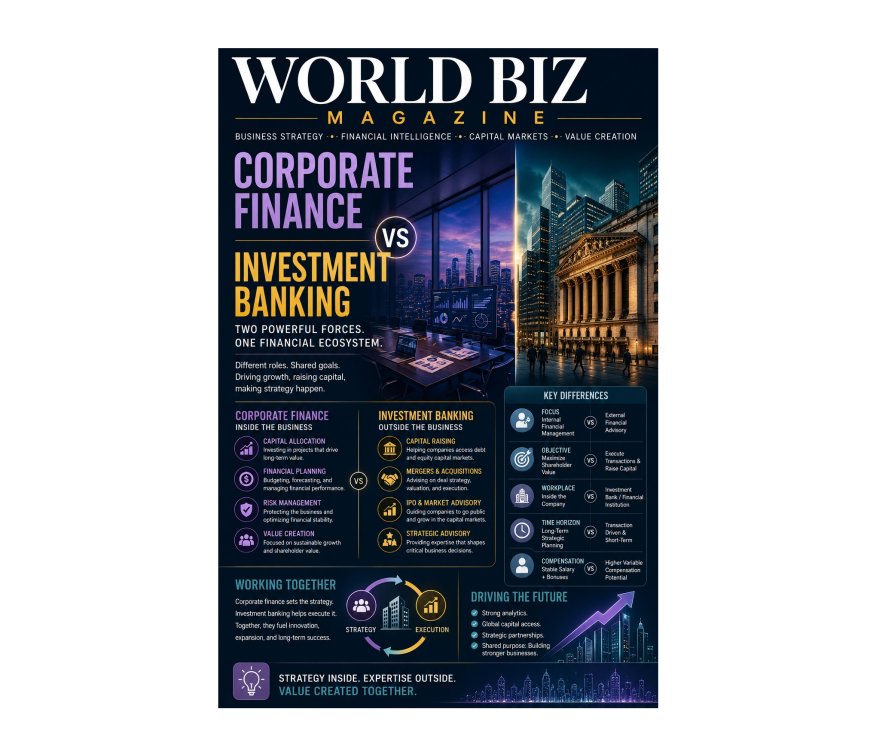
Corporate Finance vs Investment Banking
Understanding the Key Differences, Responsibilities, Career Paths, and Strategic Roles in Modern Business Finance
World Biz Magazine | Corporate Finance Intelligence | Investment Banking Analysis
Two Pillars of the Financial World
In the world of business and finance, few fields are as influential as Corporate Finance and Investment Banking. Both disciplines play critical roles in capital allocation, business growth, mergers and acquisitions, fundraising, and strategic decision-making. Because they frequently interact with one another and share many financial concepts, they are often misunderstood as being the same profession.
In reality, corporate finance and investment banking serve different purposes within the broader financial ecosystem. Corporate finance focuses on managing a company's financial resources from within the organization, while investment banking primarily advises external clients on capital raising, mergers and acquisitions, restructurings, and strategic transactions.
Corporate finance professionals work inside companies, helping management allocate capital, optimize financial performance, manage risks, and create long-term shareholder value. Investment bankers, on the other hand, typically work for financial institutions that provide advisory services to corporations, governments, investors, and organizations seeking access to capital markets or strategic transaction expertise.
Both fields require strong analytical skills, financial modeling capabilities, strategic thinking, and a deep understanding of markets and business operations. However, their objectives, responsibilities, work environments, compensation structures, and career paths differ significantly.
Understanding these differences is essential for business leaders, investors, students, finance professionals, and entrepreneurs seeking to navigate the complex world of corporate finance and capital markets.
What Is Corporate Finance?
Corporate finance refers to the financial management function within a company.
Its primary goal is: Maximizing shareholder value through effective financial decision-making.
Corporate finance teams are responsible for:
- Capital allocation
- Budgeting
- Forecasting
- Financial planning
- Cash flow management
- Risk management
- Investment evaluation
They help organizations determine how financial resources should be used to support long-term growth and profitability.
Corporate finance operates from inside the company.
What Is Investment Banking?
Investment banking is a specialized financial services industry focused on advising clients regarding major financial transactions.
Investment banks assist with:
- Capital raising
- Initial public offerings (IPOs)
- Mergers and acquisitions (M&A)
- Debt issuance
- Corporate restructuring
- Strategic advisory services
Investment bankers work primarily for financial institutions rather than operating companies.
They serve external clients seeking financial expertise and market access.
The Fundamental Difference
The simplest distinction is:
Corporate Finance
· Manages a company's finances internally.
Investment Banking
· Advises companies on financial transactions externally.
· Corporate finance professionals help make financial decisions.
· Investment bankers help facilitate financial transactions.
· While their activities often overlap, their perspectives are different.
Corporate Finance: An Internal Function
Corporate finance departments focus on improving business performance.
Their responsibilities include:
- Evaluating projects
- Managing budgets
- Controlling costs
- Optimizing capital structures
- Supporting strategic planning
They work closely with:
- CEOs
- CFOs
- Business unit leaders
- Operations teams
Their primary responsibility is supporting the company's long-term objectives.
Investment Banking: An Advisory Function
Investment bankers act as external advisors.
They help clients:
- Raise capital
- Execute acquisitions
- Sell businesses
- Enter public markets
- Restructure operations
Their role is transaction-focused rather than operational.
Investment bankers typically work with:
- Corporate executives
- Institutional investors
- Private equity firms
- Governments
Their expertise lies in executing complex financial transactions.
Corporate Finance Objectives
Corporate finance aims to:
- Increase profitability
- Improve efficiency
- Support growth
- Manage risks
- Maximize shareholder value
The focus is long-term value creation.
Corporate finance professionals continuously evaluate opportunities to improve business performance.
Investment Banking Objectives
Investment banking focuses on:
- Facilitating transactions
- Providing strategic advice
- Generating financing solutions
- Connecting companies with investors
Success is often measured by transaction completion and advisory outcomes.
Investment bankers play a crucial role in capital markets.
Capital Budgeting vs Deal Execution
One major difference involves how each field approaches investments.
Corporate Finance
Evaluates whether investments should occur.
Examples include:
- Building factories
- Expanding operations
- Launching products
Investment Banking
· Helps execute financing or acquisition transactions once decisions are made.
· Investment bankers focus on transaction structure rather than operational implementation.
Capital Structure Responsibilities
Both disciplines are involved in financing decisions.
Corporate Finance Teams
Determine the optimal mix of:
- Debt
- Equity
- Retained earnings
Investment Bankers
Help raise the capital needed through:
- Bond offerings
- Stock issuances
- Private placements
Corporate finance determines financing strategy.
Investment banking executes financing transactions.
Working Capital Management
Working capital management is primarily a corporate finance responsibility.
It includes managing:
- Cash
- Inventory
- Receivables
- Payables
The objective is maintaining liquidity and operational efficiency.
Investment bankers generally do not manage day-to-day company finances.
Mergers and Acquisitions (M&A)
M&A activity represents one of the most important areas where corporate finance and investment banking intersect.
Corporate Finance Teams
Evaluate strategic rationale.
Questions include:
- Does the acquisition fit company objectives?
- Will it create value?
- What risks exist?
Investment Bankers
Provide transaction expertise.
Responsibilities include:
- Valuation analysis
- Deal structuring
- Negotiation support
- Financing arrangements
Both functions collaborate closely during major acquisitions.
Initial Public Offerings (IPOs)
When companies go public:
Corporate Finance Teams
Prepare the organization financially.
Investment Bankers
Lead the IPO process.
Responsibilities include:
- Underwriting shares
- Marketing securities
- Pricing offerings
- Coordinating investor communications
Investment banks serve as intermediaries between companies and capital markets.
Financial Modeling
Both professions rely heavily on financial modeling.
Models may include:
- Valuation models
- Forecasting models
- Cash flow projections
- Scenario analyses
However, the purpose differs.
Corporate finance models support internal decisions.
Investment banking models support transactions and advisory services.
Corporate Finance Career Paths
Typical corporate finance roles include:
Financial Analyst
Supports budgeting and planning.
Finance Manager
Oversees departmental financial operations.
Director of Finance
Leads financial strategy.
Chief Financial Officer (CFO)
Responsible for overall financial leadership.
Corporate finance careers often progress within operating companies.
Investment Banking Career Paths
Investment banking careers generally follow a structured hierarchy.
Analyst
Performs financial modeling and research.
Associate
Manages transactions and client support.
Vice President
Oversees deal execution.
Director
Develops client relationships.
Managing Director
Leads business development and major transactions.
Career progression often centers around advisory expertise and revenue generation.
Compensation Differences
Investment banking is generally associated with higher compensation.
Reasons include:
- Transaction-based revenue
- Performance bonuses
- Intense workloads
Corporate finance compensation tends to be:
- More stable
- Less volatile
- More closely linked to company performance
Both fields offer attractive long-term earning potential.
Work-Life Balance
One of the most discussed differences involves workload.
Corporate Finance
Typically offers:
- More predictable schedules
- Better work-life balance
- Long-term planning focus
Investment Banking
Often involves:
- Extended working hours
- High-pressure deadlines
- Transaction-driven workloads
Work-life considerations frequently influence career decisions.
Skill Requirements
Both professions require:
- Financial analysis
- Accounting knowledge
- Excel proficiency
- Business understanding
Investment banking additionally emphasizes:
- Transaction execution
- Valuation expertise
- Capital market knowledge
Corporate finance emphasizes:
- Strategic planning
- Operational understanding
- Financial management
Skill overlap remains significant.
Technology and Digital Transformation
Technology is reshaping both fields.
Key developments include:
- Artificial intelligence
- Automation
- Advanced analytics
- Cloud-based financial systems
Technology improves:
- Forecasting accuracy
- Financial reporting
- Transaction efficiency
Digital transformation continues changing financial operations worldwide.
Which Career Is Better?
There is no universally superior option.
Corporate finance may appeal to those seeking:
- Long-term strategic involvement
- Operational impact
- Balanced lifestyles
Investment banking may appeal to individuals seeking:
- High compensation
- Transaction exposure
- Capital market experience
The best choice depends on personal interests, career goals, and professional preferences.
How Corporate Finance and Investment Banking Work Together
Despite their differences, these fields are highly interconnected.
Corporate finance teams frequently engage investment banks for:
- IPOs
- Bond offerings
- Acquisitions
- Strategic transactions
Investment banks provide expertise that complements internal financial management.
Together, they help businesses access capital, execute transactions, and create value.
The Future of Both Industries
Several trends are shaping future development.
Artificial Intelligence
Improving financial analysis and forecasting.
Globalization
Increasing cross-border transaction activity.
Data Analytics
Enhancing decision-making capabilities.
Alternative Capital Sources
Expanding financing options beyond traditional markets.
Both corporate finance and investment banking will continue evolving alongside technological and economic changes.
World Biz Magazine Insights
At World Biz Magazine, we view corporate finance and investment banking as complementary pillars of modern business finance. Corporate finance provides the internal framework for capital allocation, financial planning, and value creation, while investment banking connects businesses with the capital markets and strategic opportunities necessary to execute major financial transactions.
Although they share analytical foundations, their objectives differ significantly. Corporate finance focuses on managing and optimizing a company's financial resources over time, whereas investment banking specializes in facilitating transformational transactions and providing strategic advisory expertise.
As global markets become increasingly interconnected and technology continues reshaping financial services, professionals who understand both disciplines will be better positioned to navigate the evolving world of business finance.
Conclusion
Corporate finance and investment banking are closely related but fundamentally different disciplines. Corporate finance focuses on internal financial management, strategic planning, capital allocation, and long-term value creation. Investment banking focuses on external advisory services, capital raising, mergers and acquisitions, and transaction execution.
Both play essential roles within the global financial ecosystem and frequently collaborate on major corporate initiatives. Understanding their differences provides valuable insight into how businesses finance growth, access capital markets, and create shareholder value in today's complex economic environment.
Disclaimer
This article is published for informational, educational, and editorial purposes only and does not constitute financial, investment, legal, accounting, tax, career, or professional advice. Readers should consult qualified advisors before making financial, investment, or career decisions. World Biz Magazine and its affiliates are not responsible for actions taken based on the information presented in this publication.
What's Your Reaction?
 Like
0
Like
0
 Dislike
0
Dislike
0
 Love
0
Love
0
 Funny
0
Funny
0
 Angry
0
Angry
0
 Sad
0
Sad
0
 Wow
0
Wow
0