












































































































































































































How Equity, Bond, and Currency Markets Drive the Global Economy
Understand the structure, participants, risks, and opportunities within equity, bond, and FX markets worldwide.

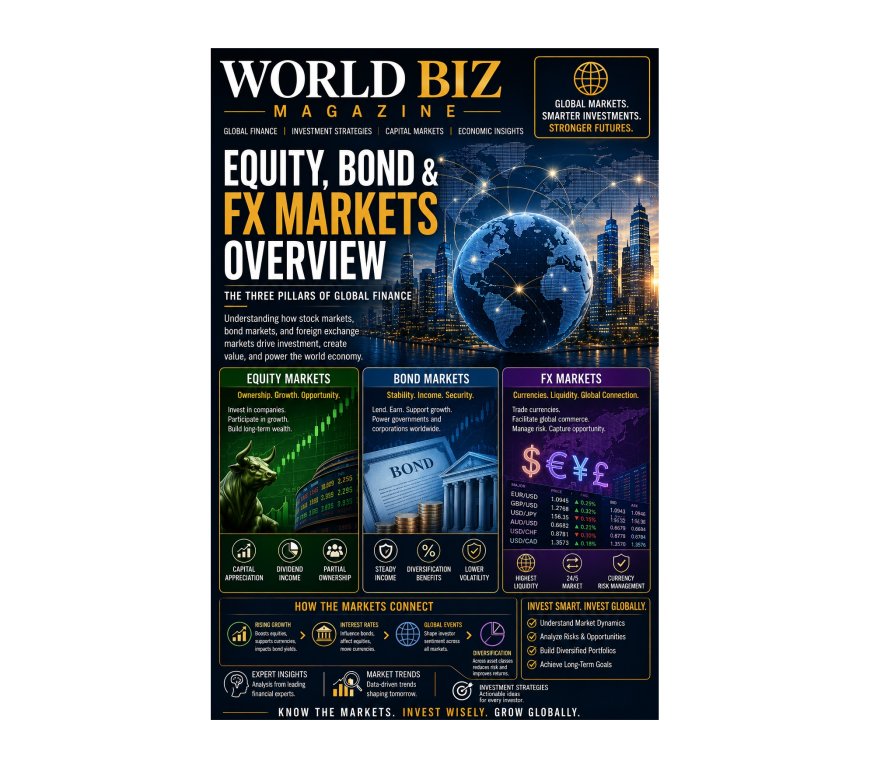
Equity, Bond & FX Markets Overview
Understanding the Three Pillars of Global Financial Markets and Their Role in Investment, Capital Formation, and Economic Growth
World Biz Magazine | Global Finance, Capital Markets & Investment Intelligence
Global financial markets serve as the foundation of modern economic activity, facilitating the movement of capital, supporting investment, enabling international trade, and promoting economic development. Among the numerous segments that comprise the financial system, three markets stand out as particularly influential: equity markets, bond markets, and foreign exchange (FX) markets. Together, these markets form the core infrastructure through which governments raise funding, corporations secure growth capital, investors build wealth, and currencies are exchanged across international borders.
The combined scale of these markets is immense. Global stock markets represent tens of trillions of dollars in listed corporate value. Bond markets have become even larger, providing financing for governments, corporations, and institutions worldwide. Meanwhile, foreign exchange markets process trillions of dollars in daily transactions, making them the largest and most liquid financial markets on earth. The interaction among these markets influences everything from interest rates and currency valuations to investment returns and economic growth.
For investors, understanding how equity, bond, and FX markets function is essential for making informed financial decisions. These markets offer different risk-return characteristics, respond differently to economic conditions, and play distinct roles within diversified investment portfolios. While equity markets are often associated with growth and wealth creation, bond markets provide income generation and capital preservation. Foreign exchange markets facilitate global trade and investment while creating opportunities for currency-based strategies and risk management.
As globalization, technology, and financial innovation continue transforming capital markets, the relationship between equities, bonds, and currencies has become increasingly interconnected. Understanding these relationships is critical for investors, business leaders, policymakers, and financial professionals seeking to navigate today's complex financial landscape.
Understanding Financial Market Structure
Financial markets exist to facilitate the efficient allocation of capital.
Investors provide funds to governments, corporations, and institutions in exchange for financial returns.
The three primary market categories include:
- Equity Markets
- Bond Markets
- Foreign Exchange Markets
Each market performs a unique function while contributing to broader economic development.
Together, they create a comprehensive ecosystem that supports investment, financing, and global commerce.
What Are Equity Markets?
Equity markets, commonly known as stock markets, facilitate the buying and selling of ownership interests in publicly traded companies.
When investors purchase shares, they acquire partial ownership in a business.
Companies issue stock to:
- Raise capital
- Fund expansion
- Finance innovation
- Support acquisitions
- Strengthen balance sheets
Investors participate in the potential growth and profitability of these businesses.
Equity markets remain one of the most important mechanisms for wealth creation worldwide.
How Equity Markets Work
Companies seeking public investment typically issue shares through Initial Public Offerings (IPOs).
Once listed, shares trade on organized exchanges where prices fluctuate based on:
- Corporate performance
- Economic conditions
- Industry trends
- Investor sentiment
- Market expectations
Stock prices reflect collective assessments regarding future earnings and growth potential.
Equity markets operate continuously, allowing investors to buy and sell securities throughout trading sessions.
Major Global Equity Markets
Several exchanges dominate global equity trading.
Key markets include:
- New York Stock Exchange
- Nasdaq
- London Stock Exchange
- Tokyo Stock Exchange
- Shanghai Stock Exchange
These exchanges serve as critical centers of capital formation and investment activity.
Their performance often influences global investor sentiment.
Benefits of Equity Investing
Equities offer several advantages.
These include:
- Long-term capital appreciation
- Dividend income
- Inflation protection
- Ownership participation
- Portfolio growth potential
Historically, equities have delivered some of the highest long-term returns among major asset classes.
However, higher potential returns are generally accompanied by increased volatility.
Investors must balance growth opportunities with risk considerations.
Risks Associated with Equity Markets
Stock investments are subject to numerous risks.
Examples include:
- Market volatility
- Economic downturns
- Industry disruptions
- Corporate failures
- Geopolitical uncertainty
Share prices can fluctuate significantly over short periods.
Successful equity investing often requires long-term discipline and diversified portfolio construction.
Risk management remains essential.
Understanding Bond Markets
Bond markets facilitate debt financing for governments, corporations, and institutions.
Unlike stock investors who acquire ownership, bond investors act as lenders.
Borrowers issue bonds and agree to:
- Pay interest
- Repay principal at maturity
Bond markets play a vital role in funding economic activity worldwide.
They support everything from public infrastructure projects to corporate expansion initiatives.
Types of Bonds
Several categories of bonds exist.
Government Bonds
Issued by national governments to finance public expenditures.
Municipal Bonds
Issued by local governments and public authorities.
Corporate Bonds
Issued by businesses seeking financing.
Agency Bonds
Issued by government-sponsored entities.
International Bonds
Issued in global markets to attract international capital.
Each category offers different risk and return characteristics.
How Bond Prices and Yields Work
Bond values are influenced by interest rates.
When interest rates rise:
- Existing bond prices generally fall.
When interest rates decline:
- Existing bond prices often rise.
Bond yields represent the return investors earn based on market pricing.
Yield movements serve as important indicators of:
- Inflation expectations
- Economic conditions
- Monetary policy outlooks
Bond markets are closely monitored by investors and policymakers alike.
Why Bond Markets Matter
Bond markets provide stability within financial systems.
They help:
- Finance governments
- Support corporate borrowing
- Establish benchmark interest rates
- Facilitate capital allocation
Many institutional investors rely on bonds for predictable income streams and risk management purposes.
Bond markets often become particularly important during periods of economic uncertainty.
Bond Market Risks
Although generally considered less volatile than equities, bonds involve risks.
Examples include:
- Interest rate risk
- Credit risk
- Inflation risk
- Liquidity risk
- Default risk
Investors must evaluate bond quality and duration carefully.
Risk assessment remains critical within fixed-income investing.
Understanding Foreign Exchange (FX) Markets
Foreign exchange markets facilitate the exchange of currencies between participants.
The FX market enables:
- International trade
- Cross-border investment
- Tourism
- Currency hedging
It is the largest financial market globally.
Daily trading volumes exceed those of all major stock exchanges combined.
The market operates continuously across global time zones.
How FX Markets Work
Currencies are traded in pairs.
Examples include:
- EUR/USD
- GBP/USD
- USD/JPY
- USD/CNY
Exchange rates fluctuate based on:
- Economic conditions
- Interest rates
- Inflation
- Trade balances
- Political developments
Currency values reflect market expectations regarding future economic performance.
FX markets play a crucial role in global commerce.
Major Participants in FX Markets
Foreign exchange markets involve a diverse range of participants.
These include:
- Central banks
- Commercial banks
- Corporations
- Hedge funds
- Asset managers
- Governments
- Retail traders
Institutional participants account for the majority of global trading activity.
The scale and liquidity of FX markets make them highly efficient.
The Importance of Currency Markets
Currencies influence international competitiveness and investment flows.
Exchange rate movements affect:
- Export performance
- Import costs
- Corporate earnings
- Inflation levels
- Foreign investment returns
For multinational businesses, effective currency risk management is essential.
Foreign exchange markets support global economic integration.
Relationship Between Equity, Bond, and FX Markets
These markets do not operate independently.
Movements in one market frequently influence others.
Examples include:
Rising Interest Rates
May strengthen currencies while placing pressure on bonds and equities.
Economic Growth
Often supports stock market performance and currency strength.
Recession Concerns
May increase demand for government bonds while reducing risk appetite.
Understanding market interconnections is important for investors and policymakers.
Cross-market analysis improves decision-making.
Central Banks and Market Influence
Central banks play a major role across all three markets.
Their responsibilities include:
- Interest rate management
- Inflation control
- Financial stability
- Currency oversight
Major institutions include:
- Federal Reserve System
- European Central Bank
- Bank of England
- Bank of Japan
Policy decisions often trigger significant market reactions.
Investors closely monitor central bank communications.
Technology and Market Evolution
Technology has transformed financial markets.
Major innovations include:
- Electronic trading
- Algorithmic execution
- Artificial intelligence
- Real-time analytics
- Digital investment platforms
These advancements have increased accessibility, transparency, and efficiency.
Technology continues reshaping how investors interact with markets.
Emerging Trends Across Financial Markets
Several trends are influencing future market development.
These include:
- Sustainable investing (ESG)
- FinTech innovation
- Digital assets
- AI-powered analytics
- Cross-border investing
- Tokenization of assets
Financial markets continue evolving in response to technological and economic changes.
Innovation remains a powerful growth driver.
Investment Strategy and Asset Allocation
Most diversified portfolios include exposure to equities, bonds, and currencies either directly or indirectly.
Each asset class contributes differently:
Equities
Growth and wealth creation.
Bonds
Income and stability.
FX Exposure
Diversification and international opportunity.
Effective asset allocation balances risk and return objectives.
Professional investors often adjust allocations based on economic conditions and market outlooks.
The Future of Global Capital Markets
Future financial markets are expected to become increasingly digital, automated, and globally interconnected.
Key developments may include:
- Real-time settlement systems
- AI-driven investing
- Enhanced global integration
- Digital currencies
- Expanded market accessibility
Despite technological change, the fundamental roles of equity, bond, and FX markets will remain essential.
These markets will continue facilitating capital formation, investment, and economic growth.
World Biz Magazine Insights
Equity, bond, and foreign exchange markets collectively form the foundation of the global financial system. While each market serves a unique purpose, their interactions shape investment opportunities, financing conditions, economic growth, and wealth creation worldwide. Understanding how these markets operate and how they influence one another is critical for investors, corporations, governments, and policymakers navigating today's increasingly interconnected economy. As technology, globalization, and financial innovation continue transforming capital markets, the ability to interpret cross-market dynamics will become an increasingly valuable strategic advantage.
Conclusion
Equity, bond, and FX markets represent the three pillars of global finance, supporting capital formation, investment activity, and international economic integration. Equity markets provide ownership-based growth opportunities, bond markets offer financing and income generation, and FX markets facilitate global commerce and currency exchange.
Together, these markets create a dynamic ecosystem that enables businesses to expand, governments to fund development, and investors to pursue financial objectives. Understanding their structure, functions, risks, and interrelationships is essential for making informed investment decisions and interpreting broader economic trends.
Ultimately, the continued evolution of equity, bond, and FX markets will play a defining role in shaping the future of global finance and economic prosperity.
Disclaimer
This article is published for informational, educational, and industry analysis purposes only and does not constitute financial, investment, legal, tax, regulatory, or professional advice. Financial markets involve risks, including potential loss of capital. Readers should consult qualified financial professionals before making investment or financial decisions.
What's Your Reaction?
 Like
1
Like
1
 Dislike
0
Dislike
0
 Love
0
Love
0
 Funny
0
Funny
0
 Angry
0
Angry
0
 Sad
0
Sad
0
 Wow
1
Wow
1