




























































































































































































Exit via REIT Conversion: Unlocking Liquidity in Large Property Portfolios
Understand how REITs provide an alternative exit strategy for developers and real estate funds seeking liquidity, capital efficiency, and scalable growth.

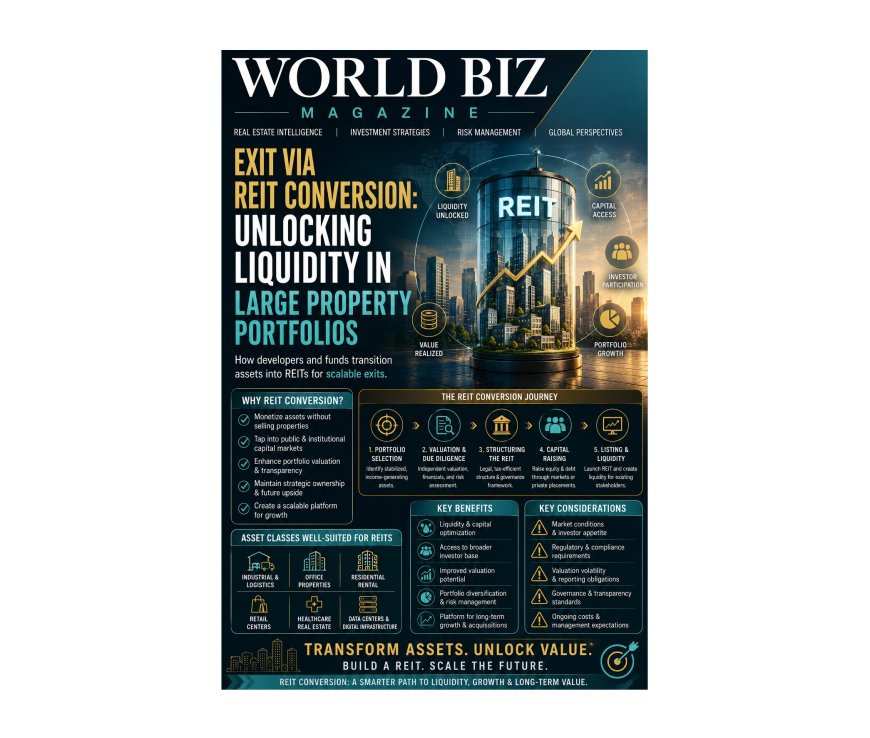
Exit via REIT Conversion: Unlocking Liquidity in Large Property Portfolios
How Developers, Institutional Investors, and Private Funds Transform Real Estate Assets into REITs for Scalable Exits and Long-Term Value Creation
World Biz Magazine | Real Estate & Investment
For decades, real estate investors have faced a fundamental challenge: how to unlock value from large property portfolios without sacrificing operational control, triggering inefficient asset sales, or limiting future growth potential. While direct property sales remain a common exit strategy, large-scale developers, institutional investors, sovereign wealth funds, and private equity real estate firms increasingly pursue an alternative approach Real Estate Investment Trust (REIT) conversion.
REIT conversion has emerged as one of the most sophisticated capital recycling and liquidity strategies in global real estate markets. Rather than selling individual properties one by one, investors package income-generating assets into a professionally managed investment vehicle that can access public or private capital markets. This process enables property owners to monetize significant portions of portfolio value while maintaining strategic exposure to future asset appreciation and recurring income streams.
Across major global markets, REIT structures have become powerful tools for unlocking trapped capital in commercial real estate, logistics facilities, industrial assets, data centers, hospitality portfolios, healthcare properties, retail centers, residential developments, and infrastructure-related assets. As investors seek greater liquidity, portfolio scalability, and capital efficiency, REIT conversions are playing an increasingly important role in modern real estate investment strategies.
This article explores how REIT conversions work, why they have become popular among developers and investment funds, and how they create scalable exit opportunities for large property portfolios.
Understanding REITs
A Real Estate Investment Trust (REIT) is a company that owns, operates, finances, or manages income-producing real estate assets.
REITs allow investors to gain exposure to professionally managed property portfolios while benefiting from:
- Regular dividend distributions
- Portfolio diversification
- Professional management
- Capital market access
- Enhanced liquidity
REITs are now established across major markets including:
- United States
- United Kingdom
- Singapore
- Japan
- Australia
- Canada
- Hong Kong
- United Arab Emirates
- Saudi Arabia
- India
- European Union markets
Globally, REITs represent trillions of dollars in real estate assets.
Why Large Property Portfolios Face Liquidity Challenges
Real estate remains one of the least liquid major asset classes.
Large property owners often face challenges when attempting to monetize assets.
These include:
- Limited buyer pools
- Lengthy transaction timelines
- Market timing risks
- Valuation uncertainty
- Regulatory complexity
- Capital concentration
Selling individual properties may require years to complete, particularly during weak market conditions.
REIT conversion offers an alternative path to liquidity.
What Is REIT Conversion?
REIT conversion refers to the process of transferring eligible income-producing real estate assets into a REIT structure.
Rather than selling properties directly to third parties, owners place assets into a REIT and monetize ownership through:
- Public listings
- Private placements
- Institutional investments
- Secondary share sales
This approach transforms illiquid real estate holdings into securities that can potentially be traded or transferred more efficiently.
The result is improved capital flexibility and broader investor participation.
Why Developers Use REIT Conversions
Property developers frequently accumulate large portfolios of stabilized assets.
Examples include:
- Office buildings
- Shopping centers
- Warehouses
- Residential rental portfolios
- Hotels
- Healthcare facilities
Holding these assets indefinitely may restrict capital availability for future development projects.
By converting stabilized assets into REITs, developers can:
- Unlock capital
- Reduce balance sheet pressure
- Fund new developments
- Improve return on equity
- Maintain strategic ownership stakes
The strategy enables developers to recycle capital without completely exiting underlying assets.
Why Private Equity Real Estate Funds Use REIT Structures
Private equity funds typically operate within defined investment timelines.
Eventually, fund managers must generate liquidity events for investors.
Traditional exits include:
- Asset sales
- Portfolio sales
- Strategic acquisitions
- Mergers
REIT conversion provides another option.
Benefits include:
- Enhanced valuation potential
- Broader investor access
- Institutional capital attraction
- Improved liquidity
- Scalable portfolio growth
For large portfolios, REIT listings may create greater value than piecemeal asset sales.
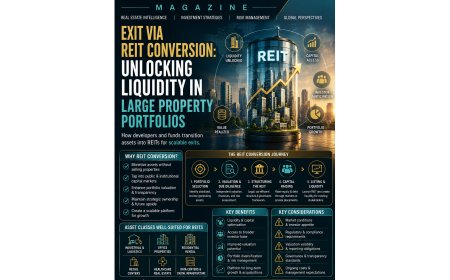
The REIT Conversion Process
Converting a property portfolio into a REIT involves several stages.
Portfolio Selection
Assets must generally possess:
- Stable income streams
- Strong occupancy rates
- Predictable cash flows
- High-quality tenants
- Institutional-grade management
Investors carefully evaluate portfolio composition before proceeding.
Asset Valuation
Independent valuation firms assess:
- Market value
- Income performance
- Future cash flow projections
- Asset quality
- Market positioning
Valuation accuracy is critical for investor confidence.
Corporate Structuring
Specialized legal and financial structures are established.
These may involve:
- Property holding companies
- Trust arrangements
- Tax optimization frameworks
- Governance systems
Regulatory compliance requirements vary across jurisdictions.
Capital Raising
The REIT may raise capital through:
- Initial Public Offerings (IPOs)
- Institutional placements
- Private fundraising
- Strategic partnerships
Capital raised can be distributed to original owners or reinvested for growth.
Public Listing or Private REIT Launch
The final stage involves launching the REIT.
Investors gain access to the underlying property portfolio through shares or units rather than direct property ownership.
Benefits of REIT Conversion
REIT conversion offers several advantages.
Liquidity Creation
Perhaps the most significant benefit is improved liquidity.
Investors can monetize holdings without requiring full property sales.
This flexibility often increases portfolio efficiency.
Access to Capital Markets
REITs can access:
- Equity capital
- Debt financing
- Institutional investors
- Global capital pools
Access to capital often supports future expansion.
Valuation Enhancement
Public markets may assign premium valuations to high-quality REITs due to:
- Transparency
- Diversification
- Governance standards
- Growth prospects
This can generate additional value for sponsors.
Portfolio Scalability
REITs provide a platform for continued acquisitions and expansion.
Assets can be added over time, supporting long-term growth strategies.
Risk Diversification
Diversified portfolios often reduce asset-specific risk.
Investors gain exposure across multiple properties, locations, and tenant groups.
Asset Classes Most Suitable for REIT Conversion
Certain sectors are particularly well-suited for REIT structures.
Industrial and Logistics
Strong demand driven by e-commerce and supply chain growth.
Office Properties
Institutional-grade office assets remain popular in certain markets.
Residential Rental Portfolios
Multifamily housing generates predictable recurring income.
Retail Centers
High-performing retail assets often attract REIT investors.
Hospitality Properties
Hotels and resorts may be packaged into specialized hospitality REITs.
Healthcare Real Estate
Hospitals, clinics, senior housing, and medical facilities are increasingly represented in REIT markets.
Data Centers
One of the fastest-growing REIT sectors globally.
Demand continues to increase due to cloud computing and artificial intelligence infrastructure.
Risks and Challenges of REIT Conversion
Despite its advantages, REIT conversion involves challenges.
Market Conditions
Weak capital markets may reduce investor demand.
Poor market timing can impact valuations.
Regulatory Complexity
Compliance requirements vary significantly across jurisdictions.
Legal and reporting obligations can be substantial.
Governance Requirements
Public REITs require higher levels of transparency and accountability.
Sponsors must adapt to institutional governance standards.
Valuation Volatility
Public market sentiment may influence REIT valuations independently of underlying property performance.
Investor Expectations
Public investors often expect:
- Consistent dividends
- Strong governance
- Portfolio growth
- Transparent reporting
Meeting these expectations requires disciplined management.
Global Growth of REIT Markets
The REIT industry continues expanding worldwide.
Growth drivers include:
- Institutional investment demand
- Retirement fund allocations
- Real estate securitization
- Urbanization
- Infrastructure development
- Digital economy expansion
Emerging markets increasingly view REIT frameworks as tools for attracting capital and improving market transparency.
The Future of REIT-Based Exits
Several trends are shaping the future of REIT conversions.
These include:
- Data center REIT growth
- Logistics and industrial expansion
- Infrastructure REITs
- Sustainable real estate portfolios
- ESG-focused investment vehicles
- Digital asset management platforms
- Cross-border REIT investment
As capital markets evolve, REIT conversions may become even more important as a liquidity solution for large-scale property owners.
World Biz Magazine Insights
The evolution of REIT markets has fundamentally changed how real estate investors think about exits. What was once a binary decision between holding assets and selling them outright has evolved into a more sophisticated capital strategy. REIT conversion allows investors to unlock liquidity, access public markets, recycle capital, and maintain exposure to future growth simultaneously. For developers, private equity funds, and institutional owners managing large portfolios, REITs increasingly represent not merely an exit mechanism but a platform for long-term value creation and scalable growth.
Conclusion
REIT conversion has become one of the most effective tools for unlocking liquidity in large real estate portfolios. By transforming income-producing assets into investable securities, property owners can access broader capital markets, enhance liquidity, improve portfolio scalability, and optimize capital allocation strategies.
For developers seeking growth capital, private equity funds pursuing liquidity events, and institutional investors aiming to maximize portfolio value, REIT conversion offers a compelling alternative to traditional asset sales. As global real estate markets continue to mature and investor demand for income-producing assets grows, REIT-based exits are likely to play an increasingly important role in the future of real estate investment and capital formation.
Disclaimer
This article is published for informational, educational, and industry analysis purposes only and does not constitute investment, financial, legal, tax, securities, or professional advice. REIT structures, regulations, tax treatment, and listing requirements vary by jurisdiction and may change over time. Investors, developers, and fund managers should consult qualified legal advisors, tax specialists, investment bankers, financial professionals, and regulatory authorities before undertaking REIT conversions, capital market transactions, or investment decisions.
What's Your Reaction?
 Like
0
Like
0
 Dislike
0
Dislike
0
 Love
0
Love
0
 Funny
0
Funny
0
 Angry
0
Angry
0
 Sad
0
Sad
0
 Wow
0
Wow
0