







































































































































































The Future of Property Valuation: CMA Standards, Risks & Technology
A detailed analysis of CMA methodologies, valuation risks, AI integration, and property market transparency worldwide.

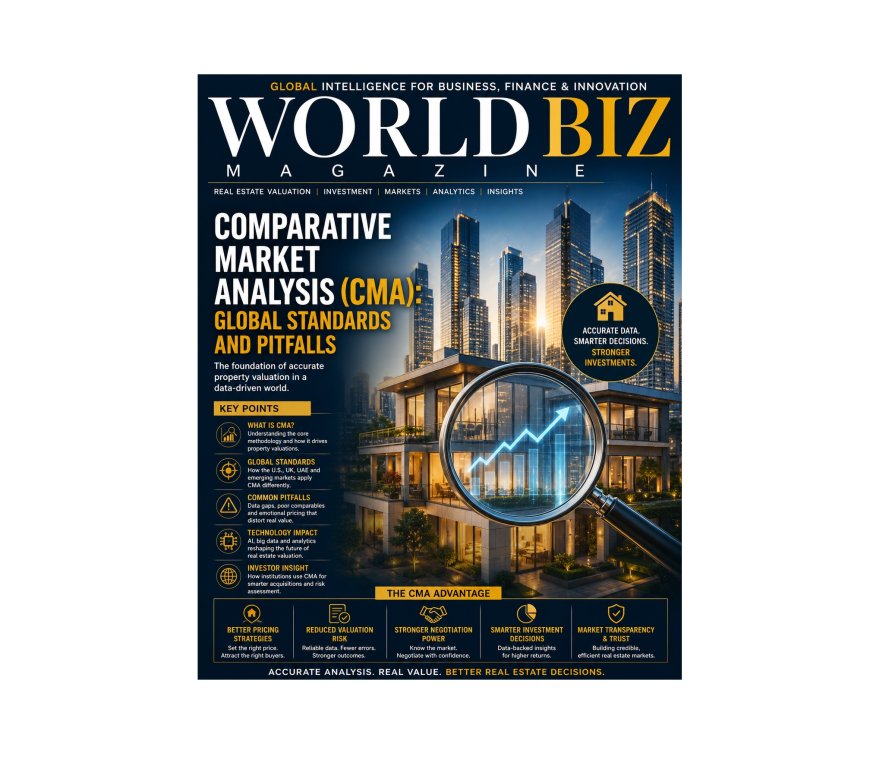
Comparative Market Analysis (CMA): Global Standards and Pitfalls
The Critical Role of Data Accuracy, Market Intelligence, and Valuation Discipline in Modern Real Estate
How Comparative Market Analysis became a global real estate valuation standard and why flawed methodologies continue to distort property pricing worldwide
World Biz Magazine | Real Estate Valuation, Investment & Global Property Intelligence
The Foundation of Modern Property Valuation
In global real estate markets, few valuation tools are as widely used or as misunderstood as Comparative Market Analysis (CMA).
From residential housing transactions to institutional property investments, CMA serves as a cornerstone for:
- Property pricing
- Investment analysis
- Mortgage lending
- Asset valuation
- Brokerage negotiations
Yet despite its widespread adoption, CMA remains vulnerable to significant inconsistencies, data manipulation, and market distortion.
In an increasingly data-driven property economy, the accuracy of comparative analysis can influence billions in investment decisions.
What is Comparative Market Analysis (CMA)?
Comparative Market Analysis is a valuation methodology used to estimate a property’s market value by comparing it to similar recently sold properties commonly called “comparables” or “comps.”
The process evaluates:
- Location
- Property size
- Condition
- Features
- Market timing
- Local demand dynamics
Unlike formal appraisals, CMAs are often prepared by:
- Real estate agents
- Brokers
- Property consultants
- Investment analysts
Why CMA Matters in Global Real Estate
CMA influences nearly every stage of the property transaction ecosystem.
Key Applications:
- Listing price determination
- Buyer negotiation strategies
- Mortgage underwriting
- Rental pricing analysis
- Portfolio valuation
- Institutional acquisition decisions
In major markets like Dubai, London, New York City, and Singapore, CMA methodologies increasingly rely on AI-powered analytics and large-scale transaction databases.
The Core Components of a CMA
Comparable Property Selection
The foundation of a reliable CMA lies in selecting accurate comparable properties.
Ideal Comparables Share:
- Similar location
- Comparable square footage
- Similar age and condition
- Similar amenities
- Similar property type
Time Relevance Matters
Most professional valuation standards prioritize sales within:
- 3-6 months in stable markets
- 30-90 days in volatile markets
Market Trend Adjustments
No two properties are perfectly identical.
Adjustments are applied for:
- Renovations
- View premiums
- Parking availability
- Floor level
- Smart home technology
- Sustainability features
Supply & Demand Dynamics
CMA is not purely mathematical.
Macroeconomic conditions influence pricing:
- Interest rates
- Inflation
- Foreign investment flows
- Regulatory changes
- Population growth
Hyperlocal Market Conditions
Real estate valuation is intensely local.
Even within the same city:
- Street-level desirability changes value
- School districts impact residential pricing
- Commercial zoning alters land value
Global Standards in Comparative Market Analysis
United States: MLS-Driven Standardization
The United States maintains one of the world’s most structured CMA systems through:
- Multiple Listing Services (MLS)
- Licensed appraisal frameworks
- Extensive transaction transparency
Advantages:
- Large comparable datasets
- Digital accessibility
- Market transparency
Challenges:
- Regional fragmentation
- Overreliance on algorithmic estimates
United Kingdom: Surveyor-Led Valuation Culture
The United Kingdom relies heavily on regulated surveyors and formal valuation standards.
Organizations like Royal Institution of Chartered Surveyors (RICS) establish global best practices.
Strengths:
- Strong professional oversight
- International valuation consistency
- High regulatory credibility
UAE: Rapidly Evolving Data-Driven Models
The United Arab Emirates has rapidly modernized valuation systems.
Key drivers include:
- Government transparency initiatives
- Smart city infrastructure
- Digital transaction platforms
Dubai’s property ecosystem increasingly integrates:
- AI valuation tools
- Blockchain registries
- Real-time market analytics
Emerging Markets: The Data Transparency Challenge
Many emerging markets face persistent CMA challenges:
- Limited transaction transparency
- Informal property sectors
- Weak regulatory oversight
- Manual valuation systems
Result:
Property pricing can become speculative rather than evidence-based.
Major Pitfalls in Comparative Market Analysis
Poor Comparable Selection
One of the most common valuation failures.
Examples include:
- Comparing different neighborhoods
- Ignoring building quality differences
- Using outdated transactions
Emotional Pricing Distortion
Sellers often overestimate value due to:
- Emotional attachment
- Renovation overvaluation
- Unrealistic expectations
Market Volatility
In rapidly changing markets, yesterday’s prices may no longer reflect current demand.
This became highly visible during:
- COVID-era housing booms
- Interest rate shocks
- Commercial real estate downturns
Algorithmic Overdependence
AI-powered valuation systems are expanding globally.
However:
- Algorithms struggle with unique properties
- Data gaps create inaccuracies
- Automated estimates can amplify market bubbles
Lack of Transparency
In many countries:
- Real transaction values are hidden
- Cash deals distort pricing
- Regulatory data is incomplete
This weakens CMA reliability.
Technology Transforming CMA
AI & Predictive Analytics
Modern valuation platforms now integrate:
- Machine learning
- Geospatial analytics
- Behavioral market forecasting
Big Data Integration
Advanced CMA systems analyze:
- Demographics
- Infrastructure projects
- Rental yields
- Traffic patterns
- Climate risk
Blockchain & Smart Registries
Some governments are exploring blockchain-based land registries to improve:
- Transaction transparency
- Fraud prevention
- Ownership verification
Institutional Investors and CMA
For institutional investors, CMA is no longer a simple pricing tool it is part of a broader risk intelligence system.
Private equity firms, REITs, and sovereign investors increasingly combine:
- CMA data
- Macroeconomic modeling
- ESG scoring
- Predictive urbanization analytics
This transforms valuation into strategic forecasting.
World Biz Magazine Insights
WBJ Insight 01 - Data Transparency Determines Market Efficiency
The strongest real estate markets are not always the largest they are the most transparent.
WBJ Insight 02 - AI Will Not Replace Human Judgment
Technology enhances valuation efficiency, but local expertise remains irreplaceable.
WBJ Insight 03 - Emerging Markets Face the Largest Valuation Gap
Weak transaction reporting creates systemic pricing inefficiencies.
WBJ Insight 04 - CMA Is Becoming a Strategic Investment Tool
Institutional investors now use comparative analysis for predictive capital allocation not just pricing.
WBJ Insight 05 - Regulation Will Shape Valuation Credibility
Global property markets increasingly depend on standardized valuation frameworks and data governance.
The Future of Comparative Market Analysis
The next generation of CMA will likely include:
- Real-time valuation engines
- AI-driven predictive pricing
- Satellite and geospatial analysis
- Smart contract integration
- ESG-adjusted property scoring
Real estate valuation is evolving from static comparison toward dynamic intelligence ecosystems.
Conclusion
Comparative Market Analysis remains one of the most essential tools in global real estate but its reliability depends entirely on data quality, methodology discipline, and market transparency.
As property markets become increasingly digitized and interconnected, the future of valuation will belong to systems that combine:
- Human expertise
- Regulatory integrity
- Advanced analytics
- Transparent transaction ecosystems
In modern real estate, valuation accuracy is no longer just a pricing issue it is a foundation of economic trust.
Disclaimer
This article is intended for informational and editorial purposes only and does not constitute financial, investment, legal, appraisal, or real estate advice. Property valuations vary by market conditions, methodology, and jurisdiction. Readers should consult licensed professionals before making investment or valuation decisions.
What's Your Reaction?
 Like
0
Like
0
 Dislike
0
Dislike
0
 Love
0
Love
0
 Funny
0
Funny
0
 Angry
0
Angry
0
 Sad
0
Sad
0
 Wow
0
Wow
0