



































































































































































































Sustainability Technology and the Rise of the Green Economy
A detailed analysis of sustainability technology, climate innovation, renewable systems, ESG investing, and intelligent environmental infrastructure.

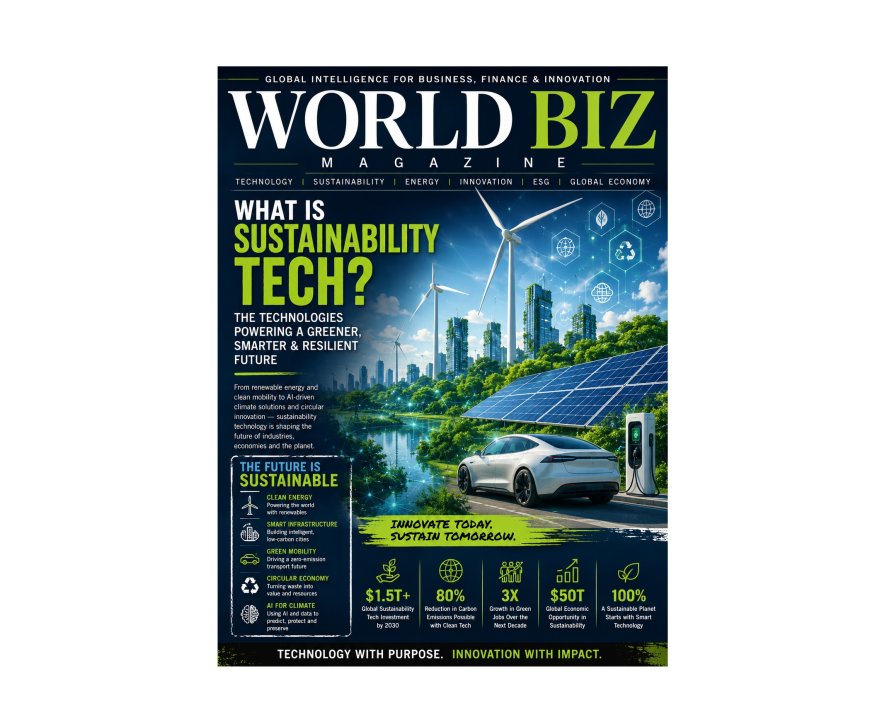
What Is Sustainability Tech?
How Green Innovation, Clean Technologies, and Intelligent Infrastructure Are Reshaping the Future Global Economy
From renewable energy systems and carbon-reduction platforms to AI-powered climate infrastructure and circular economy technologies, sustainability tech is becoming one of the fastest-growing sectors in the modern innovation economy
World Biz Magazine | Sustainability, Green Innovation & Global Technology Intelligence
The Rise of the Sustainability Economy
The global economy is entering one of the most significant industrial transitions since the rise of the digital age.
For decades, economic growth largely depended on industrial expansion powered by fossil fuels, mass manufacturing systems, large-scale extraction industries, and resource-intensive infrastructure. While this model accelerated global development, it also created mounting environmental and economic pressures involving:
- Climate change
- Carbon emissions
- Energy instability
- Resource depletion
- Pollution
- Water scarcity
- Supply chain vulnerability
- Biodiversity decline
At the same time, businesses, governments, investors, and consumers are increasingly recognizing that long-term economic growth may no longer be sustainable without large-scale environmental transformation.
This realization is driving the rapid rise of:
Sustainability technology.
Sustainability tech often called sustainable technology, climate tech, or green technology refers to innovations designed to reduce environmental impact while improving economic efficiency, operational resilience, and long-term sustainability.
The sector has expanded rapidly across:
- Renewable energy
- Electric mobility
- Smart infrastructure
- Sustainable manufacturing
- AI-powered energy systems
- Carbon management
- Water technology
- Circular economy platforms
- Green construction
- Agricultural innovation
Today, sustainability technology is no longer considered a niche environmental movement.
It is increasingly viewed as:
Strategic economic infrastructure for the future global economy.
Between 2025 and 2035, sustainability tech may become one of the largest investment, innovation, and industrial transformation sectors worldwide.
Understanding Sustainability Technology
Sustainability technology refers to systems, products, services, and infrastructure designed to support environmentally responsible and resource-efficient economic activity.
The core objective of sustainability tech is balancing:
- Economic growth
- Environmental protection
- Long-term resource stability
- Social resilience
Unlike traditional industrial models focused primarily on short-term output, sustainability technologies increasingly emphasize:
- Energy efficiency
- Carbon reduction
- Waste minimization
- Resource optimization
- Circular production systems
- Environmental resilience
These technologies aim to reduce ecological impact while maintaining or improving operational performance.
Sustainability technology increasingly intersects with:
- Artificial intelligence
- Robotics
- IoT infrastructure
- Big data analytics
- Smart city systems
- Advanced materials science
- Renewable energy engineering
The future sustainability economy may depend heavily on:
Intelligent systems capable of optimizing both economic productivity and environmental performance simultaneously.
Why Sustainability Tech Matters Globally
Sustainability technology is becoming critically important because environmental pressures are increasingly influencing:
- Economic stability
- National security
- Corporate strategy
- Infrastructure planning
- Financial markets
- Supply chains
Climate-related disruptions involving:
- Extreme weather
- Water shortages
- Energy volatility
- Agricultural instability
- Rising sea levels
are increasingly affecting global economic systems.
Governments and corporations now recognize that sustainability is not only an environmental issue it is also:
A financial, industrial, and geopolitical issue.
This shift is accelerating global investment into technologies capable of supporting:
- Cleaner infrastructure
- More resilient economies
- Lower-emission industrial systems
- Sustainable urban development
The future competitiveness of nations and corporations may increasingly depend on:
Their ability to transition toward sustainable technological ecosystems.
Renewable Energy Technology
Renewable energy remains one of the largest and most important sustainability technology sectors globally.
Renewable systems increasingly include:
- Solar energy
- Wind power
- Hydroelectric systems
- Geothermal infrastructure
- Hydrogen energy
- Bioenergy technologies
Advances in energy technology are dramatically improving:
- Efficiency
- Scalability
- Storage capability
- Grid integration
- Cost competitiveness
Solar and wind infrastructure, once considered expensive alternatives, are increasingly becoming major pillars of modern energy systems.
Energy storage technology is also advancing rapidly through:
- Lithium-ion battery systems
- Solid-state batteries
- Grid-scale storage platforms
- Smart energy management systems
The future energy economy may increasingly rely on:
Distributed intelligent renewable infrastructure rather than centralized fossil-fuel systems.
Spotlight: The Rise of Smart Energy Systems
One of the most transformative developments within sustainability tech involves intelligent energy management.
Artificial intelligence and IoT systems increasingly allow energy networks to:
- Predict consumption patterns
- Optimize energy distribution
- Reduce waste
- Balance renewable supply fluctuations
- Improve grid resilience
Smart energy systems may eventually create:
- Autonomous power optimization
- AI-driven grid management
- Real-time energy pricing ecosystems
- Predictive infrastructure maintenance
The future power grid may function more like: An intelligent digital network than a traditional utility system.
Electric Mobility and Sustainable Transportation
Transportation represents one of the largest sources of global carbon emissions.
Sustainability technology is rapidly transforming mobility through:
- Electric vehicles
- Autonomous transportation
- Smart logistics systems
- Sustainable aviation research
- Hydrogen-powered mobility
- Battery innovation
Electric vehicle adoption is accelerating globally as battery systems improve and charging infrastructure expands.
Sustainable transportation technology increasingly involves:
- AI route optimization
- Autonomous fleet coordination
- Smart traffic systems
- Shared mobility platforms
Future urban transportation ecosystems may become:
Fully connected intelligent mobility networks powered by clean energy systems.
Sustainable Manufacturing and Industrial Innovation
Industrial production is also undergoing major sustainability transformation.
Traditional manufacturing systems often involve:
- High energy consumption
- Resource inefficiency
- Waste-intensive production
- Carbon-heavy supply chains
Modern sustainability technology increasingly supports:
- Energy-efficient factories
- AI-powered resource optimization
- Robotics-driven precision manufacturing
- Circular production systems
- Smart supply chain management
Industries are increasingly integrating:
- Recyclable materials
- Predictive maintenance systems
- Waste recovery technologies
- Low-emission industrial infrastructure
The future factory may increasingly operate through:
Intelligent low-carbon production ecosystems.
Circular Economy Technologies
One of the fastest-growing sustainability concepts is the circular economy.
Traditional industrial economies largely follow a: Take - Make - Dispose model.
Circular economy systems aim to redesign this structure through:
- Recycling
- Material recovery
- Product reuse
- Sustainable design
- Resource regeneration
Technology plays a major role in enabling circular infrastructure through:
- AI-powered waste sorting
- Smart recycling systems
- Digital material tracking
- Blockchain supply chain verification
- Product lifecycle analytics
Future industries may increasingly prioritize:
Resource circulation over resource consumption.
Water Technology and Resource Security
Water scarcity is becoming one of the world’s most critical sustainability challenges.
Sustainability technologies increasingly support:
- Water purification systems
- Smart irrigation
- Desalination infrastructure
- Leak detection systems
- Water recycling technologies
AI and IoT systems now allow cities and industries to monitor:
- Water usage
- Infrastructure efficiency
- Resource leakage
- Environmental conditions in real time
Water technology may become one of the most strategically important infrastructure sectors of the next decade.
Sustainable Agriculture and Food Technology
Agriculture is also undergoing major technological transformation.
Sustainability-focused agricultural innovation increasingly includes:
- Precision farming
- Autonomous agricultural robotics
- Vertical farming
- Smart irrigation systems
- Alternative proteins
- AI crop monitoring
Future food systems may increasingly depend on:
- Controlled-environment agriculture
- Climate-resilient crops
- Data-driven farming systems
- Resource-efficient food production
Agritech sustainability systems may become critical for supporting global food security amid population growth and climate pressure.
Artificial Intelligence and Sustainability Tech
Artificial intelligence is becoming deeply integrated into sustainability ecosystems.
AI increasingly supports:
- Energy optimization
- Climate modeling
- Smart logistics
- Infrastructure efficiency
- Emissions analysis
- Resource forecasting
AI systems may significantly improve sustainability by enabling:
- Predictive environmental management
- Real-time infrastructure optimization
- Autonomous efficiency systems
- Smart city coordination
The future sustainability economy may rely heavily on: Intelligent infrastructure capable of continuously optimizing environmental performance.
Carbon Management and Climate Tech
Climate technology increasingly focuses on reducing, tracking, and managing carbon emissions.
This includes:
- Carbon capture systems
- Emissions tracking platforms
- Carbon accounting software
- Sustainable industrial systems
- Green finance infrastructure
Businesses increasingly use sustainability technologies to:
- Meet ESG goals
- Improve operational efficiency
- Reduce regulatory risk
- Strengthen investor confidence
Carbon management may become one of the largest future enterprise software sectors globally.
Country-Wise Sustainability Technology Leadership
United States: Climate Innovation and Clean Technology Investment
The United States remains highly influential in:
- Climate tech startups
- Renewable energy investment
- AI sustainability systems
- Electric mobility innovation
American private capital continues driving major clean technology development globally.
China: Large-Scale Green Infrastructure Expansion
China aggressively invests in:
- Solar manufacturing
- Electric vehicles
- Smart infrastructure
- Renewable energy systems
- Battery production ecosystems
China increasingly positions sustainability tech as part of long-term industrial modernization strategy.
European Union: Sustainability Regulation and Green Policy Leadership
The European Union strongly emphasizes:
- Climate regulation
- Green infrastructure
- Carbon reduction frameworks
- Sustainable manufacturing systems
Europe increasingly combines sustainability innovation with regulatory governance.
Japan: Energy Efficiency and Advanced Sustainability Systems
Japan remains influential in:
- Hydrogen technology
- Smart infrastructure
- Precision energy systems
- Sustainable industrial engineering
Singapore: Smart Urban Sustainability
Singapore increasingly focuses on:
- Smart city systems
- Water technology
- Sustainable urban infrastructure
- Intelligent environmental management
ESG Investing and Sustainability Technology
Environmental, social, and governance investing is becoming a major driver of sustainability technology growth.
Investors increasingly evaluate companies based on:
- Carbon footprint
- Energy efficiency
- Environmental risk exposure
- Sustainability reporting
- Climate resilience
This is accelerating capital flows into:
- Renewable infrastructure
- Clean mobility
- Smart industrial systems
- Climate software platforms
The future investment economy may increasingly reward: Sustainability-driven operational models.
Sustainability Tech Challenges
Despite rapid growth, sustainability technology still faces several challenges.
These include:
- Infrastructure cost
- Regulatory complexity
- Energy storage limitations
- Supply chain dependence
- Rare mineral sourcing concerns
- Technology scalability
Balancing:
- Economic growth
- Industrial competitiveness
- Environmental responsibility
remains a major global challenge.
The sustainability transition will likely require:
- International cooperation
- Long-term investment
- Technological innovation
- Policy modernization
The Future of Sustainability Tech: 2025-2035
Between 2025 and 2035, sustainability technology may become deeply integrated into nearly every major sector of the global economy.
Future developments may include:
- AI-driven smart cities
- Autonomous renewable infrastructure
- Carbon-negative industrial systems
- Quantum-optimized energy grids
- Climate-resilient agriculture
- Intelligent transportation ecosystems
- Circular manufacturing economies
- Fully connected environmental monitoring systems
The future economy may increasingly shift from: Resource-intensive industrial growth toward intelligent sustainable infrastructure.
World Biz Magazine Insights
WBJ Insight 01 - Sustainability Technology is Becoming Strategic Economic Infrastructure
Green innovation is increasingly central to long-term industrial competitiveness and economic resilience.
WBJ Insight 02 - AI Will Accelerate Sustainability Transformation
Artificial intelligence may dramatically improve energy optimization, infrastructure efficiency, and environmental forecasting.
WBJ Insight 03 - Clean Energy Systems Will Reshape Global Power Markets
Renewable infrastructure and smart energy ecosystems are becoming major pillars of future economic development.
WBJ Insight 04 - Sustainability and Profitability Are Converging
Businesses increasingly view environmental efficiency as both an operational and financial advantage.
WBJ Insight 05 - The Future Economy May Depend on Intelligent Resource Management
Future industrial systems may increasingly prioritize optimization, resilience, and circular sustainability models.
Conclusion
Sustainability technology is no longer a peripheral environmental sector.
It is rapidly becoming one of the defining economic, industrial, and technological transformations of the modern era.
As governments, corporations, and investors respond to:
- Climate pressure
- Energy transition
- Resource constraints
- Environmental risk
- Infrastructure modernization needs
sustainability technology is reshaping industries worldwide through cleaner, smarter, and more resilient systems.
The future sustainability economy may ultimately combine:
- Artificial intelligence
- Renewable infrastructure
- Smart industrial systems
- Circular resource management
- Intelligent environmental coordination
Between 2025 and 2035, sustainability technology may become one of the largest global innovation ecosystems influencing:
- Energy
- Transportation
- Manufacturing
- Agriculture
- Urban infrastructure
- Finance
- Global trade
The next industrial revolution may not simply be digital.
It may be: Sustainable, intelligent, and deeply interconnected with the future survival and resilience of the global economy itself.
Disclaimer
This article is intended for informational and editorial purposes only and does not constitute environmental, engineering, investment, operational, regulatory, legal, financial, or sustainability advice. Sustainability technologies, environmental policies, and market conditions vary significantly across industries and jurisdictions. Readers should consult qualified professionals before making investment, infrastructure, environmental, or operational decisions related to sustainability technologies or climate-focused systems.
What's Your Reaction?
 Like
0
Like
0
 Dislike
0
Dislike
0
 Love
0
Love
0
 Funny
0
Funny
0
 Angry
0
Angry
0
 Sad
0
Sad
0
 Wow
0
Wow
0