








































































































































Is a Global Recession Coming? Economic Risks, Geopolitical Conflicts & 2036 Forecast
Global recession risks in 2026 including Middle East conflicts, inflation shocks, rising interest rates, global debt, and economic forecasts through 2036.

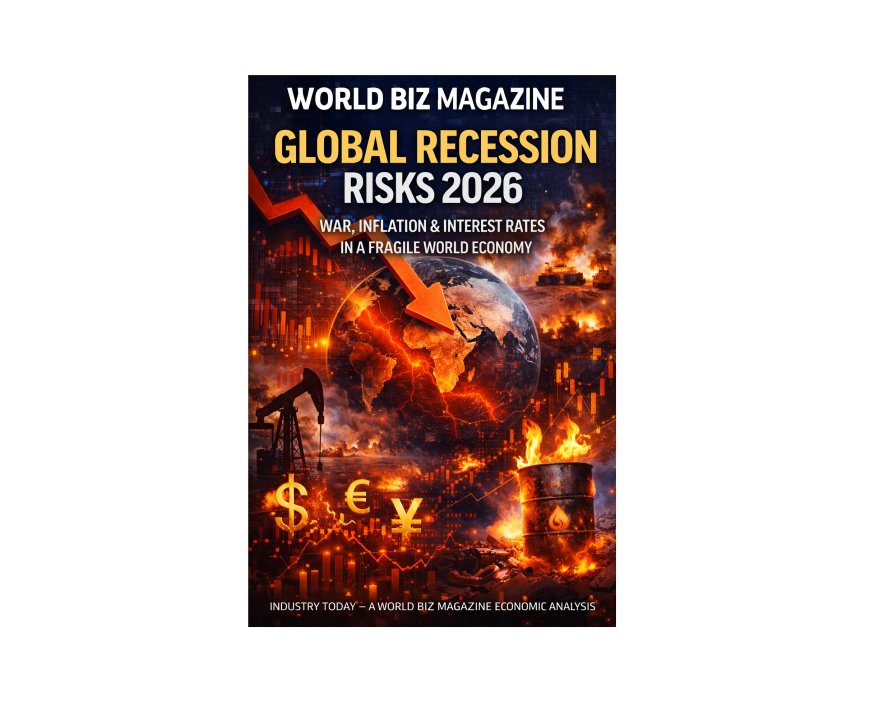
Global Recession Risks in the Current Economic Scenario
Inflation, Interest Rates, Geopolitics and Financial Stability in a Fragmenting World Economy
Industry Today - World Biz Magazine Global Economic Analysis
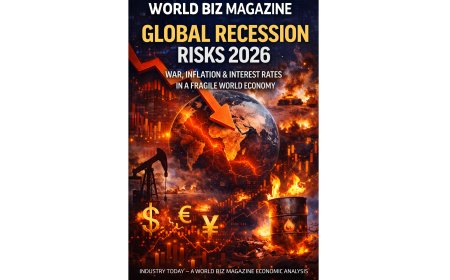
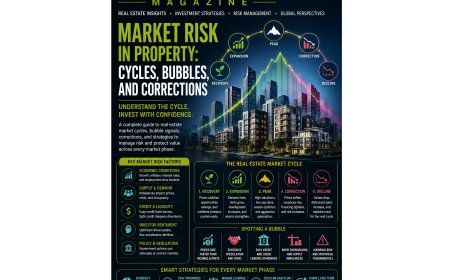
The global economy is entering one of its most uncertain periods since the financial crisis of 2008. With inflation shocks, aggressive monetary tightening, geopolitical conflicts, rising debt levels, and slowing trade growth, economists and policymakers increasingly warn about the possibility of a global recession cycle in the coming years.
From London’s financial district to New York, Frankfurt, Beijing, and Tokyo, policymakers and investors are closely monitoring economic indicators that signal potential economic contraction. While some economies remain resilient, structural risks are building across global markets.
This World Biz Magazine report examines recession risks in the current global economic environment, including the drivers of economic slowdown, regional vulnerabilities, policy responses, and the outlook through 2030.
What Is a Global Recession?
A global recession occurs when economic activity declines simultaneously across multiple major economies for a sustained period. Typical characteristics include:
• Falling GDP growth
• Rising unemployment
• Declining consumer spending
• Lower industrial production
• Reduced global trade
Global recessions are rare but impactful events that reshape financial markets, investment strategies, and economic policy.
Historically significant global downturns include:
|
Year |
Event |
|
1973 |
Oil crisis recession |
|
1991 |
Post-Cold War slowdown |
|
2008-2009 |
Global financial crisis |
|
2020 |
Pandemic-driven economic collapse |
The current economic environment shows several warning signals that economists associate with recession risks.
Key Drivers of Current Global Recession Risk
Inflation and Interest Rate Tightening
One of the most significant risks comes from the aggressive interest rate increases implemented by major central banks to control inflation.
Central banks in:
• United States
• United Kingdom
• Eurozone
• Canada
• Australia
have raised interest rates sharply since 2022.
Higher interest rates increase borrowing costs for households, businesses, and governments, potentially slowing economic growth.
Global Debt Levels
Global debt has reached historic levels.
|
Category |
Estimated Global Debt |
|
Government debt |
$92 trillion |
|
Corporate debt |
$86 trillion |
|
Household debt |
$55 trillion |
High debt levels make economies more sensitive to rising interest rates, increasing the risk of financial stress.
Geopolitical Tensions
Several geopolitical conflicts have disrupted global economic stability.
Key areas of concern include:
• Russia–Ukraine conflict
• U.S.–China strategic competition
• Middle East instability
• Trade fragmentation between economic blocs
Geopolitical risks affect energy markets, supply chains, trade flows, and investor confidence.
Slowing Global Trade
International trade growth has slowed significantly due to:
• Supply chain restructuring
• Protectionist policies
• Rising tariffs
• Regionalization of manufacturing
Trade fragmentation reduces efficiency in the global economy and can slow productivity growth.
Regional Economic Outlook
United States
The U.S. economy remains relatively resilient but faces several risks:
• High interest rates impacting housing and business investment
• Corporate debt vulnerabilities
• Tight labor market conditions
Despite these risks, strong consumer spending has helped avoid recession so far.
United Kingdom
The UK economy faces structural challenges including:
• Persistent inflation
• High public debt
• Housing market pressures
London remains a global financial center, but economic growth has been modest compared with other advanced economies.
Eurozone
The Eurozone faces slower growth due to:
• Energy price shocks
• Manufacturing sector contraction
• Structural fiscal constraints
Germany, the region’s largest economy, has experienced industrial slowdown due to global trade weakness.
China
China’s economic growth has slowed due to:
• Property sector instability
• Weak domestic consumption
• Demographic challenges
However, China continues to implement stimulus measures to support economic activity.
Emerging Markets
Emerging economies face mixed prospects.
Risks include:
• Currency volatility
• Capital outflows during global tightening cycles
• Commodity price fluctuations
However, some emerging markets benefit from demographic growth and industrial expansion.
Financial Market Signals
Financial markets often anticipate economic downturns before they occur.
Yield Curve Inversions
One of the most closely watched indicators is the yield curve inversion, when short-term interest rates exceed long-term rates.
This has historically preceded several recessions.
Equity Market Volatility
Stock markets tend to experience volatility when recession risks increase.
Sectors such as:
• technology
• real estate
• banking
are particularly sensitive to interest rate changes.
Corporate Credit Stress
Rising corporate borrowing costs increase the risk of debt defaults, particularly among highly leveraged companies.
Commodity Market Risks
Commodity markets often reflect economic slowdown signals.
Oil Prices
Lower oil demand typically indicates weaker industrial activity.
Industrial Metals
Metals such as copper are often considered economic indicators because they are used in manufacturing and construction.
Gold
Gold prices tend to rise during economic uncertainty as investors seek safe-haven assets.
Political and Policy Factors
Government policy decisions will play a critical role in determining whether global recession risks materialize.
Key policy areas include:
• fiscal stimulus programs
• infrastructure investment
• tax reforms
• financial regulation
Political stability and effective policy coordination among major economies are essential for maintaining economic resilience.
Risk Assessment Matrix
The following table outlines key recession risk factors.
|
Risk Factor |
Probability |
Impact |
|
High interest rates |
High |
High |
|
Debt crisis |
Medium |
High |
|
Geopolitical conflict escalation |
Medium |
High |
|
Financial market instability |
Medium |
Medium |
|
Trade fragmentation |
Medium |
Medium |
While no single factor guarantees a recession, the combination of risks increases global economic vulnerability.
Geopolitical Conflicts and Global Economic Shocks (2026)
One of the most significant new risk factors for the global economy in 2026 is the escalation of geopolitical conflicts, particularly in the Middle East and Eastern Europe. These conflicts are increasingly intertwined with energy markets, trade routes, and financial stability, creating additional recession risks.
Middle East Conflict and Energy Market Shock
The escalation of military operations involving Iran, Israel, and U.S. forces in early 2026 has triggered widespread economic concerns. The conflict has already produced immediate disruptions in energy markets and global financial systems.
The war led to:
- Surging oil and gas prices
- Stock market volatility
- Aviation and tourism disruptions
- Supply chain interruptions across multiple industries
A key global risk comes from the Strait of Hormuz, a strategic maritime chokepoint through which nearly 20% of global oil supply passes. Military escalation and threats to shipping routes have raised fears of severe disruptions to global energy markets.
Economists warn that a prolonged conflict in the Persian Gulf could trigger another global inflation shock similar to the energy crisis of the early 2020s.
Additionally, global institutions such as the International Monetary Fund (IMF) have warned that the Middle East war could increase inflation pressures and weaken economic growth worldwide due to rising energy costs and trade disruptions.
Economic Consequences of the 2026 Iran Conflict
The economic consequences are already visible across global markets.
Key impacts include:
- Oil prices jumping sharply in global markets
- Global aviation disruptions due to airspace closures
- Increased shipping insurance costs in the Gulf region
- Heightened volatility in global stock markets
Even regional economies are facing direct economic losses. For example, the ongoing war has been estimated to cost Israel billions of dollars per week in lost economic activity, demonstrating how quickly geopolitical crises can disrupt national economies.
If the conflict expands further, it could significantly impact:
- global oil supply
- international shipping routes
- global inflation levels
All three factors are historically associated with recessionary cycles.
Other Active Global Conflicts and Economic Pressure
The Middle East crisis is not the only geopolitical risk currently shaping the global economy.
Russia-Ukraine War
The ongoing conflict in Eastern Europe continues to affect:
- energy markets
- grain exports
- European manufacturing supply chains
The war has already contributed to inflation shocks across Europe and continues to weigh on regional economic growth.
Lebanon-Israel Conflict
Regional tensions involving Lebanon and Israel have caused substantial economic damage in Lebanon, with infrastructure destruction and GDP contraction following military escalation.
These conflicts further destabilize the Middle East economy and increase geopolitical uncertainty.
Global Trade Fragmentation
Trade tensions between major economic powers particularly the United States and China are also contributing to economic fragmentation.
Trade barriers and tariffs have increased supply chain costs and reduced global trade efficiency, increasing the risk of economic slowdown.
Financial Market Reaction to Geopolitical Risk
Financial markets have historically responded strongly to geopolitical shocks.
Current trends include:
- Increased gold prices as a safe-haven asset
- Rising oil price volatility
- Higher global defense spending
- Increased demand for U.S. dollar assets
Global stock markets have also shown volatility following the Middle East conflict escalation, reflecting investor concerns about a wider geopolitical crisis.
Global Recession Probability in the Current Scenario
Several financial institutions estimate the probability of a global recession over the next 12-24 months at around 30-35%, depending largely on the duration of geopolitical conflicts and interest-rate policies.
Key recession triggers include:
- Sustained energy price shocks
- Global interest rates remaining high
- Debt crises in emerging markets
- Trade fragmentation and supply chain disruptions
- Expansion of regional conflicts
While the global economy has shown resilience, these risks significantly increase uncertainty.
Ten-Year Global Economic Forecast (2026-2036)
Despite near-term risks, the long-term outlook remains cautiously optimistic if major crises are avoided.
Scenario 1 - Managed Stability (Most Likely)
If geopolitical conflicts remain contained and inflation moderates:
Global growth could average 2.8-3.2% annually through 2036.
Drivers include:
- technological innovation
- renewable energy investment
- digital economy expansion
- emerging market growth
Scenario 2 - Fragmented Global Economy
If geopolitical tensions intensify:
The world may divide into regional economic blocs.
Possible effects:
- slower trade growth
- increased defense spending
- lower global productivity
Global growth may fall to 2% or lower annually.
Scenario 3 - Global Crisis Scenario
In the worst-case scenario involving prolonged wars and major financial shocks:
- energy prices could spike above $120 per barrel
- global inflation could surge again
- recession could spread across major economies
Such a scenario could produce a downturn similar to the 2008 financial crisis.
Policy Measures to Mitigate Global Recession Risk
Governments and financial institutions can take several steps to reduce recession risks.
Monetary Policy Coordination
Central banks may coordinate interest rate policies to stabilize global liquidity.
Energy Market Stabilization
Investment in renewable energy and diversified supply chains can reduce dependence on geopolitically sensitive regions.
Debt Management
Countries must manage public debt levels carefully to avoid sovereign debt crises during economic slowdowns.
Trade Cooperation
Maintaining global trade cooperation is essential to sustain economic growth.
Mitigation Strategies for Governments
To reduce recession risks, policymakers may consider several approaches.
Monetary Policy Adjustments
Central banks may gradually ease interest rates if inflation stabilizes.
Fiscal Stimulus
Government investment in infrastructure and green energy can stimulate economic activity.
Financial Stability Measures
Regulatory frameworks can help prevent systemic banking crises.
Trade Cooperation
International trade agreements can support global economic growth.
Investment Implications
Investors often adjust strategies during periods of recession risk.
Common strategies include:
• diversification across asset classes
• investment in defensive sectors such as healthcare and utilities
• increased allocation to safe-haven assets like gold and government bonds
Institutional investors closely monitor central bank policies and economic indicators to anticipate market changes.
Future Outlook to 2030
Despite current risks, several long-term factors could support global economic growth.
Technological Innovation
Advances in:
• artificial intelligence
• renewable energy
• biotechnology
• automation
could significantly increase productivity.
Infrastructure Investment
Major economies are investing heavily in infrastructure modernization, which can stimulate economic activity.
Emerging Market Growth
Countries in Asia, Africa, and Latin America continue to experience population growth and urbanization, which support long-term economic expansion.
World Biz Magazine Insight
The global economy in 2026 stands at a critical crossroads.
Geopolitical conflicts, inflation pressures, and financial tightening are creating the most complex economic environment since the global financial crisis. However, technological innovation, demographic shifts, and economic resilience in emerging markets provide strong long-term growth potential.
The balance between conflict and cooperation will determine whether the world economy enters a prolonged recession or navigates toward a new era of economic transformation.
Conclusion
The risk of a global recession in the current economic scenario cannot be ignored. Geopolitical conflicts particularly in the Middle East combined with high interest rates and global debt vulnerabilities have created a fragile economic environment.
However, history shows that global economies are capable of adapting to crises through policy innovation, technological progress, and international cooperation.
The coming decade will likely determine the structure of the post-globalization world economy, shaping financial markets, trade systems, and economic power balances through 2036.
Disclaimer
This publication is intended for informational and analytical purposes only. Economic forecasts, financial insights, and risk assessments presented in this article are based on publicly available research and current market trends at the time of publication. They do not constitute financial, investment, or legal advice. Readers should conduct independent research and consult qualified professionals before making financial or investment decisions. World Biz Magazine assumes no responsibility for financial outcomes resulting from reliance on this analysis.
What's Your Reaction?
 Like
0
Like
0
 Dislike
0
Dislike
0
 Love
0
Love
0
 Funny
0
Funny
0
 Angry
0
Angry
0
 Sad
0
Sad
0
 Wow
0
Wow
0