



































































































































































































Insurance vs Reinsurance: Understanding the Two Pillars of Risk Protection
A complete guide to insurance vs reinsurance with real-world examples, key differences, and industry insights.

WORLD BIZ MAGAZINE - FEATURE ARTICLE
Insurance vs Reinsurance
Understanding the Two Pillars of Global Risk Protection and Financial Stability
World Biz Magazine | Global Financial Insights | Insurance Industry | Risk Management
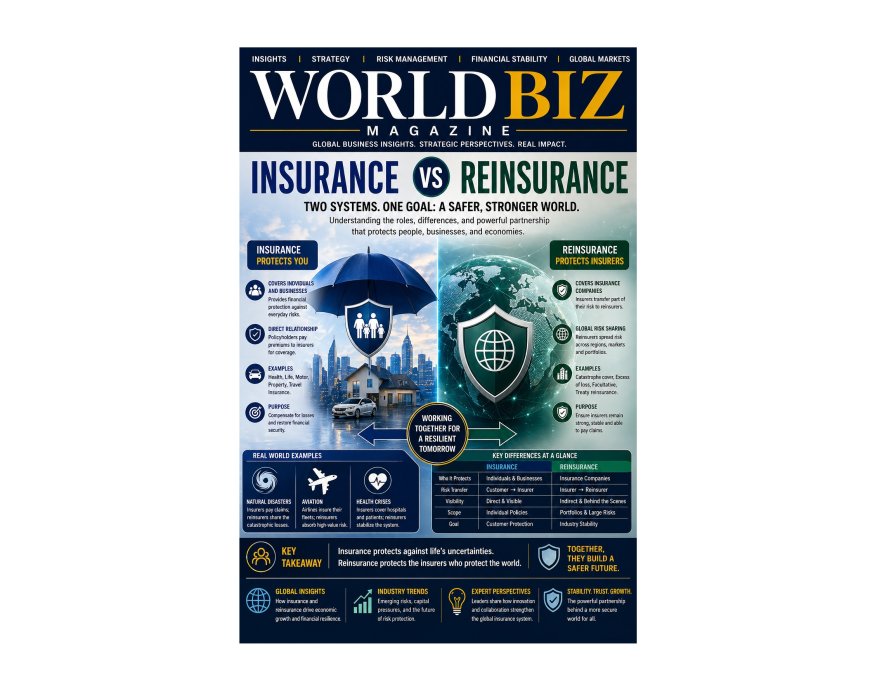
At the heart of the global financial protection system lie two interconnected mechanisms: insurance and reinsurance. While insurance is widely understood as a safeguard for individuals and businesses, reinsurance operates behind the scenes ensuring that insurers themselves remain financially resilient.
Together, they form a multi-layered risk management framework that enables economies to function, businesses to grow, and societies to recover from unexpected shocks.
This article explores the fundamental differences, relationships, and real-world applications of insurance and reinsurance along with practical examples to clarify how both systems work.
What Is Insurance?
Insurance is a financial product that provides protection against potential losses or risks.
How It Works:
- Individuals or businesses pay a premium
- The insurer assumes the risk
- In case of a loss, the insurer compensates the policyholder
Common Types of Insurance:
- Life insurance
- Health insurance
- Motor insurance
- Property insurance
- Travel insurance
Insurance is designed to transfer risk from the customer to the insurer.
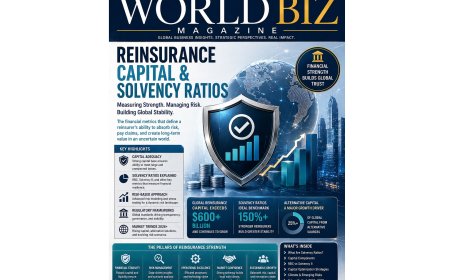
What Is Reinsurance?
Reinsurance is insurance for insurance companies.
How It Works:
- An insurer transfers part of its risk to a reinsurer
- The reinsurer receives a portion of the premium
- In case of large losses, the reinsurer shares the claim burden
Reinsurance ensures that insurers can:
- Handle large claims
- Maintain financial stability
- Continue underwriting new policies
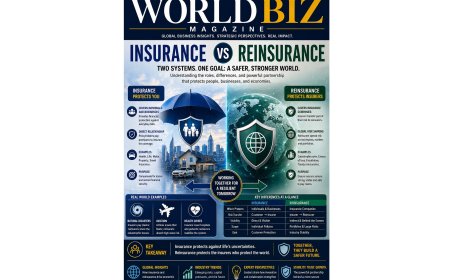
Key Differences: Insurance vs Reinsurance
|
Aspect |
Insurance |
Reinsurance |
|
Primary Purpose |
Protect individuals/businesses |
Protect insurance companies |
|
Customers |
Individuals, companies |
Insurance companies |
|
Risk Transfer |
Customer - Insurer |
Insurer - Reinsurer |
|
Visibility |
Direct and public-facing |
Indirect, behind the scenes |
|
Policy Scope |
Individual or business risks |
Large portfolios or catastrophic risks |
|
Impact Level |
Personal/organizational protection |
Systemic financial stability |
How Insurance and Reinsurance Work Together
The relationship between insurance and reinsurance is collaborative and interdependent.
Flow of Risk:
- Customer buys insurance policy
- Insurer assumes the risk
- Insurer transfers part of risk to reinsurer
- Reinsurer shares financial responsibility
This layered structure ensures risk is distributed globally rather than concentrated locally.
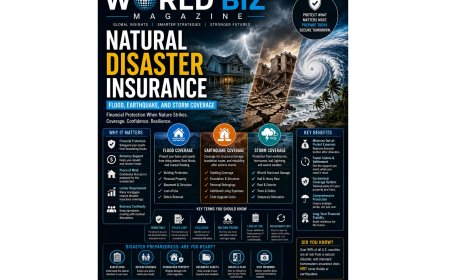
Real-World Example 1: Natural Disaster
Scenario:
A coastal city experiences a major hurricane.
Insurance Role:
- Homeowners file claims with their insurance companies
- Insurers pay for property damage
Reinsurance Role:
- Insurers pass part of these claims to reinsurers
- Reinsurers absorb large-scale losses
Without reinsurance, many insurers could face bankruptcy after such events.
Real-World Example 2: Airline Insurance
Scenario:
An airline insures its fleet worth billions of dollars.
Insurance Role:
- An insurer provides coverage for aircraft damage
Reinsurance Role:
- The insurer transfers a large portion of this risk to reinsurers
- Multiple reinsurers may share the exposure
This enables coverage of high-value assets that no single insurer could handle alone.
Real-World Example 3: Health Insurance System
Scenario:
A health insurer faces unexpectedly high claims due to a pandemic.
Insurance Role:
- Pays claims to policyholders
Reinsurance Role:
- Absorbs part of the financial burden
- Stabilizes the insurer’s operations
This ensures continuity of healthcare coverage.
Types of Reinsurance Supporting Insurance
Facultative Reinsurance
- Covers specific high-value risks
Treaty Reinsurance
- Covers entire portfolios
Proportional Reinsurance
- Shares premiums and losses
Non-Proportional Reinsurance
- Covers losses beyond a threshold
These structures help insurers manage risk efficiently.
Economic Importance of Both Systems
Insurance:
- Protects individuals and businesses
- Encourages investment and entrepreneurship
- Reduces financial uncertainty
Reinsurance:
- Stabilizes insurance markets
- Enables global risk sharing
- Supports disaster recovery
Together, they form a foundation of economic resilience.
Global Industry Structure
Insurance Companies:
- Allianz
- AXA
- MetLife
Reinsurance Companies:
- Munich Re
- Swiss Re
- Hannover Re
These organizations collectively manage trillions of dollars in global risk.
Key Risks and Challenges
Insurance Challenges:
- Fraud and false claims
- Pricing pressures
- Regulatory compliance
Reinsurance Challenges:
- Climate change risks
- Catastrophic losses
- Capital constraints
Both sectors must continuously adapt to emerging global risks.
Technology Impact on Both Sectors
Shared Innovations:
- AI for risk assessment
- Big data analytics
- Digital platforms
- Blockchain for transparency
Technology is making both insurance and reinsurance more efficient, accurate, and scalable.
Future Outlook
Insurance:
- More personalized products
- Digital-first experiences
- Integration with health and financial ecosystems
Reinsurance:
- Increased use of alternative capital
- Advanced risk modeling
- Greater focus on climate and cyber risks
The relationship between the two will become even more integrated and data-driven.
World Biz Magazine Insights
At World Biz Magazine, we observe that:
Insurance and reinsurance are not separate systems they are two layers of the same global risk architecture.
While insurance protects individuals and businesses, reinsurance ensures that the system itself remains stable and capable of handling extreme events.
Conclusion
Insurance and reinsurance together form a complete risk management ecosystem.
- Insurance provides direct protection
- Reinsurance provides system-level stability
In an increasingly uncertain world, both are essential not just for financial security, but for the functioning of global economies.
Expert FAQs: Insurance vs Reinsurance
Q1: What is insurance?
Insurance is a financial product that protects individuals or businesses from potential losses by transferring risk to an insurer.
Q2: What is reinsurance?
Reinsurance is insurance for insurance companies, allowing them to transfer risk and reduce exposure.
Q3: Why do insurers need reinsurance?
Insurers use reinsurance to manage large risks, maintain financial stability, and handle catastrophic events such as natural disasters.
Q4: What is an example of reinsurance?
An insurance company covering hurricane damage may transfer part of that risk to a reinsurer, enabling both parties to share potential losses and reduce financial impact.
Disclaimer
This article is for informational purposes only and does not constitute financial, insurance, or investment advice. Readers are encouraged to consult professional advisors before making decisions.
What's Your Reaction?
 Like
0
Like
0
 Dislike
0
Dislike
0
 Love
0
Love
0
 Funny
0
Funny
0
 Angry
0
Angry
0
 Sad
0
Sad
0
 Wow
0
Wow
0