










































































































































































































Central Asia Film Industry Growth: How Kazakhstan, Uzbekistan & Regional Markets Can Compete with Russian Cinema and Build a $1B Entertainment Economy
A deep analysis of Central Asia’s film and entertainment industry, Russian market dominance, and how Kazakhstan, Uzbekistan, and neighboring countries can reclaim market share, attract global investors, and build a billion-dollar creative economy.

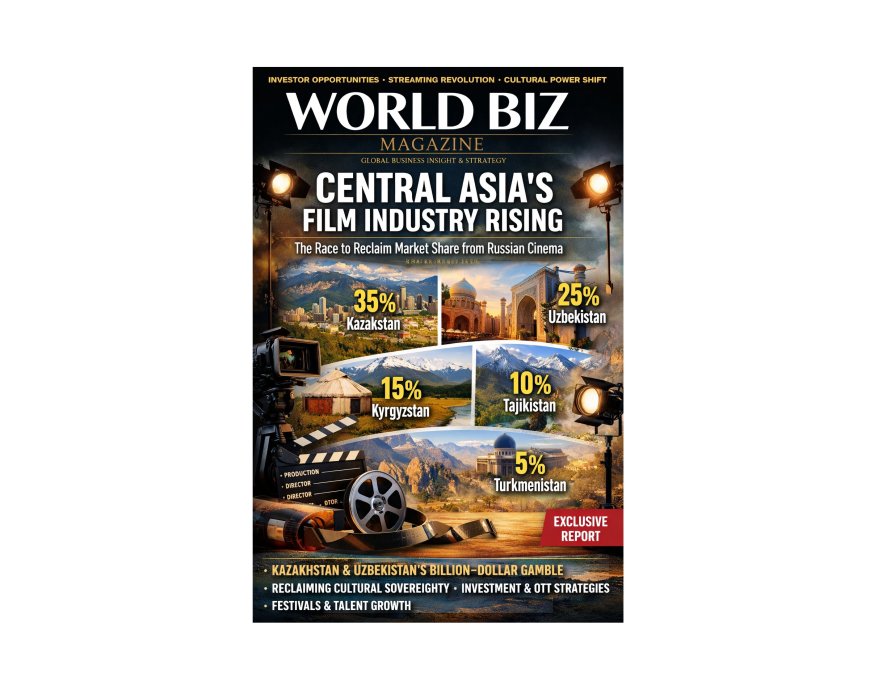
Central Asia’s Film & Entertainment Industry: Reclaiming Identity, Capturing Markets, and Building a $1 Billion Creative Economy
World Biz Magazine | Global Media, Investment & Creative Economy Special Report
This report is part of World Biz Magazine’s Global Creative Economy Series, focusing on emerging media markets, investment strategies, and cultural industry transformation.
A Region of Stories, Yet to Be Told
Central Asia anchored by Kazakhstan, Uzbekistan, Kyrgyzstan, Tajikistan, and Turkmenistan is one of the world’s most culturally rich yet commercially underdeveloped regions in film and entertainment.
With deep historical narratives rooted in the Silk Road, nomadic empires, and post-Soviet identity, the region holds immense storytelling capital. Yet, despite this, it remains largely absent from global box office charts and streaming ecosystems.
At the same time, the region faces a unique challenge: Its entertainment market is already captured primarily by Russia.
This report merges economic analysis, industry strategy, and geopolitical media dynamics to outline how Central Asia can reclaim its narrative and build a globally competitive film industry.
The Structural Reality: Why the Industry Remains Underdeveloped
1. Fragmented Post-Soviet Ecosystem
After the collapse of the Soviet Union:
- Centralized film production systems disappeared
- Funding pipelines collapsed
- Distribution networks weakened
Each country had to rebuild independently without scale.
2. Limited Domestic Markets
- Smaller populations compared to Asia, China, or the U.S.
- Low cinema density (especially in Tajikistan and Kyrgyzstan)
Result: Low commercial viability for large-scale productions
3. Weak Investment & Private Sector Participation
- Limited venture capital in creative industries
- Dependence on government funding
- Lack of structured film funds
4. Talent Drain
- Skilled filmmakers migrate to Russia or Europe
- Lack of world-class training institutions
5. Distribution Bottlenecks
- Limited access to global platforms like Netflix and Amazon Prime Video
- Weak international sales networks
Russian Dominance: How the Market Was Captured
1. Soviet Legacy Infrastructure
During the USSR era:
- Film production was centralized in Moscow
- Central Asian talent was trained under Russian systems
This created long-term dependency
2. Language Advantage
Russian remains widely spoken across the region.
This allows Russian films to:
- Enter markets without dubbing
- Build stronger audience connection
3. Distribution Control
Major entities like:
- Mosfilm
- Gazprom-Media
continue to dominate:
- Cinema supply chains
- TV broadcasting
- Content licensing
4. Cultural Familiarity
Russian content often:
- Reflects shared history
- Uses familiar storytelling formats
- Includes Central Asian actors
Making it feel “local”
The Outcome
- Central Asia became a content consumption region
- Local industries lost competitive positioning
- Significant revenue flows outward
Why Reclaiming the Industry Is Critical
Economic Impact
- Millions in revenue lost annually to foreign content
- Weak contribution to GDP
Cultural Sovereignty
- Local stories underrepresented
- Language and identity diluted
Strategic Opportunity
- Global demand for diverse content is rising
Central Asia can become the next global storytelling frontier
Country-by-Country Deep Dive & Strategy
Kazakhstan: The Regional Leader
Current Position
- Strongest infrastructure in the region
- Growing domestic production
- Increasing audience for local films
Key Institution
- Kazakhfilm Studio
Strategy to Reclaim Market
- Replace Russian imports with high-quality local films
- Introduce cinema quotas for domestic content
- Expand co-productions (Turkey, Korea, Europe)
OTT & Web Series Plan
- Develop national streaming platforms
- Produce high-quality:
- Crime dramas
- Historical epics
Investment Strategy
- Tax incentives for foreign productions
- Film production zones
Forecast
- Revenue: $300M-$500M annually
- GDP contribution: 0.5%-1%
Uzbekistan: The Rising Mass Market
Strengths
- Large youth population
- Rapid digital adoption
Strategy
- Focus on web series & digital-first content
- Launch national OTT platform
- Localize content in Uzbek language
International Collaboration
- Turkey (TV dramas)
- South Korea (production quality)
- India, Pakistan (scale and storytelling)
Forecast
- Revenue: $200M-$400M annually
- GDP: 0.4%-0.8%
Kyrgyzstan: The Festival Powerhouse
Strength
- Strong presence in international festivals
Strategy
- Focus on:
- Art-house films
- European co-productions
- Film festival circuits
Forecast
- Revenue: $50M-$100M
- GDP: 0.2%-0.3%
Tajikistan: Rebuilding the Industry
Challenges
- Minimal infrastructure
- Limited funding
Strategy
- Government-backed film funds
- Focus on documentaries & cultural cinema
- Partner with NGOs and global organizations
Forecast
- Revenue: $20M-$50M
Turkmenistan: Policy-Driven Potential
Challenges
- Heavy censorship
- Limited creative freedom
Strategy
- Liberalize media policies
- Allow foreign productions
Forecast
- Revenue: $10M-$30M
Film, Drama & Web Series Strategy
Content Categories for Global Success
- Silk Road historical epics
- Crime & political thrillers
- Family dramas
- Youth-focused web series
Platform Entry Requirements
To succeed on platforms like Netflix:
- High production quality
- Strong storytelling
- Professional subtitling & dubbing
Talent Development & Film Schools
Current Gap
- Lack of advanced training institutions
Solutions
- Establish national film academies
- Partner with:
- National Film and Television School
- New York Film Academy
- Introduce:
- Scholarships
- Exchange programs
Investment Strategy & International Partnerships
How to Attract Investors
- Tax rebates (20-40%)
- Film production zones
- Public-private funds
Strategic Partner Countries
- Turkey, Pakistan TV drama expertise
- South Korea - global storytelling
- India - mass production
- China - financing
Music Industry Integration
Film industry growth will:
- Boost local music production
- Increase streaming revenues
- Create global cultural exports
Film Festivals & Global Positioning
Required Actions
- Launch:
- Central Asia International Film Festival
- Participate in:
- Cannes
- Berlin
Festivals - global recognition gateway
Risks & Mitigation
|
Risk |
Impact |
Solution |
|
Russian dominance |
High |
Local content quotas |
|
Funding shortage |
High |
Public-private funds |
|
Talent migration |
Medium |
Education incentives |
|
Weak distribution |
High |
OTT partnerships |
Market Recovery & Growth Potential
If Central Asia reclaims its market:
- Recoverable revenue: $400M-$700M annually
- Long-term potential: $1B+ regional industry
Final Outlook: From Dependency to Global Influence
Central Asia stands at a crossroads.
It can either:
- Remain dependent on Russian content
or - Build a self-sustaining, export-driven entertainment industry
World Biz Magazine Final Insight
This is not just an industry transformation it is:
- An economic opportunity
- A cultural revival
- A geopolitical media shift
The countries that act fastest especially Kazakhstan and Uzbekistan will define the region’s creative future.
Conclusion
Central Asia’s film and entertainment industry is not constrained by lack of stories, talent, or cultural richness it is constrained by structure, investment, and strategic direction.
For decades, Russia has maintained dominance through language, infrastructure, and historical integration. This has turned Central Asia into a consumption-driven market, where economic value flows outward and local narratives remain underrepresented.
However, the conditions for transformation are now aligning.
- Kazakhstan is already proving commercial viability
- Uzbekistan offers demographic strength and digital momentum
- Kyrgyzstan brings artistic credibility on global stages
If supported by targeted policies film funds, OTT expansion, international co-productions, and talent development the region can realistically build a $1 billion+ entertainment economy within the next decade.
The strategic priority is clear:
Shift from importing content to exporting culture
Replace dependency with creative sovereignty
Build industries that contribute meaningfully to GDP and global influence
The countries that move first will not only reclaim their domestic markets but position Central Asia as the next frontier in global storytelling.
Disclaimer
This article is published by World Biz Magazine for informational, analytical, and strategic insight purposes only.
- Financial projections, revenue estimates, and market forecasts are indicative and based on current industry trends, regional data, and comparative global benchmarks.
- These projections do not constitute financial, investment, or legal advice.
- Market conditions, government policies, geopolitical developments, and technological changes may significantly impact actual outcomes.
- References to platforms such as Netflix and Amazon Prime Video are for illustrative purposes and do not imply partnerships or endorsements.
Readers, investors, and policymakers are advised to conduct independent research and consult professional advisors before making strategic or financial decisions.
What's Your Reaction?
 Like
0
Like
0
 Dislike
0
Dislike
0
 Love
0
Love
0
 Funny
0
Funny
0
 Angry
0
Angry
0
 Sad
0
Sad
0
 Wow
0
Wow
0