















































































































































































































Decoupled vs Coupled Commerce: Choosing the Right E-Commerce Platform
Learn how headless (decoupled) and traditional (coupled) e-commerce platforms compare in flexibility, performance, and scalability.

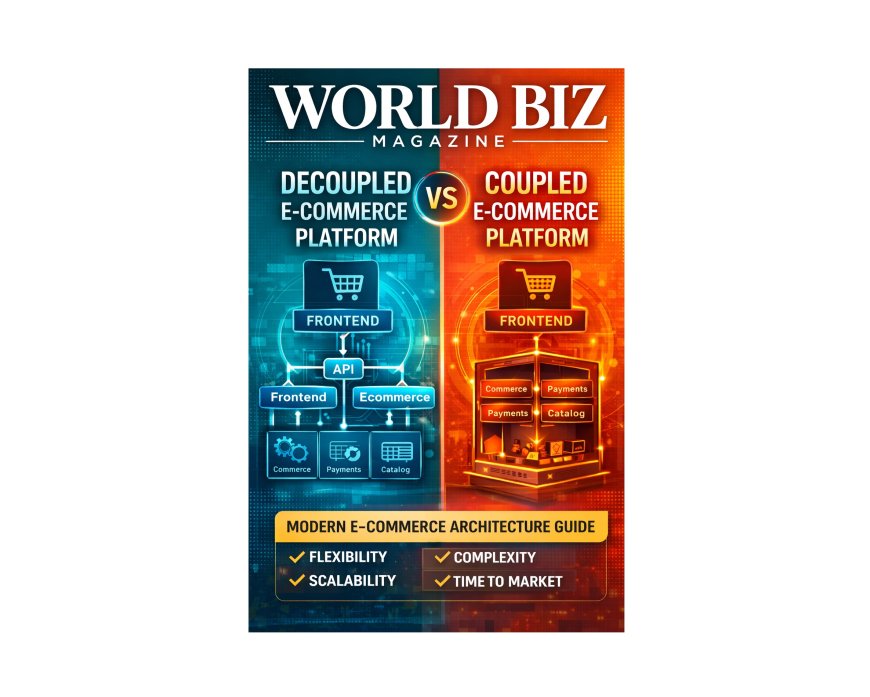
Decoupled vs Coupled E-Commerce Platforms
A Complete Guide to Understanding Modern Commerce Architecture
World Biz Magazine | Digital Economy & E-Commerce
The global digital commerce ecosystem has evolved rapidly over the past decade. Modern online retailers are no longer simply building websites; they are creating complex technology ecosystems capable of supporting millions of customers, global logistics networks, personalized shopping experiences, and omnichannel engagement.
One of the most important architectural decisions businesses face when building an online store is choosing between coupled (traditional) e-commerce platforms and decoupled (headless) e-commerce platforms.
Technology companies such as Shopify, Magento, Salesforce, and BigCommerce have shaped how these systems are built and deployed across the digital retail industry.
Understanding the difference between these two architectures is essential for businesses planning to build scalable, flexible, and future-ready e-commerce platforms.
Understanding E-Commerce Platform Architecture
An e-commerce platform consists of two major components:
Frontend (Presentation Layer)
This is the user interface where customers interact with the store, including:
- product pages
- shopping carts
- checkout pages
- search systems
- customer dashboards
Backend (Commerce Engine)
The backend manages the business logic of the platform, including:
- product catalog management
- inventory tracking
- payment processing
- order management
- customer data
How these two components are connected defines whether a platform is coupled or decoupled.
What Is a Coupled E-Commerce Platform?
A coupled platform (also called a traditional or monolithic platform) is an architecture where the frontend and backend are tightly integrated into a single system.
In this structure, the website interface and commerce engine operate as one unified application.
Traditional platforms such as Magento and earlier versions of Shopify were originally designed using this model.
Characteristics of Coupled Platforms
Coupled systems typically have the following features:
- Frontend and backend are developed together
- Changes to the interface require backend updates
- Deployment happens as a single system
- Limited flexibility for custom user experiences
While this structure simplifies development, it can limit scalability and innovation in rapidly evolving digital markets.
Advantages of Coupled Platforms
Simpler Setup
Coupled systems are easier to deploy because everything is included in one package.
This makes them popular among small businesses and startups launching their first online store.
Lower Initial Development Costs
Companies do not need to build separate frontend and backend systems.
Faster Time to Market
Businesses can launch online stores quickly using pre-built templates and integrated tools.
Limitations of Coupled Platforms
Despite their simplicity, coupled platforms have several limitations.
Limited Flexibility
Customizing user interfaces often requires modifying backend code.
Slower Innovation
Frontend updates may require redeploying the entire system.
Performance Constraints
Scaling the platform may require scaling the entire application rather than individual components.
What Is a Decoupled (Headless) E-Commerce Platform?
A decoupled platform separates the frontend from the backend commerce engine.
In this architecture, the frontend communicates with the backend through APIs (Application Programming Interfaces).
This approach is often referred to as headless commerce.
Modern commerce platforms and large digital retailers increasingly adopt this architecture to create flexible and scalable online shopping experiences.
Companies such as Amazon and Alibaba Group operate complex systems built around decoupled architecture.
Characteristics of Decoupled Platforms
Decoupled platforms have several defining features:
- frontend and backend operate independently
- communication occurs through APIs
- frontend can be built with any technology
- multiple interfaces can connect to the same commerce engine
This allows businesses to deliver shopping experiences across multiple channels.
Advantages of Decoupled Platforms
Greater Flexibility
Businesses can design custom interfaces without altering the backend commerce engine.
Omnichannel Commerce
Decoupled platforms allow companies to sell products across multiple channels, including:
- websites
- mobile apps
- social media platforms
- smart devices
Faster Frontend Innovation
Development teams can update user experiences independently of backend systems.
Better Performance Optimization
Frontend systems can be optimized for speed using modern web technologies.
Challenges of Decoupled Platforms
While powerful, decoupled architectures introduce complexity.
Higher Development Costs
Building separate frontend and backend systems requires more technical expertise.
More Infrastructure Requirements
Decoupled systems often rely on advanced cloud infrastructure.
Cloud providers such as Amazon Web Services, Microsoft, and Google support these distributed architectures.
Integration Complexity
APIs must be carefully designed to ensure smooth communication between systems.
Step-by-Step Comparison: Coupled vs Decoupled Platforms
|
Feature |
Coupled Platform |
Decoupled Platform |
|
Architecture |
Frontend and backend combined |
Frontend and backend separated |
|
Customization |
Limited |
Highly customizable |
|
Development Speed |
Faster initial launch |
Slower setup |
|
Scalability |
Moderate |
Highly scalable |
|
Omnichannel Support |
Limited |
Excellent |
This comparison highlights why many enterprises are migrating toward decoupled architectures.
When Should Businesses Choose a Coupled Platform?
Coupled platforms are suitable for:
- startups launching new stores
- small businesses with limited technical teams
- companies requiring fast deployment
These platforms provide simplicity and cost efficiency for smaller operations.
When Should Businesses Choose a Decoupled Platform?
Decoupled platforms are ideal for organizations that require:
- advanced customization
- global scalability
- omnichannel retail strategies
- integration with multiple services
Large digital retailers often rely on decoupled systems to support millions of customers worldwide.
Industry Trends Driving Decoupled Commerce
Several industry trends are accelerating the shift toward decoupled platforms.
Mobile-First Commerce
Customers increasingly shop through mobile devices and apps.
Social Commerce
Platforms such as Meta Platforms and TikTok are integrating shopping directly into social networks.
Omnichannel Retail
Consumers interact with brands across websites, apps, physical stores, and digital marketplaces.
Decoupled architectures allow businesses to manage these channels from a single backend commerce system.
The Future of E-Commerce Platform Architecture
The future of digital commerce is moving toward composable commerce, where businesses assemble their technology stack using specialized services.
These services include:
- product catalog APIs
- payment platforms
- logistics integration systems
- AI recommendation engines
This modular architecture provides maximum flexibility for innovation.
World Biz Magazine Industry Insights
The shift from coupled to decoupled commerce architecture reflects a broader transformation in digital retail infrastructure.
Businesses that adopt flexible and scalable systems will be better positioned to:
- deliver personalized shopping experiences
- integrate new technologies
- expand into global markets
As digital commerce continues to evolve, decoupled architecture is increasingly becoming the foundation of next-generation retail platforms.
Conclusion
Choosing between coupled and decoupled e-commerce platforms depends on a company’s business goals, technical capabilities, and growth strategy.
Coupled platforms remain practical for smaller businesses seeking simplicity and quick deployment.
However, decoupled platforms offer the flexibility, scalability, and omnichannel capabilities required by modern digital retailers.
As the global e-commerce industry continues to expand, businesses that invest in adaptable and scalable architecture will be best positioned to succeed in the future of digital commerce.
Disclaimer
World Biz Magazine provides industry insights, research analysis, and technology commentary for informational purposes only. Architectural approaches and technology strategies discussed in this article represent general industry perspectives and should not be interpreted as specific technical or investment advice. Organizations should consult qualified professionals when designing or implementing digital commerce platforms.
What's Your Reaction?
 Like
0
Like
0
 Dislike
0
Dislike
0
 Love
0
Love
0
 Funny
0
Funny
0
 Angry
0
Angry
0
 Sad
0
Sad
0
 Wow
0
Wow
0