








































































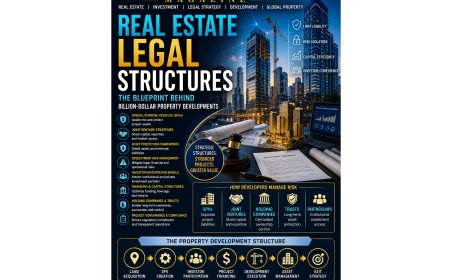































































































































The Legal Blueprint Behind Large-Scale Real Estate Development Projects
A comprehensive guide to real estate legal structures and how developers use corporate entities to manage large-scale property investments and developments.

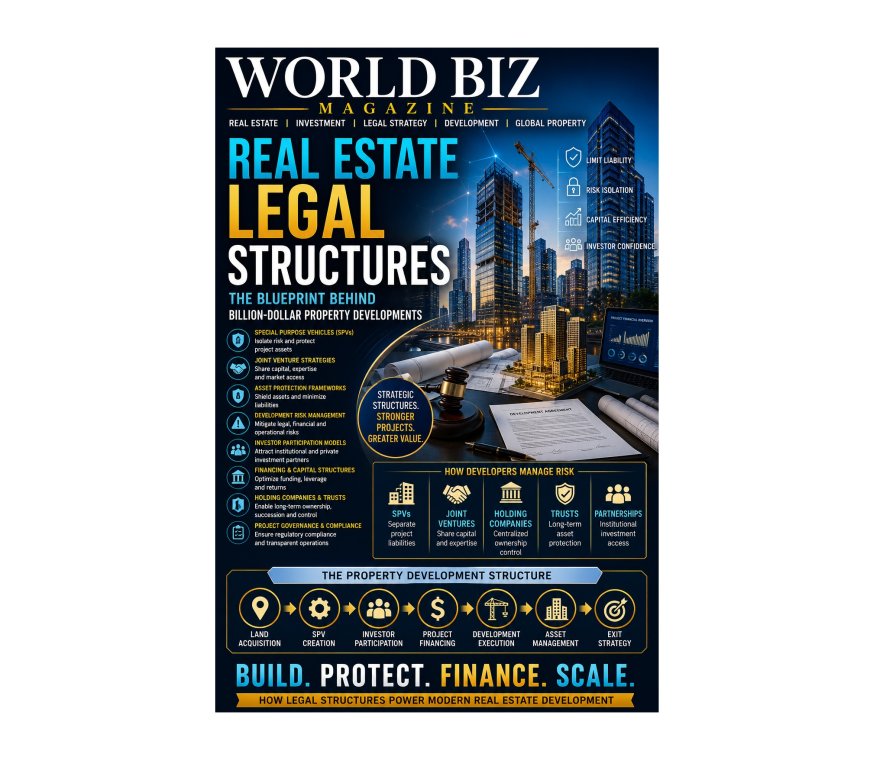
How Real Estate Developers Use Legal Structures to Manage Large Property Projects
The Strategic Role of Special Purpose Vehicles, Joint Ventures, Trusts, and Corporate Entities in Modern Real Estate Development
World Biz Magazine | Real Estate, Investment & Corporate Strategy
Real estate development is often viewed through the lens of construction, architecture, financing, and property sales. Yet behind every successful large-scale residential community, commercial tower, mixed-use development, logistics park, or hospitality project lies an equally important foundation that receives far less public attention: legal structuring. For major developers, legal structures are not merely administrative requirements; they are strategic tools used to manage risk, attract investors, secure financing, optimize taxation, facilitate partnerships, and protect assets throughout the project lifecycle.
Modern property developments frequently involve millions or even billions of dollars in capital commitments, multiple stakeholders, complex financing arrangements, extensive regulatory obligations, and long development timelines. Without carefully designed legal frameworks, developers would face significantly higher financial, operational, and legal risks. As projects become larger and increasingly international in scope, legal structures have become essential mechanisms for controlling complexity while enhancing project viability.
Today, leading developers, institutional investors, private equity firms, sovereign wealth funds, family offices, and real estate investment companies routinely utilize sophisticated legal structures to separate assets, allocate responsibilities, manage liabilities, and support long-term growth strategies.
Understanding how these structures function provides valuable insight into the business mechanics behind some of the world's largest and most successful real estate projects.
Why Legal Structures Matter in Real Estate Development
Property development involves substantial risks.
These risks may include:
- Construction delays
- Financing challenges
- Regulatory disputes
- Environmental liabilities
- Market downturns
- Litigation exposure
- Contractor disputes
- Investment losses
Without proper legal separation, a problem affecting one project could potentially impact an entire development company.
Legal structures help developers isolate risks while creating clear governance frameworks for project management.
They also provide confidence to lenders, investors, regulators, and business partners.
For large-scale developments, legal structuring is often as important as site selection and financing.
The Concept of Legal Entity Segregation
One of the most important principles in modern development is legal segregation.
Rather than holding all projects under a single corporate entity, developers frequently create separate legal entities for individual projects.
This approach helps:
- Limit liability exposure
- Improve financial transparency
- Simplify project financing
- Protect other company assets
- Facilitate future sales or refinancing
Entity segregation has become a standard practice across the global real estate industry.
Special Purpose Vehicles (SPVs)
Among the most widely used legal structures in property development is the Special Purpose Vehicle (SPV).
An SPV is a legally separate company established specifically for a single project or investment.
Examples include:
- Residential developments
- Commercial office towers
- Industrial parks
- Mixed-use communities
- Hospitality projects
The SPV owns the project assets and assumes project-specific obligations.
This creates legal separation between the development and the parent company.
Why Developers Use SPVs
SPVs provide several strategic advantages.
Risk Isolation
Project liabilities remain contained within the SPV.
Financing Flexibility
Lenders often prefer project-specific borrowing structures.
Investor Participation
Investors can acquire ownership interests in a specific project.
Easier Exit Strategies
Projects can be sold through entity transactions rather than direct asset sales.
SPVs are considered one of the most effective tools for managing large-scale development risk.
Joint Venture Structures
Large property projects frequently require substantial capital and expertise.
To share resources and risks, developers often enter into joint venture (JV) arrangements.
Joint ventures typically involve:
- Developers
- Institutional investors
- Pension funds
- Private equity firms
- Sovereign wealth funds
- Landowners
Each participant contributes capital, assets, expertise, or strategic value.
Ownership interests are allocated according to agreed investment terms.
Benefits of Joint Ventures
Joint ventures provide numerous advantages.
Risk Sharing
Financial exposure is distributed among participants.
Capital Access
Projects gain access to larger funding pools.
Strategic Expertise
Partners contribute specialized knowledge.
Market Expansion
Developers can enter new regions or sectors.
Joint ventures have become increasingly common in major commercial and mixed-use developments.
Holding Company Structures
Many development groups utilize holding companies to oversee multiple projects and subsidiaries.
A holding company generally owns interests in:
- Development companies
- SPVs
- Property management firms
- Construction businesses
- Investment entities
This structure creates a centralized ownership framework while maintaining operational separation among individual businesses.
Holding company models are particularly common among diversified real estate groups.
Real Estate Trust Structures
Trusts are frequently used for asset protection, succession planning, and long-term ownership strategies.
A trust separates legal ownership from beneficial ownership.
Benefits include:
- Asset protection
- Estate planning advantages
- Ownership continuity
- Investor confidence
Trust structures are particularly common among family-owned property groups and institutional real estate investors.
Limited Liability Companies (LLCs)
Limited Liability Companies are widely used across real estate markets due to their flexibility and liability protection.
Advantages include:
- Limited personal liability
- Flexible governance
- Simplified ownership structures
- Operational efficiency
Many development projects operate through LLC frameworks because they combine corporate protections with management flexibility.
Limited Partnerships (LPs)
Institutional real estate investments frequently utilize limited partnership structures.
A typical LP includes:
General Partner
Responsible for project management.
Limited Partners
Provide investment capital without participating in day-to-day management.
This model is particularly popular among:
- Private equity real estate funds
- Institutional investors
- Development partnerships
Limited partnerships align management expertise with investor capital.
Financing and Legal Structures
Financing strategies are often directly linked to legal structuring decisions.
Lenders generally prefer clear ownership frameworks and risk segregation.
Well-structured projects may benefit from:
- Lower financing costs
- Improved loan terms
- Greater investor confidence
- Enhanced project transparency
Legal structures frequently influence borrowing capacity and overall project economics.
Tax Planning Considerations
Tax efficiency is another major factor influencing legal structure selection.
Developers often evaluate:
- Corporate taxation
- Capital gains treatment
- Transfer taxes
- Withholding taxes
- International tax obligations
Proper structuring can improve after-tax project returns while maintaining regulatory compliance.
However, tax optimization must always align with applicable laws and regulations.
International Real Estate Development Structures
Cross-border developments often require additional layers of legal complexity.
International projects may involve:
- Multiple jurisdictions
- Foreign investment regulations
- Currency considerations
- Cross-border financing arrangements
Developers frequently establish jurisdiction-specific entities to comply with local legal requirements.
These structures help facilitate international investment participation.
Asset Protection Strategies
Protecting valuable assets is a key objective for many developers.
Legal structures can help shield:
- Land holdings
- Development rights
- Income-producing properties
- Intellectual property
- Corporate assets
Asset protection strategies are designed to reduce exposure to project-specific risks and litigation.
This approach contributes to long-term organizational resilience.
Governance and Decision-Making
Large developments often involve multiple stakeholders.
Legal structures establish governance frameworks that define:
- Voting rights
- Management authority
- Profit distributions
- Capital contribution requirements
- Dispute resolution mechanisms
Clear governance structures improve project efficiency and reduce stakeholder conflicts.
Exit Planning and Capital Recycling
Developers often consider exit strategies before construction begins.
Legal structures can facilitate:
- Asset sales
- Portfolio transactions
- REIT conversions
- Refinancing events
- Institutional acquisitions
Well-designed structures improve flexibility when pursuing future liquidity events.
This has become increasingly important as institutional capital flows into global real estate markets.
Regulatory Compliance and Risk Management
Real estate development is highly regulated.
Legal structures help ensure compliance with:
- Land use regulations
- Environmental laws
- Construction standards
- Investment regulations
- Corporate governance requirements
Proper compliance frameworks reduce legal exposure while enhancing project credibility.
Emerging Trends in Real Estate Structuring
Several trends are influencing future legal frameworks.
These include:
- REIT expansion
- Cross-border investment growth
- ESG-focused governance models
- Digital property ownership platforms
- Real estate tokenization
- Institutional capital partnerships
As the industry evolves, legal structures are becoming increasingly sophisticated.
Developers are seeking greater flexibility, transparency, and scalability.
World Biz Magazine Insights
The most successful real estate developers understand that legal structures are not simply legal requirements they are strategic business tools. From risk management and investor participation to financing efficiency and asset protection, the right legal framework can significantly influence project success. As development projects become larger, more capital intensive, and increasingly global, sophisticated legal structures are becoming a critical competitive advantage within the real estate industry.
Conclusion
Large-scale property developments involve significant financial commitments, operational complexity, and risk exposure. To manage these challenges effectively, developers rely on a variety of legal structures including SPVs, joint ventures, holding companies, trusts, LLCs, and limited partnerships.
These frameworks provide essential benefits such as liability protection, financing flexibility, governance clarity, tax efficiency, investor participation, and long-term asset management capabilities. Beyond legal compliance, they serve as strategic tools that support growth, enhance project economics, and protect organizational value.
As global real estate markets continue evolving, legal structuring will remain a fundamental element of successful property development. Developers who effectively align legal frameworks with business objectives will be better positioned to attract capital, manage risk, and deliver sustainable long-term returns.
Disclaimer
This article is published for informational, educational, and industry analysis purposes only and does not constitute legal, financial, tax, accounting, investment, or professional advice. Legal structures, tax regulations, corporate governance requirements, and real estate laws vary significantly across jurisdictions. Readers should consult qualified legal, tax, accounting, and financial professionals before establishing or modifying any legal entity, ownership structure, investment vehicle, or real estate development framework.
What's Your Reaction?
 Like
0
Like
0
 Dislike
0
Dislike
0
 Love
0
Love
0
 Funny
0
Funny
0
 Angry
0
Angry
0
 Sad
0
Sad
0
 Wow
0
Wow
0