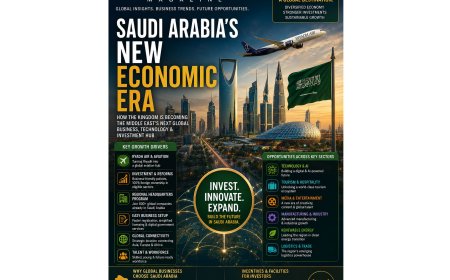








































































































Why Saudi Arabia Is Emerging as the Middle East's Next Global Business Hub
From Riyadh Air to AI, tourism, media, and smart cities, explore the sectors driving Saudi Arabia's next phase of economic growth.

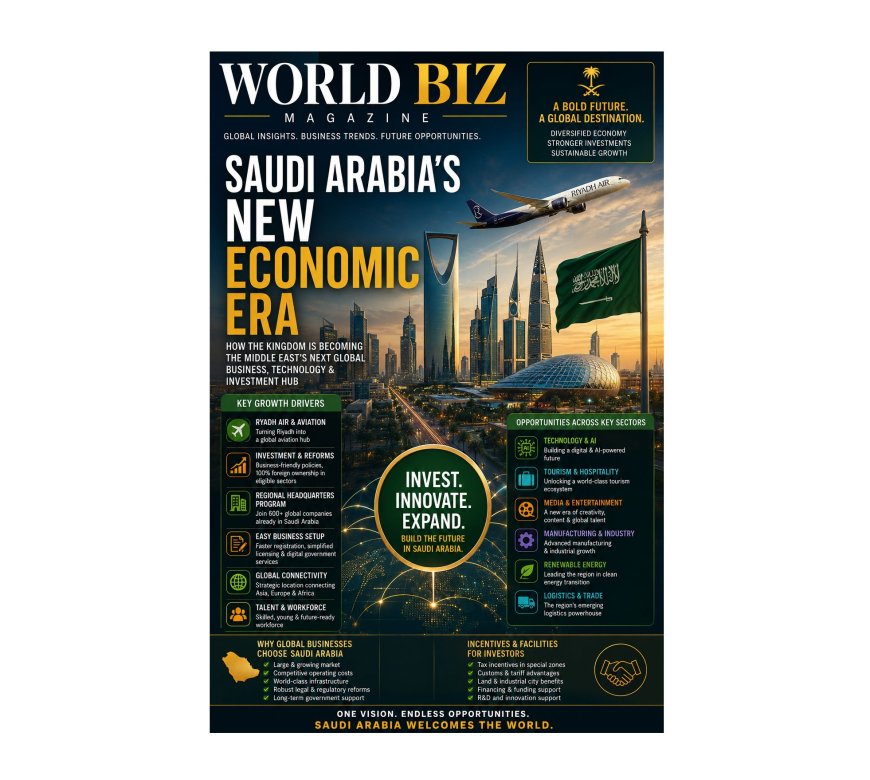
Saudi Arabia's Economic Transformation
Why the Kingdom Is Emerging as the Middle East's Next Global Business and Investment Powerhouse
World Biz Magazine | Global Economy, Investment & Business Strategy
Saudi Arabia is undergoing one of the most ambitious economic transformations in modern history. Driven by significant regulatory modernization, major infrastructure investments, and an investor-focused growth strategy, the Kingdom is positioning itself as one of the world's most attractive destinations for international businesses and investors. As it accelerates diversification beyond oil, Saudi Arabia is investing heavily in aviation, tourism, technology, manufacturing, logistics, entertainment, renewable energy, artificial intelligence, and financial services creating new opportunities for global companies, entrepreneurs, and institutional investors.
Vision 2030: The Strategic Foundation
Saudi Arabia's economic transformation is guided by Vision 2030, the Kingdom's long-term national strategy to diversify the economy, strengthen the private sector, attract foreign direct investment (FDI), create high-value employment opportunities, and establish Saudi Arabia as a global hub for business, logistics, tourism, technology, and innovation. Since its launch, the initiative has evolved from a strategic roadmap into an execution-driven program, with many flagship projects and policy reforms now actively reshaping the country's economic landscape.
Saudi Arabia's Next Phase of Economic Transformation
Saudi Arabia has entered a new phase of economic transformation, moving beyond long-term planning toward large-scale execution. Across the Kingdom, ambitious projects are becoming operational, new industries are emerging, and international investment is accelerating. Major developments in aviation, tourism, logistics, artificial intelligence, advanced manufacturing, renewable energy, entertainment, and financial services are reshaping the country's economic landscape.
Government reforms are making it easier for international businesses to establish operations, invest in strategic sectors, and participate in one of the world's largest economic diversification programs. Rather than relying primarily on its traditional energy sector, Saudi Arabia is building a globally competitive economy powered by innovation, private-sector growth, technology, and international partnerships. This execution-focused approach is positioning the Kingdom as one of the Middle East's most attractive destinations for investors, multinational corporations, entrepreneurs, and high-growth industries.
Building a Global Business Hub
Saudi Arabia's strategic geographic location linking Asia, Europe, and Africa provides access to more than three billion consumers within a relatively short flight time. Combined with world-class logistics investments, expanding airports, modern seaports, industrial cities, and digital infrastructure, the Kingdom aims to become a preferred regional headquarters location for multinational corporations.
The government's Regional Headquarters (RHQ) program has attracted hundreds of international companies to establish regional headquarters in Riyadh, reinforcing the Kingdom's ambition to become a leading Middle Eastern business center.
Riyadh Air: Challenging Regional Aviation Leadership
One of Saudi Arabia's most ambitious initiatives is the launch of Riyadh Air, a new national airline designed to transform Riyadh into a major international aviation hub.
The airline supports broader national objectives by increasing passenger capacity, strengthening global connectivity, supporting tourism, and enhancing cargo logistics. Rather than competing only in domestic markets, Riyadh Air is intended to attract international travelers and corporate traffic that has traditionally flowed through regional hubs such as Dubai, Abu Dhabi, and Doha.
Together with airport expansion projects and integrated logistics investments, Riyadh Air forms part of Saudi Arabia's long-term strategy to become one of the world's leading aviation centers.
Competing for Regional Business Leadership
Saudi Arabia is increasingly positioning itself as an attractive destination for multinational companies considering Middle East expansion.
The Kingdom's strategy focuses on:
- A rapidly growing domestic market
- Large government-backed investment programs
- Competitive industrial policies
- Strategic infrastructure investments
- Expanding private-sector opportunities
- Long-term economic diversification
Rather than replacing other regional business centers, Saudi Arabia seeks to become an additional global headquarters destination by leveraging the scale of its economy and Vision 2030 investment pipeline.
Easier Business Registration and Investment Reforms
Saudi Arabia has introduced significant reforms aimed at simplifying business establishment for international investors.
The updated investment framework emphasizes streamlined licensing procedures, stronger investor protections, and greater regulatory transparency. In many sectors, foreign investors may own 100% of their businesses, subject to applicable regulations and sector-specific requirements.
Digital government platforms have reduced paperwork while accelerating licensing and regulatory approvals, making company formation faster and more predictable than in previous years.
Holding Companies and International Expansion
Saudi Arabia is increasingly attracting international holding companies, regional headquarters, and multinational corporate structures.
Foreign businesses can establish Saudi entities, subsidiaries, or branches depending on licensing requirements and business activities. Many international companies also use Saudi Arabia as a regional operational base while maintaining global corporate structures in other jurisdictions.
These flexible investment structures enable businesses to manage regional operations more efficiently while participating in Saudi Arabia's expanding economy.
Incentives for Foreign Investors
The Kingdom has introduced numerous initiatives to encourage international investment.
These include:
- Competitive investment incentives for qualifying projects
- Access to industrial and economic zones
- Government-supported financing programs
- Infrastructure support
- Investment facilitation services
- Digital licensing systems
- Investor protection reforms
Certain strategic projects may qualify for investment incentives, including support tied to eligible capital investments, depending on sector and program requirements.
Special Economic Zones
Saudi Arabia has established Special Economic Zones (SEZs) focused on attracting international investors in manufacturing, logistics, cloud computing, advanced technology, and other strategic industries.
These zones may offer benefits such as customs facilitation, tax-related incentives where applicable, modern infrastructure, and streamlined regulatory procedures designed to improve competitiveness.
Visa Reforms Supporting Global Talent
Saudi Arabia has modernized several visa programs to encourage tourism, investment, entrepreneurship, and skilled professionals.
Business visas, investor pathways, premium residency options, and expanded tourism visas have made international travel significantly easier than in previous years.
These reforms support multinational companies by facilitating executive travel, workforce mobility, and international collaboration while strengthening Saudi Arabia's global business ecosystem.
Opportunities for the IT and Technology Sector
Technology is one of the fastest-growing sectors under Vision 2030.
Saudi Arabia is investing heavily in:
- Artificial Intelligence
- Cloud Computing
- Cybersecurity
- Data Centers
- FinTech
- Digital Government
- Smart Cities
- Robotics
- Internet of Things (IoT)
- Software Development
Government-backed digital transformation initiatives, increasing venture capital activity, and strong enterprise demand are creating significant opportunities for international technology companies.
Media, Entertainment, and Creative Industries
One of the most visible transformations has occurred in entertainment and media.
Saudi Arabia has rapidly expanded investments in:
- Gaming
- Film production
- Television
- Animation
- Music
- Live entertainment
- Theme parks
- Cultural festivals
- Sports events
- Digital content creation
Large-scale projects such as Qiddiya, Diriyah, Red Sea Global, and NEOM are creating demand for international creative agencies, production studios, technology companies, and media businesses. These initiatives form part of the Kingdom's broader strategy to build a diversified tourism and entertainment economy.
Tourism Becoming a Major Economic Driver
Tourism has become one of the fastest-growing sectors in Saudi Arabia.
Massive investments are transforming the Kingdom into a destination for:
- Luxury tourism
- Heritage tourism
- Religious tourism
- Adventure tourism
- Sports tourism
- Entertainment tourism
- Business events
- International conferences
Hotel developments, airports, cruise terminals, cultural attractions, and transportation infrastructure are expanding rapidly to support long-term tourism growth.
Manufacturing and Industrial Development
Saudi Arabia is investing aggressively in advanced manufacturing to strengthen domestic production and global exports.
Priority industries include:
- Automotive
- Electronics
- Aerospace
- Pharmaceuticals
- Food Processing
- Chemicals
- Industrial Equipment
- Green Technologies
Government programs encourage technology transfer, industrial innovation, and foreign partnerships to develop globally competitive manufacturing capabilities.
Renewable Energy and Sustainability
Energy diversification remains another major priority.
The Kingdom is investing in:
- Solar Power
- Wind Energy
- Green Hydrogen
- Battery Technologies
- Smart Energy Infrastructure
- Carbon Reduction Programs
These investments support both domestic energy transition and future export opportunities in clean energy technologies.
Infrastructure Supporting Growth
Infrastructure spending remains central to Vision 2030.
Major investments include:
- High-speed rail
- Metro systems
- Expressways
- Smart cities
- Airports
- Logistics hubs
- Digital infrastructure
- Industrial zones
- Seaports
- Residential developments
These projects are designed to support private investment while improving overall business competitiveness.
Challenges Alongside Opportunity
Despite impressive progress, investors should recognize that operating in Saudi Arabia still requires careful planning.
Businesses must understand:
- Sector-specific licensing requirements
- Employment localization (Saudization) obligations
- Regulatory compliance
- Cultural and commercial practices
- Tax and legal frameworks
Success depends on long-term commitment, local partnerships where appropriate, and compliance with evolving regulations.
Looking Toward the Future
Saudi Arabia's long-term vision extends well beyond infrastructure development.
Future priorities include:
- AI leadership
- Advanced manufacturing
- Digital economy expansion
- Global logistics leadership
- Financial sector growth
- Space technologies
- Biotechnology
- Smart mobility
- Sustainable urban development
- Knowledge-based industries
The Kingdom's objective is to build one of the world's most diversified and innovation-driven economies over the coming decades.
World Biz Magazine Insights
Saudi Arabia is no longer viewed solely as an energy powerhouse. Through Vision 2030, it is positioning itself as a diversified investment destination capable of competing across technology, logistics, aviation, tourism, manufacturing, media, entertainment, and financial services. For international businesses, the Kingdom offers expanding opportunities supported by regulatory reforms, major public investment, and a rapidly evolving private sector. Companies that align their strategies with Saudi Arabia's long-term development priorities may find significant growth opportunities in one of the world's most dynamic emerging business environments.
Conclusion
Saudi Arabia's economic transformation represents one of the most significant development initiatives of the twenty-first century. Through regulatory modernization, infrastructure investment, digital transformation, aviation expansion, business-friendly reforms, and strategic diversification, the Kingdom is building a globally competitive economy designed to attract investment, foster innovation, and create sustainable long-term growth. While businesses should carefully evaluate regulatory and operational requirements, Saudi Arabia's evolving investment landscape offers substantial opportunities for organizations seeking to participate in one of the Middle East's fastest-changing economies.
Disclaimer
This article is published by World Biz Magazine for informational, educational, and editorial purposes only. The content is intended to provide a general overview of Saudi Arabia's economy, business environment, investment landscape, regulatory developments, and emerging market opportunities. It should not be interpreted as legal, financial, investment, tax, accounting, immigration, regulatory, or professional business advice.
While every effort has been made to ensure that the information presented is accurate, balanced, and based on publicly available sources and industry research at the time of publication, economic conditions, government policies, investment incentives, business regulations, visa requirements, licensing procedures, ownership structures, tax laws, and compliance obligations are subject to change without notice and may vary depending on the industry, business activity, and jurisdiction.
Readers, investors, entrepreneurs, corporations, and organizations are strongly encouraged to conduct their own independent due diligence and obtain advice from qualified legal counsel, licensed financial advisors, tax professionals, accountants, and the appropriate Saudi government authorities before making any investment, business formation, market entry, financing, relocation, partnership, or commercial decisions.
The inclusion of references to government initiatives, economic reforms, investment programs, infrastructure projects, companies, industries, or business opportunities does not constitute an endorsement, recommendation, guarantee, or solicitation by World Biz Magazine. Any references to potential opportunities, incentives, growth prospects, or future developments are provided solely for informational purposes and should not be considered assurances of future performance or commercial success.
World Biz Magazine, its publisher, editors, writers, contributors, affiliates, and associated entities shall not be liable for any direct, indirect, incidental, consequential, special, or punitive loss, damage, liability, claim, cost, or expense arising from or related to the use of, reliance upon, or interpretation of the information contained in this publication. This includes, but is not limited to, investment decisions, business establishment, company registration, regulatory compliance, financing arrangements, commercial transactions, strategic planning, or any financial or operational outcomes resulting from actions taken based on this article.
Readers are responsible for verifying all information with official government agencies and relevant regulatory authorities before proceeding with any business or investment activity. Independent professional advice should always be sought where appropriate.
What's Your Reaction?
 Like
1
Like
1
 Dislike
0
Dislike
0
 Love
0
Love
0
 Funny
0
Funny
0
 Angry
0
Angry
0
 Sad
0
Sad
0
 Wow
1
Wow
1