
















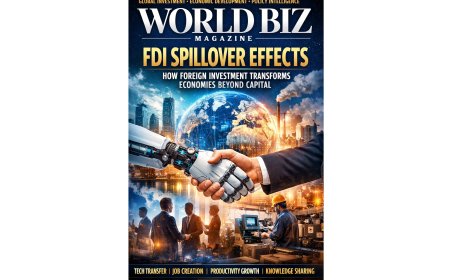
















































































































































































FDI Spillover Effects: How Foreign Investment Transforms Economies Beyond Capital
How does FDI reshape economies beyond funding? Learn about productivity gains, knowledge transfer, and long-term development impacts.


FDI Spillover Effects: How Foreign Investment Transforms Economies Beyond Capital
World Biz Magazine | Global Investment, Economic Development & Policy Intelligence Report
Beyond Capital: The Hidden Power of Foreign Direct Investment
Foreign Direct Investment (FDI) has long been viewed as a catalyst for economic growth, bringing capital, infrastructure, and employment into host economies. However, its most profound impact lies beyond financial inflows within the spillover effects that reshape industries, elevate productivity, and transform national competitiveness.
From technology transfer to workforce development, FDI creates ripple effects that influence not only recipient firms but entire economic ecosystems.
In today’s interconnected world, FDI is not just about investment it is about knowledge diffusion, innovation, and structural transformation.
What Are FDI Spillover Effects?
FDI spillover effects refer to the indirect benefits that domestic firms and economies gain from the presence of foreign investors, particularly multinational corporations (MNCs).
These effects occur when:
- Local firms adopt new technologies
- Workers gain skills and transfer knowledge
- Supply chains evolve and modernize
In simple terms: FDI does not just bring capital it spreads capability
Types of FDI Spillover Effects
Horizontal Spillovers (Within Industry)
These occur when domestic firms in the same industry:
- Learn from foreign competitors
- Improve efficiency and productivity
Impact:
- Increased competition
- Innovation adoption
- Industry-wide upgrades
Vertical Spillovers (Supply Chain Effects)
Vertical spillovers occur through:
- Backward linkages (local suppliers)
- Forward linkages (distributors and service providers)
Impact:
- Improved quality standards
- Integration into global value chains
Labor Mobility Spillovers
Employees trained in multinational firms often:
- Move to local companies
- Start their own businesses
Impact:
- Skill transfer
- Entrepreneurship growth
Technology & Knowledge Spillovers
MNCs introduce:
- Advanced technologies
- Management practices
- R&D capabilities
Impact:
- Innovation ecosystem development
- Productivity gains
Sectoral Impact of FDI Spillovers
Manufacturing
- Technology upgrades
- Export competitiveness
Services
- Financial services modernization
- Digital transformation
Agriculture
- Improved techniques
- Supply chain integration
FDI spillovers are strongest where local capacity exists to absorb knowledge
Benefits of FDI Spillover Effects
Productivity Growth
Domestic firms become more efficient and competitive.
Employment & Skill Development
Workforce gains:
- Technical skills
- Managerial expertise
Global Market Integration
Local firms gain access to:
- International markets
- Export opportunities
Innovation Ecosystem Development
Encourages:
- Research & development
- Startup creation
Challenges & Limitations
|
Challenge |
Impact |
Solution |
|
Weak local capacity |
Limited spillovers |
Skill development programs |
|
Technology gap |
Slow adoption |
Innovation incentives |
|
Foreign dominance |
Market imbalance |
Support local SMEs |
|
Policy gaps |
Inefficiency |
Strong regulatory frameworks |
Measuring FDI Spillover Impact
Governments assess spillovers through:
- Productivity growth rates
- Export performance
- Employment statistics
- Innovation indicators
Effective policies amplify positive spillovers
Policy Framework for Maximizing Spillovers
Strengthening Local Firms
- SME support programs
- Access to finance
Education & Skill Development
- Technical training
- Industry-academia collaboration
Encouraging Linkages
- Supplier development programs
- Local sourcing incentives
Innovation Policies
- R&D incentives
- Technology parks
Global Examples of FDI Spillover Success
China
- Leveraged FDI to build manufacturing dominance
- Strong technology transfer policies
Vietnam
- Rapid export growth through FDI integration
- Supply chain development
India/Pakistan/Bangladesh
- IT sector growth driven by global firms
- Skilled workforce development
Future Trends in FDI Spillovers
- Rise of digital economy spillovers
- Green technology transfer
- Regional investment hubs
- Knowledge-based economies
Future spillovers will be driven by technology and sustainability
World Biz Magazine Insights
FDI is Becoming a Knowledge Economy Tool
Countries are attracting investment not just for capital but for capabilities.
Technology Spillovers Will Define Competitiveness
AI, automation, and digital skills will shape future economies.
Competition for High-Quality FDI is Increasing
Countries are competing to attract:
- High-tech industries
- Innovation-driven investment
Emerging Markets Have the Greatest Opportunity
With the right policies, they can leapfrog development stages.
Policy Determines Impact
FDI alone is not enough policy design determines success
Conclusion
FDI spillover effects represent one of the most powerful yet underappreciated forces in global economic development.
While capital inflows provide immediate benefits, it is the long-term diffusion of knowledge, skills, and innovation that defines sustainable growth.
The real value of FDI lies not in what is invested but in what is learned, shared, and multiplied.
Countries that strategically harness spillovers will:
- Build competitive industries
- Develop skilled workforces
- Integrate into global value chains
In the evolving global economy, FDI is no longer just an investment it is a transformational engine of progress.
Disclaimer
This article is published by World Biz Magazine for informational and analytical purposes only.
- Economic insights, trends, and projections are based on current data and research and may vary depending on policy changes and global conditions.
- The examples provided are illustrative and do not guarantee similar outcomes in other markets.
- Readers and policymakers are advised to conduct independent analysis before making strategic or investment decisions.
What's Your Reaction?
 Like
0
Like
0
 Dislike
0
Dislike
0
 Love
0
Love
0
 Funny
0
Funny
0
 Angry
0
Angry
0
 Sad
0
Sad
0
 Wow
0
Wow
0