























































































































































































The Global Blockchain Industry Report 2026-2030: Market Trends, Investments & Economic Impact
What blockchain technology is and how it works step by step. Explore global market size, key players, investments, country-by-country analysis, regulations, and detailed industry forecasts to 2030 in this World Biz Magazine report.


What Is Blockchain Technology? How Blockchain Works Step by Step
Industry Today - A World Biz Magazine Deep Dive
Blockchain technology is one of the most transformative innovations shaping the global digital economy from finance and supply chains to governance and data security. In this detailed World Biz Magazine feature, we explore what blockchain is, how it works, its global market landscape, key players, regulatory impacts, investment flows, country-by-country adoption, economic implications, market forecasts to 2030, comparisons with other sectors, and future outlooks.
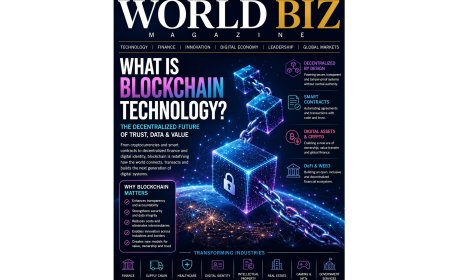
What Is Blockchain Technology?
At its core, blockchain is a decentralized, distributed ledger system that securely records transactions across networks of computers without needing a central authority. Each transaction is grouped into a “block,” cryptographically sealed, and linked to previous blocks forming an immutable chain. This structure makes blockchain tamper-resistant, transparent, and reliable, appealing across many sectors beyond its cryptocurrency origins.
How Blockchain Works: Step by Step
1. Transaction Initiation:
A user (e.g., Alice sending value or data) initiates a transaction.
2. Verification:
A global network of computers (nodes) validates the transaction using cryptographic protocols.
3. Block Creation:
Verified transactions are grouped into a block.
4. Block Sealing:
Once full, the block is sealed using hashes unique cryptographic fingerprints.
5. Chain Linking:
The sealed block joins the existing blockchain, making the record permanent and traceable.
Industry Overview & Market Size
Global Market Today
Blockchain is rapidly expanding far beyond cryptocurrencies. According to market research data:
· The blockchain technology market was valued at roughly USD 31 billion in 2024 and shows explosive growth trends.
· Projections vary, but many forecasts indicate astonishing growth from USD 57 billion in 2025 to over USD 1.4 trillion by 2030, driven by enterprise adoption and digital transformation initiatives.
· Long-term outlooks suggest the market could reach USD 376 billion by 2035 and beyond depending on regulatory clarity and technological scaling.
Fast-growing segments include platforms, services, digital identity, DeFi (decentralized finance), smart contracts, and secure supply chain solutions.
Key Players in the Blockchain Ecosystem
Blockchain’s landscape blends established tech giants with specialized platforms:
Major Corporations
· IBM - enterprise blockchain solutions
· Amazon Web Services (AWS) - cloud blockchain services
· Microsoft Azure - blockchain tools and identity solutions
· Oracle - enterprise ledger integrations
· SAP - blockchain in business processes
Platforms & Consortiums
· Ethereum / ConsenSys - smart contract leader
· R3 - financial enterprise consortia
· Ripple Labs - cross-border settlements
· Polkadot - interoperable multi-chain ecosystem
Policies, Politics, and Regulations
Central Bank Digital Currencies (CBDCs)
Many central banks are experimenting with blockchain for national digital currencies:
· Bank of Japan is testing blockchain settlement systems to increase efficiency.
· Japan Post Bank plans to roll out a blockchain-based digital yen by 2026.
Countries like the UAE and Singapore have regulatory sandboxes promoting innovation, while EU’s MiCA regime aims to standardize crypto rules across Europe.
Political Impact on Economy
Blockchain has become a strategic geopolitical asset:
· Governments support blockchain to boost financial inclusivity, cross-border trade, and digital sovereignty.
· Some nations tighten oversight to mitigate fraud risks, affecting how exchanges and wallets operate.
Economic Impact & Investments
Global Investment Flows
Blockchain draws capital from:
· Venture funds focused on Web3 ecosystems.
· Corporate R&D budgets integrating blockchain into banking, logistics, and healthcare.
· Government grants for digital identity and public-sector transparency.
The technology is forecast to contribute significantly to GDP growth globally by 2030, with research estimating multi-trillion-dollar impacts. Analysts have projected blockchain could add as much as 2 % to global GDP by 2030 with expanded adoption.
Country-By-Country Snapshot
United States:
North America leads blockchain adoption, propelled by strong tech infrastructure and financial services investment.
European Union:
The EU pursues balanced regulations (MiCA) alongside enterprise blockchain projects.
Asia-Pacific:
China, India, South Korea and Singapore rapidly adopt blockchain for digital economy use cases; Asia remains a high-growth region.
Middle East:
The UAE has emerged as a Web3 hub, with thousands of blockchain firms and innovative regulatory frameworks attracting global capital.
Market Challenges & Comparisons with Other Sectors
Blockchain faces hurdles such as:
· Scalability limits (the “Blockchain Trilemma” of security, scalability, and decentralization).
· Regulatory ambiguity across jurisdictions.
· Energy concerns with certain consensus models.
Compared with traditional tech sectors like cloud or AI, blockchain’s decentralized foundations introduce unique legal and operational complexities but they also promise lower intermediary costs and higher transparency once scaled.
Future of Blockchain & Forecast to 2030
Growth Projections
Market Size Trend (Indicative)
· 2024: USD 31 billion
· 2025: USD 57 billion
· 2026: USD 108 billion
· 2027-2028: Rapid expansion to hundreds of billions
· 2030: Potentially above USD 1.4 trillion
Sector Outlooks
· Finance/DeFi: Blockchain will deepen integration in cross-border payments and settlements.
· Enterprise IT: Decentralized identity, traceability, and smart contracts.
· Supply Chain: Increased adoption to verify provenance and reduce fraud.
Countries Winning Investments:
· U.S., UAE, Singapore, and EU nations remain leaders in attracting blockchain capital.
Countries Losing Investment:
· Nations with restrictive crypto laws or lagging digital policies risk falling behind investment flows.
Conclusion
Blockchain technology has matured into a cornerstone of modern digital infrastructure with transformative potential across industries and governments. Its rise illustrates not merely technological innovation but a global reshaping of economic frameworks, trust models, and capital flows. As regulations evolve and companies expand blockchain integration, the world economy stands at the threshold of a deep digital transformation.
Disclaimer:
This publication is intended for informational and industry analysis purposes only. Market forecasts, investment insights, and economic projections are based on available research data, industry reports, and public sources at the time of publication. They do not constitute financial, investment, or legal advice. Readers are advised to conduct independent research and consult professional advisors before making investment or policy decisions. World Biz Magazine does not assume responsibility for market fluctuations, regulatory changes, or geopolitical developments that may impact the blockchain industry.
What's Your Reaction?
 Like
0
Like
0
 Dislike
0
Dislike
0
 Love
0
Love
0
 Funny
0
Funny
0
 Angry
0
Angry
0
 Sad
0
Sad
0
 Wow
0
Wow
0