





































































































































































Inside the US Investment Banking Industry: Markets, Deals & Power Players
Explore how US investment banks operate, including IPOs, M&A, debt markets, regulations, and sector focus.

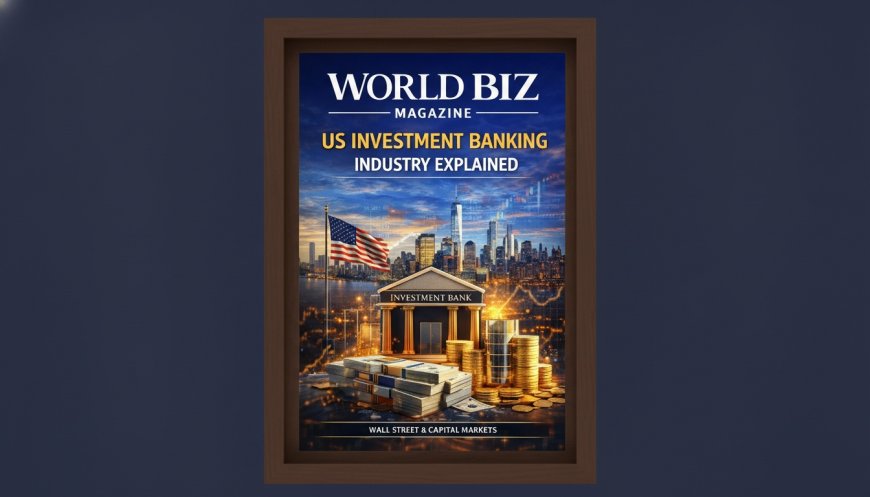
US Investment Banking Industry Explained: How Wall Street Works
Market Structure, Key Players, Capital Flows, and Economic Impact
World Biz Magazine | Investment Banking & Capital Markets
The United States investment banking industry is the largest, most sophisticated, and most influential in the global financial system. Centered around Wall Street and supported by deep capital markets, advanced regulation, and institutional investors, US investment banks play a defining role in global capital formation, mergers and acquisitions, corporate finance, and economic growth.
From financing Silicon Valley startups to structuring multi-billion-dollar mergers, underwriting IPOs, and advising governments and corporations, US investment banks operate at the core of the world’s financial architecture. Their influence extends far beyond domestic markets, shaping capital flows across Europe, Asia, the Middle East, and emerging economies.
This article provides a complete industry overview of how investment banks operate in the United States covering market size, key players, investment modes, procedures, eligibility, deal sizes, sectoral focus, regulatory framework, and overall contribution to the US economy.
Overview of the US Investment Banking Market
The US investment banking market is characterized by:
· The world’s deepest equity and debt markets
· High deal volumes and liquidity
· Strong institutional investor participation
· Advanced financial innovation
· Robust regulatory oversight
The US accounts for the largest share of global IPOs, bond issuance, and M&A advisory revenues, making it the global benchmark for investment banking operations.
Key Financial Centers
New York City (Wall Street)
· Global hub for investment banking
· Headquarters of major bulge-bracket banks
· Center for equity, debt, and M&A activity
San Francisco & Silicon Valley
· Technology-focused investment banking
· Venture capital and growth equity
· Startup IPOs and acquisitions
Chicago, Boston, Los Angeles
· Sector-specific banking (industrials, healthcare, media)
· Middle-market advisory
Key Investment Banking Players in the US
Bulge-Bracket Investment Banks
· Goldman Sachs
· JPMorgan Chase
· Morgan Stanley
· Bank of America Securities
· Citi
These firms dominate large-cap IPOs, global M&A, and structured finance.
Elite Boutique Advisory Firms
· Lazard
· Evercore
· Centerview Partners
· PJT Partners
· Moelis & Company
Focused on high-value strategic advisory and complex transactions.
Middle-Market & Sector Specialists
· Houlihan Lokey
· Jefferies
· William Blair
· Piper Sandler
Serve mid-sized companies and specialized industries.
Modes of Investment Banking Operations
1. Equity Capital Markets (ECM)
· Initial Public Offerings (IPOs)
· Follow-on offerings
· SPAC transactions
· Private placements
The US hosts the world’s largest IPO market, including tech, healthcare, and consumer brands.
2. Debt Capital Markets (DCM)
· Corporate bonds
· High-yield debt
· Convertible bonds
· Structured credit
US bond markets are the largest and most liquid globally.
3. Mergers & Acquisitions (M&A)
· Domestic and cross-border acquisitions
· Leveraged buyouts (LBOs)
· Strategic mergers
· Corporate divestitures
US banks lead global M&A advisory by deal value.
4. Leveraged & Structured Finance
· Acquisition financing
· Mezzanine debt
· Asset-backed securities
· Securitization
Critical to private equity and corporate expansion.
5. Private Capital Advisory
· Private equity placements
· Venture capital advisory
· Growth equity financing
Supports startups and scale-ups before public listing.
Investment Banking Market Size & Scale
· Annual transaction volumes reach trillions of US dollars
· Individual deals often range from:
o USD 50 million (mid-market)
o to USD 50+ billion (mega-mergers)
The US consistently leads global league tables in investment banking revenue.
Who Receives Investment?
Investment banks facilitate capital for:
· Publicly listed corporations
· Private companies and startups
· Private equity–backed firms
· Government and municipal entities
· Infrastructure and energy developers
The client base spans from early-stage growth companies to Fortune 500 corporations.
Eligibility & Requirements for Investment
Corporate Eligibility
· US or international legal entity
· Transparent ownership and governance
· Audited financial statements
· SEC compliance (for public offerings)
· Strong growth or cash-flow profile
Project & Deal Eligibility
· Commercial and financial viability
· Market demand and scalability
· Regulatory approvals
· ESG and compliance alignment
Investment Size & Ticket Ranges
|
Segment |
Typical Deal Size |
|
Middle-market M&A |
USD 50M – 500M |
|
Large IPOs |
USD 500M – 20B+ |
|
Bond Issuance |
USD 250M – 50B+ |
|
LBO Financing |
USD 100M – multi-billion |
Investment Procedures (How the System Works)
1. Client engagement and mandate
2. Financial analysis and valuation
3. Due diligence and risk assessment
4. Deal structuring and documentation
5. Regulatory filings (SEC, FINRA)
6. Investor marketing and book-building
7. Execution, settlement, and post-deal support
Key Sectors of Investment Focus
1. Technology
· Software
· AI and data
· Semiconductors
· Internet platforms
2. Healthcare & Life Sciences
· Pharmaceuticals
· Biotech
· Medical devices
3. Financial Services
· Banks
· Fintech
· Insurance
4. Energy & Infrastructure
· Oil & gas
· Renewables
· Utilities
· Energy transition projects
5. Consumer & Retail
· E-commerce
· Consumer brands
· Food and beverage
6. Industrials & Manufacturing
· Aerospace
· Defense
· Logistics
· Advanced manufacturing
Contribution to the US Economy
The investment banking industry contributes by:
· Enabling capital formation
· Supporting innovation and entrepreneurship
· Financing infrastructure and energy projects
· Facilitating corporate consolidation and efficiency
· Creating high-skilled employment
· Strengthening global competitiveness of US firms
Investment banks are a core pillar of US economic growth and global financial leadership.
Regulatory Framework
US investment banks operate under strict oversight:
· Securities and Exchange Commission (SEC)
· Financial Industry Regulatory Authority (FINRA)
· Federal Reserve
· Department of Justice (antitrust)
This framework ensures transparency, investor protection, and market integrity.
Future Outlook
Key trends shaping the US investment banking industry:
· Growth of private credit
· Increased technology-driven deal execution
· ESG and sustainability-linked financing
· Resurgence of IPO markets
· Continued dominance in global M&A
Despite market cycles, the US will remain the global center of investment banking activity.
Conclusion
The US investment banking industry operates at unmatched scale and sophistication, serving as the backbone of global capital markets. Through deep liquidity, innovation, and regulatory strength, US investment banks continue to shape economic growth, corporate strategy, and global investment flows.
As industries evolve and capital needs expand, investment banks will remain central to the US financial system and the broader global economy.
Disclaimer
This article is published by World Biz Magazine for informational purposes only and does not constitute financial, legal, or investment advice. Market conditions, regulations, and investment practices are subject to change. Readers should consult licensed professionals before making financial or investment decisions.
What's Your Reaction?
 Like
0
Like
0
 Dislike
0
Dislike
0
 Love
0
Love
0
 Funny
0
Funny
0
 Angry
0
Angry
0
 Sad
0
Sad
0
 Wow
0
Wow
0