













































































































































































































How Virtual Reality Is Transforming the Future of Sports Broadcasting
Virtual reality sports streaming is redefining how fans watch live sports through immersive stadium experiences and interactive broadcasting technologies.


VR Sports Streaming Technology Ecosystem
(VR + AI + 5G + Cloud)
World Biz Magazine | Global Business, Technology, and Sports Industry Insights
World Biz Magazine delivers in-depth coverage of global industries, emerging technologies, sports business, infrastructure development, and economic trends shaping the future of international markets.
The Future of Sports is Immersive
The global sports industry is undergoing a profound transformation driven by the convergence of immersive technologies and next-generation digital infrastructure. Traditional broadcasting once limited to flat screens and passive viewing is rapidly evolving into an interactive, personalized, and immersive experience powered by virtual reality, artificial intelligence, high-speed connectivity, and cloud computing.
At the center of this transformation lies the VR Sports Streaming Technology Ecosystem, a multi-layered digital architecture that enables fans to experience live sporting events as if they were physically present in the stadium. This shift is not merely technological it represents a fundamental redefinition of how sports are consumed, monetized, and experienced globally.
The Core Ecosystem: A Convergence of Technologies
Virtual reality sports streaming depends on a tightly integrated ecosystem where multiple advanced technologies work in synchronization to deliver seamless, real-time immersive experiences. Each layer of this ecosystem plays a critical role in enabling scalability, performance, and user engagement.
1. Virtual Reality (VR): The Experience Layer
Virtual reality serves as the front-end interface that defines the user experience. By creating immersive 360-degree environments, VR allows fans to virtually “sit” in stadium seats, switch camera angles, and interact with digital overlays in real time.
Key capabilities include:
- 360° live match viewing
- Virtual seating and stadium navigation
- Interactive fan engagement features
- Multi-angle camera switching
VR transforms spectators into participants, offering a level of immersion that traditional broadcasting cannot replicate.
2. Artificial Intelligence (AI): The Intelligence Engine
Artificial intelligence acts as the brain of the ecosystem, processing massive volumes of real-time data generated during sporting events. AI enables automated decision-making, content personalization, and intelligent broadcasting enhancements.
Key capabilities include:
- Automated highlight generation
- Player tracking and performance analytics
- Dynamic camera angle selection
- Personalized content recommendations
AI not only enhances viewer experience but also creates new revenue opportunities through targeted content delivery and data-driven insights.
3. 5G Networks: The Connectivity Backbone
The success of VR sports streaming relies heavily on ultra-fast, low-latency connectivity. 5G networks provide the necessary bandwidth and speed to transmit high-resolution VR content in real time without buffering or delays.
Key capabilities include:
- Ultra-low latency streaming
- High-speed data transmission
- Real-time synchronization of multiple camera feeds
- Support for high-density stadium environments
Without 5G, the scalability and responsiveness required for immersive sports broadcasting would be significantly constrained.
4. Cloud Computing: The Infrastructure Layer
Cloud computing forms the backbone of the VR streaming ecosystem, enabling scalable storage, processing, and global content distribution. It ensures that millions of users can access live events simultaneously without performance degradation.
Key capabilities include:
- Global content delivery networks (CDNs)
- Scalable video processing and encoding
- Real-time data management
- Multi-region streaming distribution
Cloud platforms enable broadcasters to operate at global scale while maintaining high performance and reliability.
5. AR / Mixed Reality: Enhancing the Experience
Augmented reality and mixed reality technologies complement VR by overlaying real-time data onto live sports environments. These overlays enhance storytelling and provide deeper insights into the game.
Key capabilities include:
- Real-time statistics visualization
- Player tracking graphics
- Interactive overlays during live matches
- Enhanced broadcast storytelling
6. Data Analytics Platforms: Driving Insights
Data analytics platforms provide the intelligence needed to optimize both performance and user engagement. They analyze fan behavior, predict trends, and enable personalized experiences.
Key capabilities include:
- Predictive game analysis
- Viewer behavior tracking
- Personalized content delivery
- Performance optimization
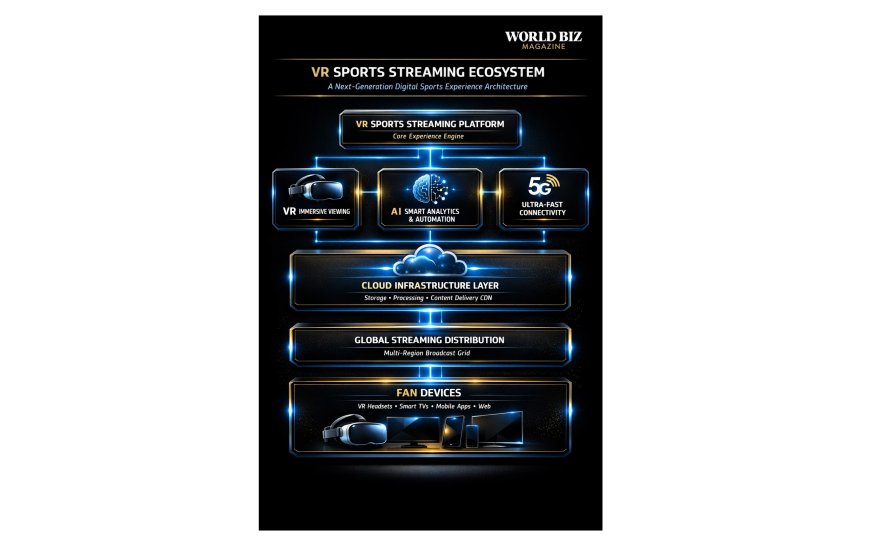
Ecosystem Architecture: From Platform to Fan Devices
The VR sports streaming ecosystem operates through a structured flow of technology layers:
- Core Platform: VR Sports Streaming Engine
- Technology Inputs: VR + AI + 5G
- Infrastructure Layer: Cloud Computing
- Distribution Layer: Global Streaming Networks
- End Layer: Fan Devices (VR headsets, smart TVs, mobile apps)
This architecture ensures that immersive sports experiences can be delivered efficiently to global audiences across multiple devices and platforms.
Virtual reality sports streaming depends on a powerful digital ecosystem that combines multiple advanced technologies to deliver immersive sports experiences in real time.
|
Technology Layer |
Role in VR Sports Streaming |
Key Capabilities |
|
Virtual Reality (VR) |
Creates immersive stadium environments |
360° viewing, virtual seating, interactive fan experiences |
|
Artificial Intelligence (AI) |
Processes game data and camera tracking |
automated highlights, player analytics, dynamic camera selection |
|
5G Networks |
Enables ultra-low latency streaming |
high-speed real-time VR video transmission |
|
Cloud Computing |
Manages data processing and streaming distribution |
scalable global streaming infrastructure |
|
AR / Mixed Reality |
Enhances live broadcasts with overlays |
real-time statistics, player tracking graphics |
|
Data Analytics Platforms |
Provides performance and fan insights |
predictive game analysis, viewer personalization |
VR Sports Streaming Ecosystem Visualization
VR SPORTS STREAMING PLATFORM
Key Insight
The integration of VR, artificial intelligence, 5G networks, and cloud computing creates the technological foundation for next-generation immersive sports broadcasting.
Top Companies Developing VR Sports Broadcasting Platforms
Several technology companies, media platforms, and digital infrastructure providers are actively developing VR-based sports broadcasting solutions.
|
Company |
Country |
Focus Area |
Key Contribution |
|
Meta Platforms |
USA |
VR hardware and metaverse |
VR headsets and immersive digital environments |
|
Apple |
USA |
Spatial computing |
Vision Pro immersive streaming ecosystem |
|
Microsoft |
USA |
Cloud and AI |
cloud-based immersive streaming infrastructure |
|
Google |
USA |
AI and streaming platforms |
immersive video technologies |
|
Sony |
Japan |
VR hardware and gaming ecosystems |
PlayStation VR immersive viewing |
|
NextVR (Apple acquisition) |
USA |
VR sports broadcasting |
immersive sports streaming experiences |
|
Intel Sports |
USA |
immersive sports analytics |
360° sports replay technology |
|
LiveLike VR |
USA |
social VR sports viewing |
virtual fan engagement platforms |
|
Unity Technologies |
USA |
real-time 3D development |
VR sports broadcasting software |
|
Messenger2050 Technologies |
Global |
immersive communication platforms |
next-generation VR-based digital event and streaming infrastructure |
Key Insight: The Power of Integration
The true strength of the VR sports streaming ecosystem lies not in individual technologies but in their integration. When VR, AI, 5G, and cloud computing operate together, they create a seamless digital environment capable of delivering next-generation sports experiences.
This integration enables:
- Real-time immersive broadcasting
- Personalized fan engagement
- Scalable global distribution
- New monetization models
Industry Leaders Driving VR Sports Innovation
A growing number of global technology companies and platforms are actively shaping the future of VR sports broadcasting:
- Meta Platforms is leading in VR hardware and metaverse ecosystems through its advanced headset technologies and immersive environments.
- Apple is redefining spatial computing with its Vision Pro ecosystem, integrating immersive streaming into its hardware ecosystem.
- Microsoft is leveraging its cloud and AI capabilities to support large-scale immersive streaming infrastructure.
- Google continues to innovate in AI-driven video processing and streaming platforms.
- Sony is advancing VR gaming and immersive viewing through PlayStation VR technologies.
- NextVR has pioneered immersive sports broadcasting experiences.
- Intel Sports is developing 360-degree replay and volumetric video technologies.
- LiveLike VR focuses on social VR viewing and fan interaction platforms.
- Unity Technologies provides the software backbone for real-time immersive content creation.
- Messenger2050 Technologies is emerging as a next-generation player in VR-based communication, digital events, and immersive streaming infrastructure.
Market Dynamics and Growth Outlook
The global VR sports streaming market is expected to witness exponential growth over the next decade, driven by increasing demand for immersive experiences, advancements in connectivity, and investments from major technology companies.
Key growth drivers include:
- Rising adoption of VR headsets
- Expansion of 5G networks globally
- Increasing demand for personalized content
- Growth of digital sports platforms and esports
As technology costs decrease and accessibility improves, VR sports streaming is likely to transition from a niche offering to a mainstream consumption model.
Challenges and Considerations
Despite its potential, the VR sports streaming ecosystem faces several challenges:
- High Infrastructure Costs: Deployment of VR-compatible broadcasting systems requires significant investment
- Hardware Accessibility: VR headsets are not yet widely adopted across all markets
- Bandwidth Requirements: High-quality VR streaming demands substantial network capacity
- Content Production Complexity: Creating immersive content requires advanced production techniques
Addressing these challenges will be critical for widespread adoption.
Future Outlook: The Next Era of Sports Media
The future of sports broadcasting will be defined by immersive, interactive, and data-driven experiences. VR sports streaming is expected to evolve beyond passive viewing into fully interactive environments where fans can engage, socialize, and even influence the viewing experience.
Emerging trends include:
- Metaverse-based sports experiences
- Interactive fan communities in VR
- AI-driven personalized broadcasting
- Integration of blockchain and digital ownership (NFTs)
Key Industry Insight
The future of VR sports broadcasting will likely be shaped by collaboration between technology giants, cloud infrastructure providers, and innovative media platforms developing immersive fan experiences.
Companies integrating VR streaming, AI analytics, and cloud-based distribution will play a critical role in defining the next generation of sports media.
Conclusion: Redefining the Sports Experience
The VR Sports Streaming Technology Ecosystem represents a paradigm shift in how sports are consumed and experienced. By integrating VR, AI, 5G, and cloud computing, the industry is building a powerful digital foundation for the future of sports entertainment.
Companies that successfully combine immersive technologies with scalable infrastructure will not only lead the next generation of sports media but also redefine global fan engagement.
World Biz Magazine Insights
Virtual reality sports streaming represents one of the most transformative innovations in modern sports media. As immersive technologies continue to mature, the traditional concept of watching sports on television screens may gradually evolve into fully interactive digital stadium experiences.
The convergence of VR hardware, artificial intelligence, cloud infrastructure, and high-speed connectivity will define the next generation of sports broadcasting. Companies capable of delivering immersive and personalized sports experiences will likely dominate the future global sports media ecosystem.
For sports leagues, broadcasters, and technology innovators, virtual reality is not simply a new viewing format it is a strategic gateway to the next era of global fan engagement and digital sports entertainment.
Disclaimer
The information presented in this article is intended for informational and editorial purposes only. Market forecasts, technological developments, and industry projections are based on publicly available research and industry data available at the time of publication.
The virtual reality and immersive media sectors are rapidly evolving, and technological adoption, investment trends, and market conditions may change over time. Readers are encouraged to conduct independent research and consult qualified professionals before making technology, business, or investment decisions based on the information provided.
World Biz Magazine and its contributors are not responsible for any outcomes resulting from the use of this information.
What's Your Reaction?
 Like
0
Like
0
 Dislike
0
Dislike
0
 Love
0
Love
0
 Funny
0
Funny
0
 Angry
0
Angry
0
 Sad
0
Sad
0
 Wow
0
Wow
0