



























































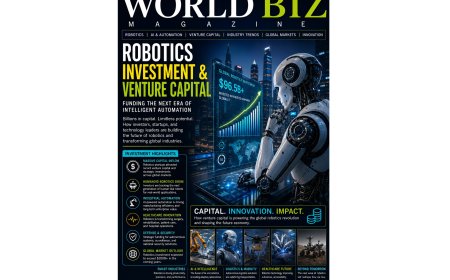













































































































































Robotics Investment & Venture Capital: The Future of Intelligent Automation
A detailed analysis of robotics venture capital, startup funding, AI integration, and the future of automation economies.

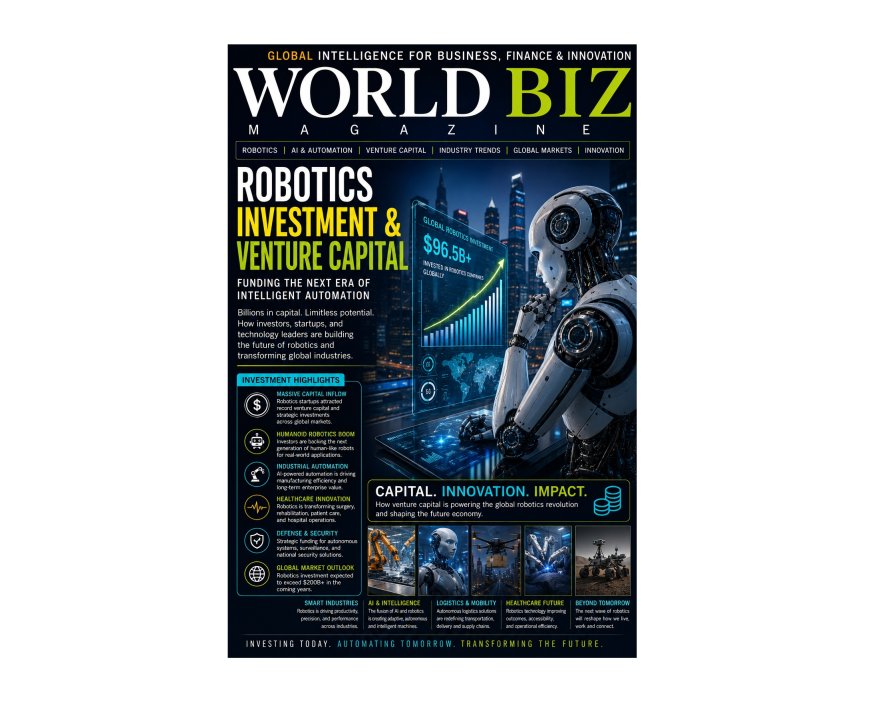
Robotics Investment & Venture Capital
How Investors Are Funding the Next Era of Intelligent Automation and AI-Driven Machines
From humanoid robotics and autonomous logistics to healthcare automation and defense systems, venture capital is accelerating the global robotics revolution
World Biz Magazine | Robotics, Venture Capital & Global Innovation Intelligence
The New Capital Race in Robotics
The robotics industry is rapidly becoming one of the most strategically important investment sectors in the global technology economy.
What was once considered a specialized engineering field has evolved into a multi-industry innovation ecosystem attracting billions in venture capital, sovereign wealth investment, private equity funding, corporate strategic partnerships, and government-backed innovation programs.
Across global markets, investors are increasingly betting that robotics may become one of the defining economic transformations of the next two decades.
The reasons behind this investment surge are structural, not temporary.
Aging populations, labor shortages, rising operational costs, geopolitical supply chain disruption, artificial intelligence breakthroughs, and accelerating digital transformation are collectively pushing industries toward automation at an unprecedented scale.
At the same time, advancements in:
- Artificial intelligence
- Computer vision
- Edge computing
- Sensor systems
- Semiconductors
- Battery technologies
- Autonomous mobility infrastructure
are making robotics commercially viable across sectors that previously remained difficult to automate.
This convergence is creating one of the largest investment opportunities in modern industrial history.
The next decade may determine which companies, investors, and nations control the future infrastructure of intelligent automation.
Why Robotics Has Become a Major Investment Sector
Unlike many short-term technology trends, robotics addresses deep long-term economic and operational challenges.
Global industries increasingly face:
- Workforce shortages
- Rising labor costs
- Productivity pressure
- Supply chain inefficiencies
- Demand for operational resilience
Robotics offers solutions capable of improving:
- Efficiency
- Scalability
- Precision
- Safety
- Cost optimization
This makes the industry attractive not only to venture capital firms seeking high-growth startups, but also to institutional investors searching for long-term strategic sectors.
What differentiates robotics from earlier automation cycles is the integration of artificial intelligence.
Modern robots are no longer limited to repetitive factory tasks. AI-powered systems can increasingly:
- Navigate dynamic environments
- Interpret data
- Learn from operational outcomes
- Collaborate with humans
- Make autonomous decisions
The combination of AI and robotics is fundamentally reshaping investor expectations regarding the scale of future automation markets.
Venture Capital and the Rise of Robotics Startups
Over the past decade, venture capital firms have aggressively expanded investment into robotics startups across multiple categories.
Investors are targeting companies developing:
- Humanoid robotics
- Warehouse automation
- Autonomous logistics systems
- Surgical robotics
- Agricultural automation
- Defense technologies
- Consumer robotics
- AI-powered industrial systems
The venture capital thesis behind robotics is increasingly centered on one core belief:
Intelligent automation may become foundational infrastructure for the future global economy.
Unlike traditional software startups, robotics companies often require:
- Large research budgets
- Hardware manufacturing capability
- Long development cycles
- Complex engineering teams
Despite these challenges, investor appetite remains strong because successful robotics companies may control extremely large industrial markets once scalability is achieved.
The Growth of AI-Driven Robotics Investment
Artificial intelligence has become the central force accelerating robotics investment globally.
Earlier robotics systems depended heavily on fixed programming and structured environments. Today, AI enables robots to adapt, analyze, predict, and improve continuously through machine learning systems.
This dramatically expands the commercial potential of robotics.
Investors increasingly favor robotics startups integrating:
- Generative AI
- Computer vision
- Neural networks
- Predictive analytics
- Autonomous operational systems
because intelligence not simply hardware is becoming the most valuable layer of the robotics economy.
Modern robotics investment increasingly resembles AI infrastructure investment.
The companies attracting the largest funding rounds are often those capable of combining:
- Hardware scalability
- AI software intelligence
- Real-world operational deployment
- Cloud connectivity
- Data-driven optimization systems
The future robotics market may ultimately be dominated not just by machine builders, but by companies controlling intelligent automation ecosystems.
Humanoid Robotics: The High-Risk, High-Reward Frontier
One of the most heavily funded segments of robotics today is humanoid robotics.
Humanoid robots are designed to operate in environments built for humans, including:
- Warehouses
- Hospitals
- Airports
- Retail spaces
- Offices
- Homes
Investors see enormous long-term potential because humanoid systems could theoretically perform a wide range of labor-intensive tasks without requiring major infrastructure redesign.
However, humanoid robotics also represents one of the highest-risk sectors in automation.
The technical challenges are immense:
- Mobility
- Balance
- Dexterity
- Energy efficiency
- Real-time decision-making
- Human interaction safety
Despite these obstacles, investment momentum continues accelerating because the commercial upside could be transformational.
If humanoid robotics becomes economically scalable, the implications for global labor markets, logistics, healthcare, and infrastructure could be historic.
The sector increasingly attracts:
- Venture capital firms
- AI investors
- Sovereign wealth funds
- Automotive manufacturers
- Technology giants
all competing for strategic positioning in what may become the next major industrial platform.
Robotics Investment in Logistics and Warehousing
The logistics sector has emerged as one of the strongest near-term investment opportunities in robotics.
Global e-commerce growth has dramatically increased demand for:
- Warehouse automation
- Autonomous inventory movement
- Robotic picking systems
- Smart fulfillment infrastructure
- Last-mile delivery automation
Investors favor logistics robotics because the commercial demand is immediate and measurable.
Companies operating fulfillment networks face enormous pressure to improve:
- Speed
- Efficiency
- Labor optimization
- Operational scalability
Robotics provides a direct solution.
Warehouse automation startups increasingly attract funding because they generate:
- Clear operational ROI
- Enterprise demand
- Scalable deployment opportunities
As global supply chains become more digitized, autonomous logistics systems may become one of the largest robotics markets over the next decade.
Healthcare Robotics and Long-Term Demographic Investment
Healthcare robotics represents another major investment frontier.
Aging populations across developed economies are creating structural pressure on healthcare systems worldwide.
Hospitals increasingly face:
- Staffing shortages
- Rising operational costs
- Higher patient demand
- Long-term elderly care challenges
Robotics startups developing:
- Surgical systems
- Rehabilitation robotics
- Elderly assistance technologies
- Hospital logistics automation
- AI-powered diagnostics
are attracting growing investor attention.
Healthcare robotics offers something highly attractive to long-term investors:
Persistent demographic demand.
Unlike cyclical technology trends, aging populations create structural healthcare automation opportunities that may continue expanding for decades.
Defense and National Security Robotics Investment
Defense robotics has become one of the fastest-growing strategic investment sectors globally.
Governments increasingly invest in:
- Autonomous drones
- AI-powered surveillance systems
- Unmanned military vehicles
- Border security robotics
- Autonomous maritime systems
Defense technology startups are receiving increasing support from:
- Government contracts
- Defense-focused venture capital
- Strategic military partnerships
National security concerns, geopolitical tensions, and technological competition are accelerating defense robotics investment worldwide.
However, the rise of autonomous military systems also raises major ethical and geopolitical questions regarding:
- AI warfare
- Human oversight
- International regulation
- Autonomous weapon systems
The future of defense robotics may become one of the defining technology policy debates of the next decade.
Sovereign Wealth Funds and Government Robotics Strategy
Robotics is no longer only a private-sector investment trend.
Governments increasingly view robotics as critical national infrastructure.
Countries investing aggressively in robotics ecosystems aim to strengthen:
- Manufacturing competitiveness
- AI leadership
- Supply chain resilience
- Defense capability
- Technological sovereignty
The China continues investing heavily in industrial automation and domestic robotics manufacturing as part of broader long-term economic strategy.
The United States remains highly influential in AI software, autonomous systems, and venture-backed robotics innovation.
Japan continues leading industrial robotics and elderly-care robotics development.
South Korea increasingly integrates robotics into smart infrastructure and advanced manufacturing ecosystems.
The European Union focuses heavily on ethical AI governance, automation regulation, and industrial competitiveness.
Robotics investment is increasingly becoming a geopolitical competition.
Challenges Facing Robotics Investors
Despite enormous long-term potential, robotics investment remains highly complex.
Unlike pure software companies, robotics startups face substantial operational barriers including:
- Hardware manufacturing costs
- Supply chain dependency
- Regulatory complexity
- Long commercialization timelines
- Safety certification requirements
Capital intensity remains one of the biggest risks in robotics investing.
Many startups require years of funding before reaching scalable profitability.
Investors must also navigate:
- AI safety concerns
- Cybersecurity risks
- Market adoption uncertainty
- Ethical debates surrounding automation and labor displacement
The robotics industry offers enormous upside but also significant execution risk.
Robotics IPOs, Mergers, and Exit Opportunities
As the industry matures, robotics startups are increasingly becoming acquisition targets for:
- Technology giants
- Industrial manufacturers
- Automotive companies
- Defense contractors
- Logistics firms
Future robotics exits may occur through:
- IPOs
- Strategic acquisitions
- Cross-industry partnerships
- AI ecosystem consolidation
The robotics sector may eventually mirror the evolution of cloud computing and semiconductor industries, where a small number of dominant infrastructure companies control large portions of the market.
ESG, Sustainability, and Robotics Capital
Robotics increasingly aligns with ESG and sustainability investment themes.
Automation systems can support:
- Energy optimization
- Waste reduction
- Precision agriculture
- Smart manufacturing efficiency
- Safer industrial operations
Autonomous systems may also improve:
- Renewable energy infrastructure
- Climate monitoring
- Smart city sustainability
As ESG investing evolves, robotics may become increasingly integrated into long-term sustainable infrastructure strategies.
The Future of Robotics Investment
Between 2025 and 2035, robotics investment may accelerate into one of the largest capital deployment cycles in modern technology history.
The next decade could produce:
- Commercial humanoid robotics ecosystems
- Autonomous logistics networks
- AI-integrated manufacturing infrastructure
- Smart healthcare automation systems
- Robotics-as-a-service business models
- Intelligent urban infrastructure platforms
The companies that successfully combine:
- AI intelligence
- Scalable hardware
- Real-world deployment capability
- Operational reliability
- Data-driven optimization
may emerge as the dominant infrastructure providers of the automation economy.
World Biz Magazine Insights
WBJ Insight 01 - Robotics is Becoming a Strategic Capital Sector
Investors increasingly view robotics as long-term economic infrastructure rather than speculative technology experimentation.
WBJ Insight 02 - AI Integration Will Determine Valuation Leadership
The most valuable robotics companies may ultimately be AI intelligence platforms operating through physical systems.
WBJ Insight 03 - Humanoid Robotics Could Reshape Venture Capital Markets
If commercialization accelerates, humanoid systems may become one of the largest technology investment categories globally.
WBJ Insight 04 - Sovereign Investment Will Influence Global Robotics Power
Governments increasingly view robotics as a strategic national competitiveness issue.
WBJ Insight 05 - The Future Robotics Economy Will Be Ecosystem-Driven
The winners may not simply build robots they will control data, AI infrastructure, operational networks, and automation platforms.
Conclusion
Robotics investment is entering a transformational era.
What was once considered a niche engineering industry is rapidly evolving into one of the most strategically important sectors in global technology and venture capital markets.
The convergence of:
- Artificial intelligence
- Intelligent automation
- Smart infrastructure
- Healthcare transformation
- Logistics modernization
- Defense technology
is creating unprecedented demand for robotics innovation.
Between 2025 and 2035, robotics may evolve from industrial automation into foundational global infrastructure influencing nearly every major economic sector.
For investors, the opportunity is enormous but so is the complexity.
The future leaders of robotics will likely be the companies capable of combining advanced AI intelligence with scalable real-world operational systems.
The robotics revolution is no longer theoretical.
It is becoming one of the defining capital races of the modern economy.
Disclaimer
This article is intended for informational and editorial purposes only and does not constitute financial, investment, legal, operational, engineering, or strategic advice. Investment markets, startup performance, and technology sectors involve significant risks and uncertainties. Readers should conduct independent research and consult qualified professionals before making investment or business decisions.
What's Your Reaction?
 Like
0
Like
0
 Dislike
0
Dislike
0
 Love
0
Love
0
 Funny
0
Funny
0
 Angry
0
Angry
0
 Sad
0
Sad
0
 Wow
0
Wow
0