







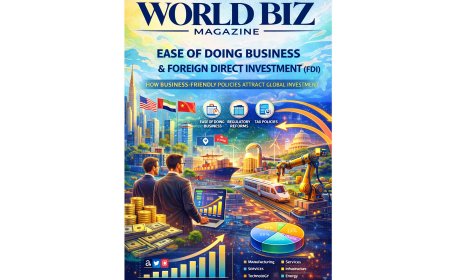



























































































































































Ease of Doing Business and FDI: How Business-Friendly Policies Attract Global Investment
A World Biz Magazine analysis of how regulatory efficiency and business-friendly policies attract global investment and FDI.


Ease of Doing Business & Foreign Direct Investment (FDI)
How Business-Friendly Policies Drive Global Investment Flows
World Biz Magazine | Global Economy & Investment Special Report
In the modern global economy, countries compete not only through natural resources or labor costs but increasingly through the ease of doing business they offer to domestic and foreign investors. For multinational corporations, institutional investors, and international entrepreneurs, the regulatory and administrative environment of a country can determine whether an investment opportunity becomes a long-term strategic venture or an abandoned proposal.
Ease of Doing Business refers to the overall regulatory environment in which businesses operate. It encompasses the processes required to start a company, obtain permits, access finance, protect investments, pay taxes, and enforce contracts. Countries with streamlined regulatory systems and transparent governance structures are generally more attractive destinations for Foreign Direct Investment (FDI).
Over the past decade, governments around the world have introduced significant reforms aimed at simplifying administrative procedures, improving digital governance, and creating investor-friendly environments. These reforms are designed to stimulate economic growth, attract global capital, and promote private-sector development.
This World Biz Magazine Industry Today report explores the relationship between ease of doing business and foreign direct investment, analyzing regulatory frameworks, economic policies, global rankings, investment trends, and the outlook for international capital flows through 2035.
Understanding Ease of Doing Business
Ease of Doing Business is a concept used to measure how easily businesses can start, operate, and expand within a country. It evaluates regulatory efficiency, legal protections, administrative procedures, and infrastructure availability.
Countries that reduce bureaucratic obstacles and provide predictable legal environments tend to attract higher levels of domestic and foreign investment.
Ease of Doing Business indicators typically assess several areas of economic activity, including business registration, construction permits, property registration, credit access, tax compliance, and dispute resolution. These factors collectively shape the overall investment environment.
When regulatory processes are transparent, efficient, and predictable, businesses can operate with greater confidence and lower operational risk.
Relationship Between Ease of Doing Business and FDI
Foreign investors are particularly sensitive to regulatory conditions when evaluating new markets. Establishing operations in a foreign country involves navigating unfamiliar legal systems, regulatory requirements, and business practices. If administrative procedures are excessively complex or unpredictable, investors may choose alternative markets with more favorable business environments.
A strong ease-of-doing-business framework supports FDI in several ways.
First, simplified company registration procedures enable foreign companies to establish operations quickly.
Second, transparent legal systems protect investors’ rights and ensure fair dispute resolution.
Third, efficient tax and regulatory policies reduce operational costs and improve long-term investment profitability.
As a result, countries that implement business-friendly reforms often experience increased FDI inflows.
Key Factors Influencing Ease of Doing Business
Several major factors determine how easily companies can operate in a given market.
Business Registration and Licensing
The time and cost required to register a company significantly influence investment decisions. In countries where business registration takes weeks or months, investors may face costly delays before operations begin.
Many governments have introduced digital registration systems that allow companies to establish businesses within days or even hours.
Regulatory Transparency
Clear and predictable regulations help investors plan long-term business strategies. Sudden regulatory changes or inconsistent enforcement of laws can discourage foreign investment.
Countries with transparent regulatory systems create a stable environment for investors.
Taxation Policies
Corporate taxation policies strongly influence business profitability. Competitive tax rates, investment incentives, and tax stability attract multinational corporations seeking efficient global tax structures.
Many countries establish special economic zones or investment incentives to encourage foreign investment.
Infrastructure Quality
Reliable infrastructure is essential for efficient business operations. Transportation networks, energy supply, telecommunications systems, and digital infrastructure all contribute to the ease of conducting business.
Countries with advanced infrastructure reduce logistical costs and increase productivity for investors.
Legal Protection of Investors
Foreign investors require strong legal protections for property rights and contractual agreements. Effective judicial systems and arbitration mechanisms ensure that business disputes can be resolved fairly and efficiently.
Investor confidence increases when legal frameworks are reliable and enforceable.
Global Ease of Doing Business Leaders
Several economies consistently rank among the most business-friendly investment destinations.
Countries such as Singapore, Switzerland, New Zealand, the United Arab Emirates, and Denmark have implemented extensive regulatory reforms that support efficient business operations.
These countries offer streamlined company registration systems, transparent legal frameworks, and strong infrastructure networks, making them highly attractive to global investors.
Their success demonstrates how regulatory efficiency can translate into increased investment flows and economic growth.
Emerging Markets Improving Business Environments
Many emerging economies are actively improving their regulatory environments to attract foreign investment.
Countries including India, Vietnam, Indonesia, and Saudi Arabia have introduced significant business reforms in recent years. These reforms include digitalizing government services, simplifying licensing procedures, and strengthening investor protections.
As a result, these markets are attracting growing levels of international capital and becoming important hubs in global supply chains.
Ease of Doing Business and Industrial Development
Business-friendly environments do more than attract investment they also promote industrial growth.
Manufacturing industries often require large-scale investments in infrastructure, equipment, and workforce training. Countries that provide efficient regulatory systems and investment incentives create favorable conditions for industrial expansion.
Technology companies also favor environments where intellectual property rights are protected and regulatory frameworks support innovation.
Consequently, ease of doing business plays a central role in shaping the development of key economic sectors.
Government Policies Supporting Investment
Governments seeking to improve their investment climate often implement comprehensive economic reforms.
These reforms may include:
· reducing bureaucratic procedures
· digitalizing public administration services
· establishing one-stop investment centers
· strengthening investor protection laws
· providing tax incentives for strategic industries
Investment promotion agencies frequently coordinate these efforts to attract international investors.
Challenges to Improving Business Environments
Despite global progress, many countries still face challenges in improving ease of doing business.
Complex administrative procedures, regulatory inconsistencies, corruption risks, and infrastructure gaps can hinder investment.
In some regions, political instability and policy uncertainty also discourage investors from entering local markets.
Addressing these challenges requires sustained policy reforms and institutional improvements.
Global Investment Trends and Business Environment Reforms
In recent years, the global investment landscape has evolved significantly.
Digital transformation has encouraged governments to adopt electronic governance systems that streamline regulatory processes. Online company registration platforms, digital tax filing systems, and electronic licensing procedures are becoming standard features in many economies.
These reforms reduce administrative burdens and improve transparency for businesses.
Future Outlook for Ease of Doing Business and FDI
Looking toward 2035, several trends are likely to shape the relationship between business environments and global investment.
First, digital governance systems will continue improving administrative efficiency and reducing bureaucratic barriers.
Second, sustainable investment policies will encourage investment in green infrastructure, renewable energy, and environmentally responsible industries.
Third, regional economic integration will create new cross-border investment opportunities as trade agreements expand.
Countries that continue modernizing their regulatory frameworks will be better positioned to attract future investment flows.
World Biz Magazine Insights
Ease of doing business has evolved from a regulatory concept into a central pillar of economic competitiveness. Nations that simplify business procedures, strengthen legal protections, and invest in infrastructure are creating powerful incentives for global investors.
As international capital flows become increasingly competitive, governments must continually refine their policies to maintain investor confidence.
Conclusion
Ease of Doing Business is a critical factor influencing Foreign Direct Investment and global economic development. Countries that prioritize regulatory transparency, efficient administrative systems, and investor protections create environments where businesses can thrive.
As global competition for investment intensifies, policymakers must recognize that a favorable business environment is not only a regulatory advantage but also a strategic economic asset.
The countries that successfully build efficient and transparent business environments will lead the next era of global investment and economic growth.
Disclaimer
The information presented in this article is intended for informational and educational purposes only. Market statistics, projections, and forecasts are based on publicly available industry data and analytical estimates at the time of publication. While every effort has been made to ensure accuracy, World Biz Magazine does not guarantee future market performance or investment outcomes. Readers should consult professional advisors before making financial or strategic decisions based on the information contained in this report. All trademarks and company names mentioned belong to their respective owners.
What's Your Reaction?
 Like
0
Like
0
 Dislike
0
Dislike
0
 Love
0
Love
0
 Funny
0
Funny
0
 Angry
0
Angry
0
 Sad
0
Sad
0
 Wow
0
Wow
0