










































































































































































































Global Apparel Manufacturing Shift: Why Asia and Africa Are Becoming Fashion Production Hubs
A World Biz Magazine analysis of the global apparel manufacturing shift toward Asia and Africa, covering trade policies, investment trends, export leaders, and industry forecasts.

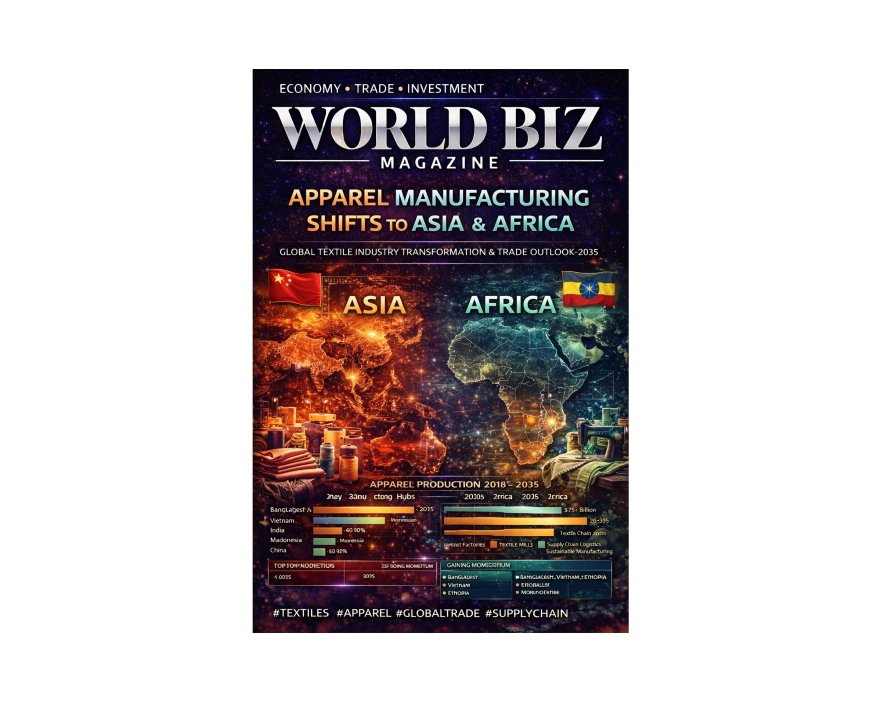
Apparel Manufacturing Shifts to Asia & Africa
Global Industry Transformation, Trade Dynamics & Outlook to 2035
World Biz Magazine | Industry Today Special Report
The global apparel manufacturing industry is undergoing a major structural transformation as production shifts from traditional manufacturing hubs toward emerging economies across Asia and Africa. Driven by rising labor costs in established markets, geopolitical supply chain diversification, and government-led industrial policies, apparel production is increasingly relocating to lower-cost regions with expanding manufacturing capacity.
This transition is reshaping global trade patterns, labor markets, foreign investment flows, and supply chain strategies for international fashion brands.
The World Biz Magazine Industry Today report explores the drivers behind this shift, including economic policies, political influences, investment trends, production costs, export leadership, inflation impacts, and the future outlook for apparel manufacturing through 2035.
Global Apparel Industry Overview
The global apparel manufacturing sector represents one of the largest labor-intensive industries in the world.
Global Market Size
|
Year |
Market Value |
|
2015 |
$1.3 trillion |
|
2020 |
$1.5 trillion |
|
2024 |
$1.77 trillion |
|
2030 (forecast) |
$2.2 trillion |
|
2035 (forecast) |
$2.7 trillion |
The sector supports tens of millions of jobs globally and plays a vital role in economic development, particularly in emerging markets.
Why Apparel Manufacturing Is Moving
Several structural forces are pushing production toward Asia and Africa.
Rising Labor Costs
Manufacturing wages in China have increased significantly over the past decade, making production more expensive for global brands.
Supply Chain Diversification
Companies are reducing dependence on single-country supply chains due to geopolitical tensions and pandemic disruptions.
Government Incentives
Emerging economies offer tax incentives, export subsidies, and industrial zones to attract foreign manufacturers.
Trade Agreements
Preferential trade access to the European Union and United States encourages manufacturing relocation to countries with favorable trade agreements.
Major Apparel Manufacturing Regions
Asia
Asia remains the largest apparel manufacturing hub globally.
Key manufacturing countries include:
- China
- Bangladesh
- Vietnam
- India
- Indonesia
- Cambodia
Asia accounts for over 60% of global garment production.
Bangladesh
Bangladesh has become the second-largest apparel exporter globally due to:
- low labor costs
- large-scale manufacturing capacity
- strong export infrastructure
The country’s garment sector accounts for nearly 80% of national export earnings.
Vietnam
Vietnam has rapidly expanded apparel exports through:
- free trade agreements
- foreign direct investment
- modern textile factories
Vietnam is now one of the fastest-growing garment exporters worldwide.
Africa
Africa is emerging as a new frontier for apparel manufacturing.
Key countries include:
- Ethiopia
- Kenya
- Morocco
- Egypt
- Madagascar
Several African governments are investing heavily in textile industrial zones to attract global brands.
Ethiopia
Ethiopia positioned itself as a low-cost apparel production hub with:
- government-backed industrial parks
- export-focused manufacturing policies
- competitive labor costs
However, political instability and infrastructure challenges have slowed progress in recent years.
Morocco
Morocco has become a key supplier for European fashion brands due to its geographic proximity and strong logistics infrastructure.
Key Players in Global Apparel Manufacturing
Major global apparel brands outsourcing production include:
- Nike
- H&M
- Zara (Inditex)
- Adidas
- Uniqlo
- Levi’s
- Gap Inc.
These companies operate global sourcing networks spanning dozens of manufacturing countries.
Policies and Political Influence
Government policies strongly shape apparel manufacturing relocation.
Key Policy Drivers
- export incentives
- labor regulations
- environmental compliance laws
- import tariffs
- regional trade agreements
For example:
- The African Growth and Opportunity Act (AGOA) provides African countries with duty-free access to the US market.
- The EU Generalised Scheme of Preferences (GSP) supports apparel exports from developing economies.
Political stability and regulatory transparency are crucial for attracting apparel investment.
Investment Trends in Apparel Manufacturing
Global investment is flowing into emerging production hubs.
Key Investors
- multinational fashion brands
- private equity funds
- sovereign wealth funds
- textile manufacturers
Investment focuses on:
- automated garment factories
- sustainable textile production
- supply chain logistics infrastructure
- apparel industrial zones
Asia continues to attract the majority of apparel investment, but Africa is gaining attention as a long-term manufacturing destination.
Countries Gaining Investment
Several countries are emerging as new apparel manufacturing hubs.
Asia
- Vietnam
- Bangladesh
- India
- Indonesia
- Cambodia
Africa
- Ethiopia
- Morocco
- Egypt
- Kenya
These regions offer competitive labor costs and growing manufacturing infrastructure.
Countries Losing Manufacturing Momentum
Some traditional manufacturing hubs are experiencing declining competitiveness due to rising costs.
Key Examples
- China (higher wages and regulatory costs)
- Eastern Europe (labor shortages)
- parts of Latin America (logistics challenges)
As a result, global brands are shifting production toward lower-cost regions.
Price Trends and Cost Inflation
Apparel manufacturing costs have increased globally due to:
- rising wages
- energy price increases
- transportation costs
- sustainability compliance costs
However, manufacturers in emerging economies still maintain cost advantages compared to developed markets.
10-Year Price Flow in Apparel Production
|
Period |
Trend |
|
2015-2018 |
Stable manufacturing costs |
|
2019 |
gradual price increases |
|
2020 |
supply chain disruptions |
|
2021-2023 |
inflation-driven cost increases |
|
2024-2025 |
stabilization with efficiency improvements |
Automation and supply chain optimization may reduce costs in the future.
Future Outlook to 2035
The apparel manufacturing landscape will continue evolving over the next decade.
Key Trends
Regional Diversification
Manufacturing will spread across multiple countries to reduce risk.
Automation
Advanced robotics and AI may transform production efficiency.
Sustainable Manufacturing
Environmental regulations will reshape textile production.
Digital Supply Chains
Blockchain and AI will improve traceability and logistics management.
Apparel Manufacturing Forecast
|
Region |
Growth Outlook |
|
Southeast Asia |
Strong growth |
|
South Asia |
Strong growth |
|
Africa |
Rapid emerging growth |
|
Europe |
Moderate decline |
|
China |
Stable but shifting toward high-value production |
Africa could become a major apparel production hub by 2035 if infrastructure investment continues.
Comparison with Other Global Industries
|
Industry |
Global Size |
|
Consumer Goods |
$30+ trillion |
|
Energy |
$7–8 trillion |
|
Automotive |
$4 trillion |
|
Fashion |
$3+ trillion |
|
Apparel Manufacturing |
$2.7 trillion by 2035 |
Apparel manufacturing remains one of the largest labor-intensive industries globally.
World Biz Magazine Insights
The shift of apparel manufacturing toward Asia and Africa reflects broader transformations in the global economy.
Three major trends define the future:
- Diversified supply chains replacing single-country dependence
- Emerging markets becoming manufacturing powerhouses
- Sustainability shaping production standards
Companies that build flexible supply networks and invest in sustainable production will dominate the next era of apparel manufacturing.
Conclusion
The migration of apparel manufacturing toward Asia and Africa represents one of the most significant industrial shifts in the global fashion industry.
Driven by cost advantages, trade policies, and supply chain diversification, these regions are poised to play an increasingly important role in global garment production.
By 2035, Asia will remain the dominant manufacturing hub, while Africa may emerge as the next frontier for apparel production, transforming the economic landscape of global fashion.
Disclaimer
The information presented in this article is intended for informational and educational purposes only. Market statistics, projections, and forecasts are based on publicly available industry data and analytical estimates at the time of publication. While every effort has been made to ensure accuracy, World Biz Magazine does not guarantee future market performance or investment outcomes. Readers should consult professional advisors before making financial or strategic decisions based on the information contained in this report. All trademarks and company names mentioned belong to their respective owners.
What's Your Reaction?
 Like
0
Like
0
 Dislike
0
Dislike
0
 Love
0
Love
0
 Funny
0
Funny
0
 Angry
0
Angry
0
 Sad
0
Sad
0
 Wow
0
Wow
0