
























































































































Fulfillment by Amazon vs Independent Logistics: A Complete Guide for E-Commerce Businesses
Compare Fulfillment by Amazon (FBA) and independent fulfillment models. Learn the differences in cost, scalability, control, and growth strategies for e-commerce success.

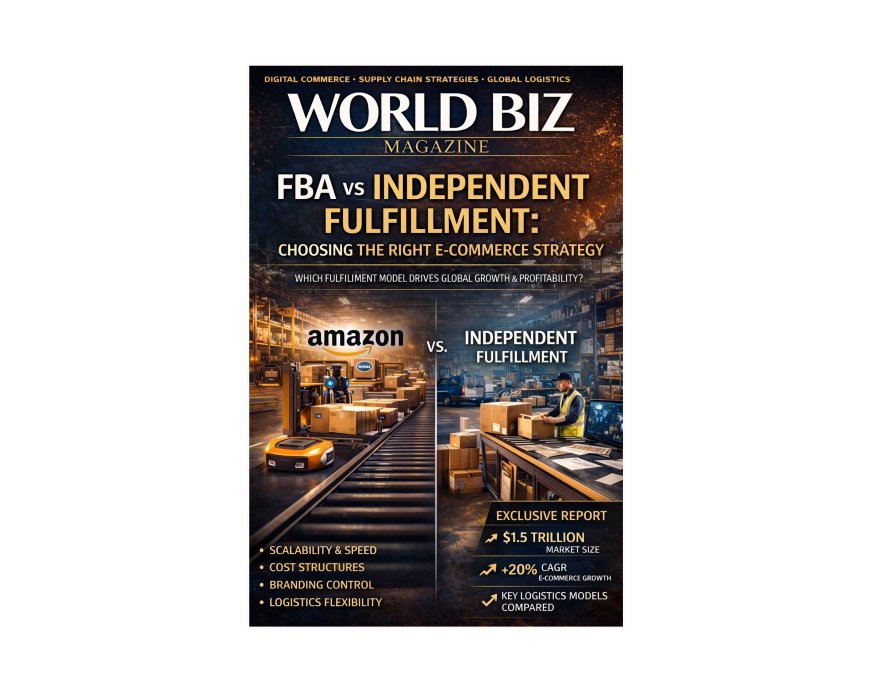
Fulfillment by Amazon (FBA) vs Independent Fulfillment: Choosing the Right Strategy for Global E-Commerce Growth
World Biz Magazine | E-Commerce, Logistics & Digital Strategy Report
The Fulfillment Decision That Defines E-Commerce Success
In today’s hyper-competitive e-commerce landscape, fulfillment is no longer a backend function it is a strategic decision that directly impacts growth, scalability, and profitability.
At the center of this decision lies a critical choice: Use Amazon’s Fulfillment by Amazon (FBA) ecosystem
or
Build and manage independent fulfillment operations
This choice determines everything from delivery speed and customer experience to margins and long-term brand control.
Understanding the Two Models
Fulfillment by Amazon (FBA)
FBA is a service where sellers store products in Amazon warehouses, and Amazon handles:
- Storage
- Picking & packing
- Shipping
- Customer service
- Returns
It is a fully integrated, plug-and-play fulfillment solution
Independent Fulfillment
Independent fulfillment means managing logistics outside Amazon, either through:
- In-house warehouses
- Third-party logistics (3PL) providers
Examples include partnerships with DHL or FedEx.
It offers full control but requires operational expertise
FBA vs Independent Fulfillment: Core Comparison
|
Factor |
FBA |
Independent Fulfillment |
|
Setup |
Easy & fast |
Complex |
|
Control |
Limited |
Full control |
|
Scalability |
High |
Depends on infrastructure |
|
Cost Structure |
Fees-based |
Variable |
|
Branding |
Limited |
Fully customizable |
|
Customer Data |
Restricted |
Full access |
Fulfillment by Amazon (FBA): Strategic Advantages
Instant Global Infrastructure
FBA gives sellers access to:
- Amazon’s global warehouse network
- Fast shipping (Prime delivery)
Enables rapid international expansion
Customer Trust & Conversion Boost
Products fulfilled by Amazon benefit from:
- Prime badge
- Faster delivery
Higher conversion rates and sales volume
Operational Simplicity
FBA eliminates:
- Warehousing headaches
- Logistics management
Ideal for startups and scaling businesses
Automated Returns & Customer Support
Amazon handles post-sale processes, reducing operational burden.
FBA Limitations
- High fees (storage + fulfillment)
- Limited branding opportunities
- Dependence on Amazon ecosystem
- Restricted customer data access
Sellers risk becoming platform-dependent
Independent Fulfillment: Strategic Advantages
Full Brand Control
- Custom packaging
- Personalized customer experience
Stronger brand identity
Higher Margin Potential
- No platform fees
- Cost optimization over time
Better long-term profitability
Multi-Channel Flexibility
Sell across:
- Own website
- Marketplaces
- Retail channels
Not tied to a single platform
Data Ownership
- Access to customer insights
- Ability to build long-term relationships
Independent Fulfillment Challenges
- High initial investment
- Complex logistics management
- Slower scalability
- Requires operational expertise
Technology & Automation Impact
Both models are evolving rapidly with technology:
Key Innovations:
- AI-driven inventory management
- Warehouse robotics
- Real-time tracking systems
- Route optimization for delivery
Independent players can now compete with FBA using advanced logistics tech
Cost Analysis: Short-Term vs Long-Term
FBA
- Low upfront cost
- High ongoing fees
Independent
- High initial investment
- Lower long-term costs
Decision depends on business stage and scale
Global Expansion Strategy
FBA Approach
- Enter new markets quickly
- Use Amazon’s logistics network
Independent Approach
- Build regional warehouses
- Partner with local logistics providers
Hybrid strategies are increasingly common
Hybrid Model: The Emerging Trend
Many businesses now combine both:
- Use FBA for:
- Fast-moving products
- International markets
- Use independent fulfillment for:
- Brand-focused products
- Direct-to-consumer channels
This approach balances scale + control
Risks & Strategic Considerations
|
Risk |
FBA |
Independent |
|
Platform dependency |
High |
Low |
|
Operational complexity |
Low |
High |
|
Margin pressure |
Medium-High |
Medium |
|
Scalability risk |
Low |
Medium |
World Biz Magazine Insights
Fulfillment is Now a Strategic Asset
Companies are competing on logistics, not just products.
Platform vs Independence is the Core Battle
FBA represents speed and scale, while independent fulfillment represents control and brand power.
Technology is Closing the Gap
Automation tools are enabling independent sellers to compete with giants.
Hybrid Models Will Dominate the Future
Businesses will not choose one they will combine both strategies.
Data Ownership is the Hidden Advantage
Owning customer data will define long-term success.
Conclusion
The choice between FBA and independent fulfillment is not simply operational it is strategic and transformational.
- FBA offers speed, simplicity, and scale
- Independent fulfillment offers control, flexibility, and long-term value
The winning strategy depends on:
- Business stage
- Growth ambitions
- Brand positioning
As e-commerce continues to evolve, fulfillment will determine:
- Customer experience
- Profit margins
- Market dominance
The future belongs to businesses that master fulfillment not just sales
Disclaimer
This article is published by World Biz Magazine for informational and analytical purposes only.
- Business strategies, cost structures, and operational insights are based on industry trends and may vary depending on market conditions.
- References to Amazon, DHL, and FedEx are for illustrative purposes only and do not imply endorsement or partnership.
- Readers are advised to conduct independent research and consult professionals before making operational or investment decisions.
What's Your Reaction?
 Like
0
Like
0
 Dislike
0
Dislike
0
 Love
0
Love
0
 Funny
0
Funny
0
 Angry
0
Angry
0
 Sad
0
Sad
0
 Wow
0
Wow
0