































































































































































Investment Banking Business Models: How Global Financial Institutions Operate
Discover how investment banks make money through IPOs, M&A advisory, institutional trading, asset management, and global financial services.

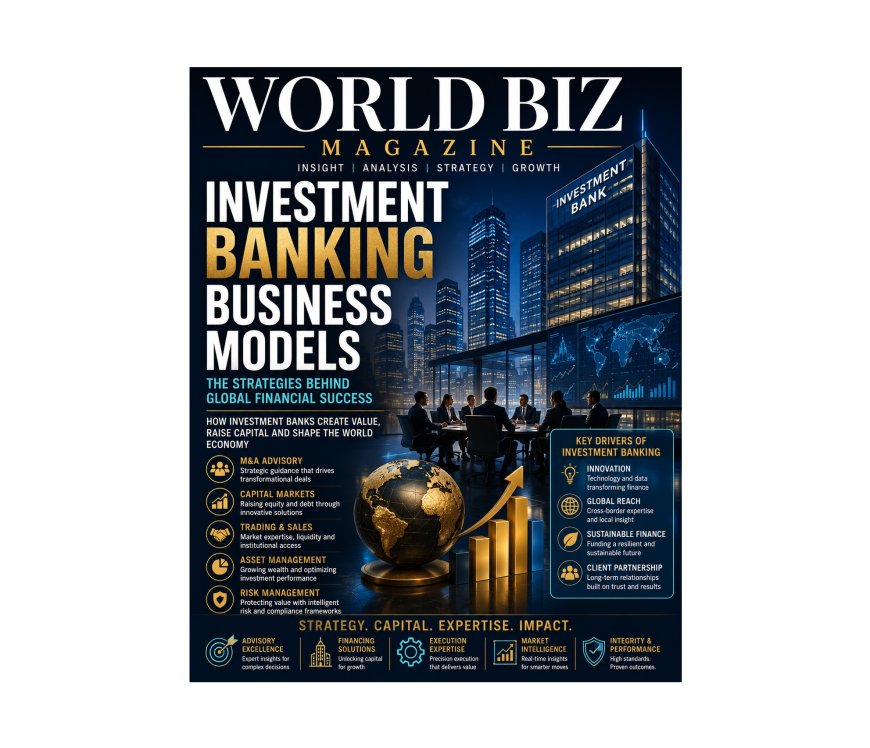
Investment Banking Business Models
Understanding the Financial Structures Powering Global Capital Markets
World Biz Magazine | Global Financial Intelligence, Banking & Fintech, Consumer Finance
The Strategic Core of Global Finance
Investment banking stands at the center of the modern financial system. From billion-dollar mergers and corporate fundraising to global stock offerings and infrastructure financing, investment banks play a critical role in shaping the direction of economies, corporations, governments, and financial markets worldwide. Unlike traditional retail or commercial banks that primarily serve consumers and businesses through deposits and loans, investment banks operate within capital markets, corporate finance, institutional investing, and strategic financial advisory services.
Over the past century, investment banking has evolved into one of the most influential sectors in the global economy. Major investment banking institutions facilitate complex financial transactions that influence industries, create multinational corporations, finance infrastructure megaprojects, support technological innovation, and drive international capital flows. Their business models are built around advisory expertise, financial engineering, market access, institutional relationships, risk management, and global capital allocation.
The investment banking industry operates through highly specialized business models designed to generate revenue from corporate advisory services, securities underwriting, mergers and acquisitions, trading operations, asset management, institutional brokerage, and alternative investments. These models vary significantly depending on the size, geographic reach, specialization, and strategic focus of the institution.
Modern investment banking is also undergoing rapid transformation due to technological disruption, regulatory changes, fintech innovation, artificial intelligence, environmental investing, geopolitical risk, and evolving capital market dynamics. Digital infrastructure, algorithmic trading, private capital expansion, sustainable finance, and decentralized financial systems are reshaping how investment banks operate and compete globally.
As financial markets become increasingly interconnected and sophisticated, understanding investment banking business models has become essential for investors, entrepreneurs, policymakers, corporate executives, and financial professionals seeking insight into the mechanisms driving global capital markets.
What Is Investment Banking?
Investment banking refers to specialized financial services focused primarily on capital raising, corporate finance, strategic advisory, institutional trading, and complex financial transactions. Investment banks help corporations, governments, institutions, and high-net-worth clients raise capital, manage financial risk, execute mergers and acquisitions, and access global financial markets.
Core investment banking activities include:
- Initial Public Offerings (IPOs)
- Mergers and acquisitions (M&A)
- Debt financing
- Equity financing
- Institutional trading
- Securities underwriting
- Asset management
- Wealth management
- Structured finance
- Risk management
- Market research
- Corporate restructuring
Investment banks act as intermediaries between capital providers and organizations seeking financing or strategic financial solutions.
Unlike commercial banks, investment banks typically do not focus primarily on consumer deposits or retail banking services. Their clients are generally corporations, institutional investors, governments, sovereign wealth funds, private equity firms, hedge funds, and large financial organizations.
The Core Investment Banking Business Model
At its core, the investment banking business model revolves around generating revenue through financial advisory services, transaction execution, market intermediation, and institutional financial operations.
Investment banks earn money through:
- Advisory fees
- Underwriting commissions
- Trading profits
- Asset management fees
- Brokerage services
- Financing spreads
- Performance incentives
The industry is relationship-driven, highly competitive, and deeply connected to global financial markets.
Corporate Advisory Business Model
One of the most important investment banking business models involves corporate advisory services.
Mergers and Acquisitions (M&A)
Investment banks advise corporations on mergers, acquisitions, divestitures, buyouts, and strategic restructuring transactions.
Advisory services include:
- Company valuation
- Deal structuring
- Due diligence
- Negotiation support
- Regulatory guidance
- Financing strategy
- Transaction execution
Investment banks earn advisory fees based on the size and complexity of the transaction.
Major global M&A deals often involve billions of dollars and require extensive legal, financial, regulatory, and strategic expertise.
Corporate Restructuring
Investment banks also assist struggling or highly leveraged companies with restructuring operations, refinancing debt, asset sales, bankruptcy planning, and turnaround strategies.
This advisory model becomes especially important during economic downturns and financial crises.
Securities Underwriting Business Model
Securities underwriting represents one of the foundational revenue models within investment banking.
Equity Underwriting
Investment banks help companies raise capital by issuing shares through:
- Initial Public Offerings (IPOs)
- Secondary offerings
- Private placements
The bank purchases securities from the issuer and resells them to institutional or retail investors. In return, the investment bank earns underwriting fees and commissions.
IPO underwriting remains one of the most visible and prestigious functions of investment banking.
Debt Underwriting
Investment banks also help governments and corporations issue bonds and debt securities.
Debt underwriting services include:
- Bond issuance
- Corporate debt financing
- Government debt offerings
- Structured debt products
- Convertible securities
These activities allow organizations to raise capital from institutional debt markets rather than relying solely on traditional bank loans.
Sales and Trading Business Model
Many large investment banks operate institutional sales and trading divisions.
Institutional Trading
Investment banks buy and sell securities on behalf of institutional clients such as:
- Pension funds
- Hedge funds
- Asset managers
- Insurance companies
- Sovereign wealth funds
Trading activities may involve:
- Equities
- Bonds
- Commodities
- Currencies
- Derivatives
- Structured products
Market Making
Investment banks often act as market makers by providing liquidity within financial markets. They continuously quote buy and sell prices for securities, facilitating efficient trading activity.
This model generates profits through bid-ask spreads and trading volume.
Proprietary Trading
Historically, some investment banks engaged heavily in proprietary trading, using their own capital to generate profits through speculative market activity.
However, regulatory reforms after the 2008 global financial crisis significantly restricted proprietary trading activities at many major banks.
Asset Management and Wealth Management Models
Investment banks increasingly generate stable recurring revenue through asset and wealth management businesses.
Institutional Asset Management
Investment banks manage investment portfolios for:
- Pension funds
- Insurance companies
- Governments
- Corporations
- Endowments
Revenue comes from management fees and performance-based incentives.
Private Wealth Management
High-net-worth individuals and family offices rely on investment banks for:
- Investment advisory
- Portfolio management
- Tax planning
- Estate planning
- Alternative investments
Wealth management has become a highly profitable segment due to growing global wealth concentration.
Alternative Investment Business Models
Many investment banks operate or partner with alternative investment platforms.
Private Equity
Investment banks may advise private equity firms or directly participate in leveraged buyouts and private investment transactions.
Hedge Funds
Some banks offer prime brokerage services to hedge funds, including:
- Financing
- Securities lending
- Trade execution
- Risk management
Infrastructure and Real Asset Investing
Investment banks increasingly participate in infrastructure financing, renewable energy projects, logistics systems, telecommunications networks, and digital infrastructure investments.
Boutique Investment Banking Model
Not all investment banks operate as massive multinational institutions.
Boutique investment banks focus on specialized advisory services rather than full-scale trading or underwriting operations.
Boutique firms often specialize in:
- M&A advisory
- Industry-specific expertise
- Restructuring
- Cross-border transactions
- Middle-market deals
Because they operate with lower overhead and narrower focus areas, boutique banks can compete effectively through expertise and client relationships.
Universal Banking Model
Some financial institutions combine commercial banking, retail banking, and investment banking services within a single corporate structure.
This is known as the universal banking model.
Universal banks may offer:
- Consumer banking
- Commercial lending
- Investment banking
- Wealth management
- Insurance services
- Asset management
Large global financial institutions often use this diversified structure to create multiple revenue streams and cross-selling opportunities.
Technology and Digital Transformation in Investment Banking
Technology is rapidly transforming investment banking business models.
Algorithmic Trading
AI-driven and automated trading systems now dominate many financial markets.
These systems execute trades at extremely high speeds using:
- Machine learning
- Quantitative models
- Predictive analytics
- Real-time market data
Artificial Intelligence
AI is improving:
- Financial analysis
- Risk management
- Fraud detection
- Client advisory
- Investment research
- Compliance monitoring
Blockchain and Digital Assets
Investment banks are increasingly exploring:
- Tokenized assets
- Blockchain settlement systems
- Digital securities
- Central bank digital currencies (CBDCs)
The future of capital markets may involve greater integration between traditional finance and blockchain infrastructure.
ESG and Sustainable Finance Models
Environmental, Social, and Governance (ESG) investing has become a major focus within investment banking.
Investment banks now advise clients on:
- Green bonds
- Renewable energy financing
- Sustainable infrastructure
- ESG compliance
- Climate risk reporting
Sustainable finance is becoming a rapidly expanding revenue segment globally.
Risks Within Investment Banking Models
Investment banking is highly profitable but also highly exposed to financial and operational risk.
Market Risk
Investment banks are vulnerable to:
- Stock market volatility
- Interest rate changes
- Currency fluctuations
- Economic downturns
Regulatory Risk
The industry faces strict regulations related to:
- Capital requirements
- Trading restrictions
- Compliance standards
- Financial transparency
Reputation Risk
Because investment banks manage high-profile transactions and institutional relationships, reputational damage can significantly impact business operations.
Liquidity and Credit Risk
Large financial exposures and leveraged transactions create ongoing risk management challenges.
The Future of Investment Banking
Several trends are expected to shape the future of investment banking.
Growth of Private Capital Markets
Private equity and private debt markets are expanding rapidly, reducing dependence on public capital markets.
AI-Driven Financial Services
Artificial intelligence will increasingly automate analysis, trading, compliance, and advisory functions.
Digital Asset Integration
Blockchain-based financial infrastructure may transform securities issuance, settlement, and asset management.
Sustainable Finance Expansion
Green financing and ESG investment products are expected to become core business segments.
Global Infrastructure Investment
Investment banks are likely to play major roles in financing:
- Smart cities
- Renewable energy systems
- AI infrastructure
- Telecommunications networks
- Logistics modernization
World Biz Magazine Insights
At World Biz Magazine, we view investment banking as one of the most strategically influential sectors within the global financial system. Investment banks are not merely intermediaries facilitating transactions; they are architects of capital allocation, corporate expansion, infrastructure financing, and global economic transformation.
The industry is currently entering a new era defined by artificial intelligence, digital finance, sustainable investing, private capital growth, and geopolitical complexity. Institutions capable of adapting to technological innovation while managing regulatory and market risk are likely to dominate the next generation of global investment banking.
As economies continue modernizing and capital markets evolve, investment banking business models will remain central to corporate growth, financial innovation, and international economic development.
Conclusion
Investment banking business models form the foundation of modern capital markets and global corporate finance. Through advisory services, underwriting operations, institutional trading, wealth management, and infrastructure financing, investment banks support economic growth, business expansion, technological innovation, and global investment activity.
As financial systems become increasingly digital, interconnected, and sustainability-focused, investment banking continues evolving into a more technology-driven and globally integrated industry. Institutions capable of balancing innovation, risk management, strategic expertise, and regulatory compliance will likely shape the future of international finance.
Understanding these business models provides valuable insight into how capital flows through the global economy and how financial institutions influence the future of business, infrastructure, and investment markets worldwide.
Disclaimer
This article is published for informational, educational, and editorial purposes only and does not constitute financial, investment, legal, tax, or professional advisory services. Readers should consult licensed financial professionals, investment advisors, or legal experts before making financial decisions or investments. World Biz Magazine and its affiliates are not responsible for financial outcomes, investment decisions, or losses resulting from the information presented in this publication.
What's Your Reaction?
 Like
1
Like
1
 Dislike
0
Dislike
0
 Love
1
Love
1
 Funny
0
Funny
0
 Angry
0
Angry
0
 Sad
0
Sad
0
 Wow
1
Wow
1