











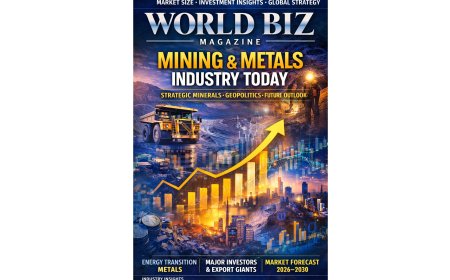









































































































Mining & Metals Industry Today: Global Market Trends, Politics & Future Outlook
World Biz Magazine deep dive into metals supply chains, investments, and global industrial impact.

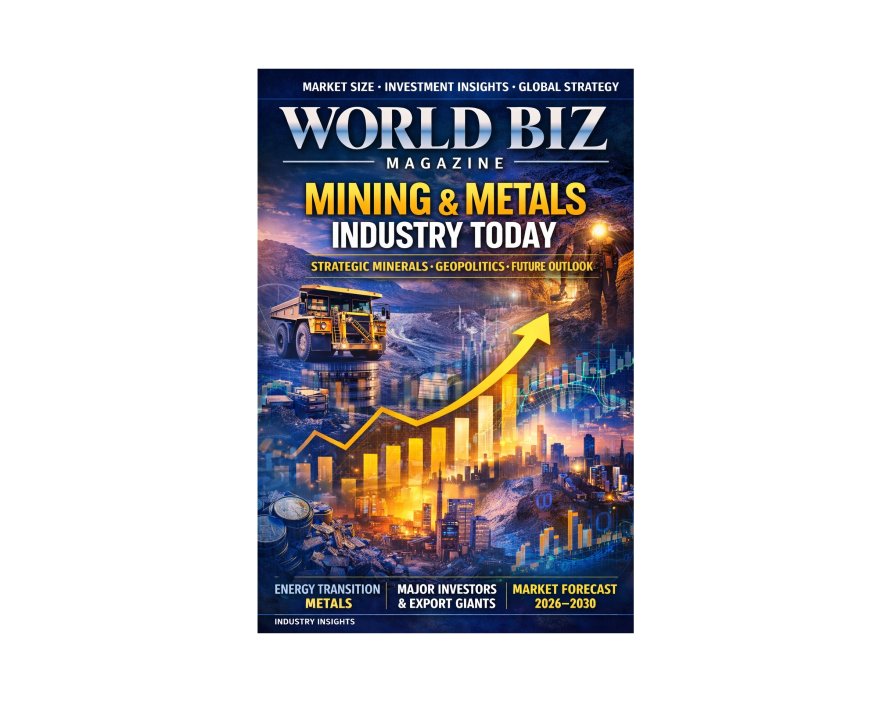
Mining & Metals Industry Today
Market Scale, Geopolitics, Strategic Minerals, and the Global Industrial Future
World Biz Magazine - Industry Intelligence Feature
The mining and metals industry is a foundational pillar of the global economy, supplying raw materials essential for infrastructure, manufacturing, technology, defense, and energy systems. From iron ore and copper to lithium and rare earth elements, metals underpin industrial growth and digital transformation.
As the global economy transitions toward electrification, renewable energy, and advanced manufacturing, demand for minerals has surged. The global mining market is valued at several trillion dollars, with long-term expansion driven by infrastructure development, urbanization, electric vehicles, battery production, and semiconductor supply chains.
Unlike hydrocarbons, metals form the backbone of both traditional and next-generation industries, positioning mining as a strategic sector at the center of geopolitical competition and industrial policy.
Industry Structure & Segments
Mining and metals operations typically fall into the following categories:
Extraction (Upstream)
- Exploration and geological surveying
- Surface and underground mining
- Ore extraction
Processing (Midstream)
- Crushing, concentration, and smelting
- Refining and alloy production
- Recycling and secondary recovery
Manufacturing & Distribution (Downstream)
- Industrial metals supply
- Fabrication
- Component manufacturing
Commodity Groups
- Bulk minerals - Iron ore, coal
- Base metals - Copper, aluminum, zinc
- Precious metals - Gold, silver, platinum
- Strategic/critical minerals - Lithium, cobalt, nickel, rare earths
The fastest growth currently occurs in battery and energy-transition materials.
Market Size & Economic Impact
- Global mining industry value: multi-trillion-dollar sector
- Employs tens of millions globally
- Supplies materials to construction, automotive, electronics, and energy sectors
Key drivers:
- Infrastructure expansion
- Green energy investment
- Urbanization in developing regions
- Defense manufacturing demand
Asia-Pacific dominates consumption due to industrial output, while resource-rich regions dominate supply.
Key Global Players
Major multinational mining corporations include:
- BHP
- Rio Tinto
- Vale
- Glencore
- Anglo American
These companies manage global operations, shaping supply chains and price stability.
Major Contracts & Industry Deal Structures
Common agreements shaping sector economics:
- Mineral exploration licenses
- Extraction rights concessions
- Long-term supply agreements
- Joint ventures
- Equipment procurement contracts
- Mergers & acquisitions
Recent years have seen rising M&A activity centered on battery minerals and rare earth portfolios.
Country-by-Country Influence & Export Dynamics
Major Producers
- Australia - Iron ore, lithium
- China - Rare earth processing dominance
- Chile - Copper production leader
- Brazil - Iron ore
- Canada - Nickel, uranium
Export-Dependent Economies
Mining exports heavily support GDP in several nations through:
- Employment
- Infrastructure development
- Foreign exchange earnings
Industrial Import Dependence
Manufacturing economies rely on imports to sustain:
- Electronics
- Automotive
- Construction
- Energy infrastructure
Mining supply chains thus influence global trade balance and economic resilience.
Political Influence & Strategic Policy
Resource Nationalism
Governments increasingly assert control over mineral resources through:
- Export restrictions
- Ownership regulations
- Royalty increases
Strategic Mineral Policies
Countries implement industrial policies securing:
- Lithium
- Rare earths
- Copper
These resources are critical for energy transition and defense.
Economic Effects
Commodity price fluctuations impact:
- Inflation
- Currency stability
- Fiscal revenue
Policy shifts often ripple through global markets.
Investments & Exploration Trends
Investment growth centers on:
- Battery metals
- Deep-sea exploration
- Arctic mineral potential
- Automation-enabled mining
Emerging exploration zones:
- Africa
- South America
- Central Asia
- Northern Canada
Technology-driven exploration lowers discovery risk and increases recovery rates.
Technology Transformation
Modern mining innovation includes:
- Autonomous drilling systems
- AI-driven geological mapping
- Drone surveying
- Robotics and remote operations
- Digital supply chain tracking
These advances improve:
- Safety
- Efficiency
- Environmental monitoring
Metals & Global Commerce Ecosystem
Metals support:
- Data center infrastructure
- Semiconductor fabrication
- EV production
- Aerospace manufacturing
- Urban construction
E-commerce growth indirectly drives metal demand through logistics, warehousing, and electronics manufacturing.
Price Trends & Inflation Linkages
Commodity price cycles respond to:
- Industrial demand
- Geopolitical instability
- Supply disruptions
- Speculation
Last decade characteristics:
- Pandemic supply shock volatility
- Infrastructure stimulus demand
- Energy transition metal spikes
Forecast trends indicate sustained upward pressure on strategic metals due to structural demand increases.
Countries Facing Resource Depletion
Some regions encounter declining ore grades or reserve exhaustion, requiring:
- Import dependency
- Recycling expansion
- Exploration acceleration
This shift alters global supply chains and trade dynamics.
Emerging New Players
- Smaller mining startups
- State-backed resource firms
- Technology-driven exploration companies
These entrants target high-value minerals overlooked by traditional operators.
Global Shift Toward Strategic Metals
Economic transition toward electrification accelerates demand for:
- Lithium
- Nickel
- Cobalt
- Rare earths
This shift parallels the gradual diversification away from fossil fuel dominance.
Major Beneficiaries
Industries benefiting from mining expansion:
- Renewable energy
- Electric vehicles
- Construction
- Defense manufacturing
- Technology hardware
Investors view mining exposure as strategic hedging against inflation and industrial growth cycles.
Future Outlook
Key trends shaping the coming decade:
Demand Growth
Infrastructure and electrification drive continued material consumption.
Sustainability Pressures
Environmental regulation and ESG compliance reshape operations.
Recycling Expansion
Urban mining and circular economy initiatives reduce primary extraction needs.
Geopolitical Competition
Strategic mineral access influences global alliances and trade policy.
Digital Integration
Automation and AI will redefine cost structures and productivity.
Conclusion
The mining and metals industry stands at the center of global industrial transformation. Unlike oil and gas, whose dominance faces long-term transition pressure, metals demand is expanding alongside emerging technologies and renewable energy systems.
Strategic competition over mineral resources, evolving environmental expectations, and technological innovation will define the sector’s trajectory.
World Biz Magazine Insight:
Mining is no longer simply an extraction business - it is a geopolitical, technological, and economic battleground shaping the architecture of the future global economy.
Disclaimer
This article is published for informational, educational, and editorial purposes only. Market data, projections, and industry insights are derived from aggregated public sources and analytical interpretation at the time of publication. The information should not be considered financial, investment, legal, or operational advice.
World Biz Magazine does not warrant the completeness or accuracy of forecasts or market estimates and assumes no responsibility for decisions made based on this content. Readers and organizations are encouraged to seek professional consultation before making strategic or investment decisions.
All company names, trademarks, and referenced entities remain the property of their respective owners and are used strictly for journalistic and informational reference.
What's Your Reaction?
 Like
0
Like
0
 Dislike
0
Dislike
0
 Love
0
Love
0
 Funny
0
Funny
0
 Angry
0
Angry
0
 Sad
0
Sad
0
 Wow
0
Wow
0