























































































Hong Kong vs Singapore Investment Banking: Market Size, Key Players & Strategic Differences
A detailed comparison of Hong Kong vs Singapore investment banking markets, covering market size, key players, services, risks, and opportunities.

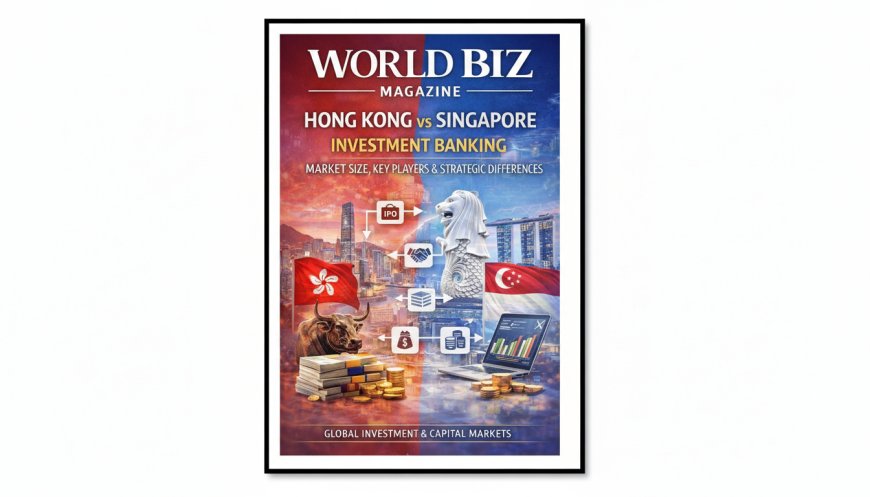
Hong Kong vs Singapore Investment Banking Comparison
Competing Financial Hubs in Asia: Capital Markets, Advisory Strengths & Strategic Opportunities
World Biz Magazine | Investment Banking & Capital Markets
Hong Kong and Singapore are Asia’s two most prominent financial centers both vital hubs for investment banking, capital markets, corporate advisory, and global deal-making. Though both cities aim to capture cross-border capital flows and support corporate growth across Asia and beyond, their strengths, market structures, regulatory frameworks, and strategic value propositions differ in meaningful ways.
This comparative analysis examines how investment banking operates in Hong Kong and Singapore, including market size, core services, economic impact, key players, sectors served, risk environments, regulatory frameworks, competitive advantages, and opportunities for clients and investors.
Market Overview & Size
Hong Kong
Hong Kong’s investment banking ecosystem is one of the largest in Asia:
· Consistently ranks among the top global IPO markets
· Strong linkage to Mainland China and offshore RMB markets
· Heavy focus on equity capital markets and cross-border M&A
Market Signals
· IPO deal value often among highest globally
· Significant volume in Offshore RMB bond issuance
· Strong demand for China-linked advisory
Singapore
Singapore’s investment banking market is:
· The financial gateway to Southeast Asia
· A preferred hub for regional treasury, structured finance, and wealth-linked advisory
· Increasingly strong in private equity placement and fintech-linked capital flows
Market Signals
· Steady growth in debt capital markets (DCM)
· Rising prominence in green and sustainability-linked finance
· Increasing listing activity post-SPAC reform
Role of Investment Banking in the Economy
Hong Kong
Investment banking in Hong Kong:
· Fuels capital inflows into Mainland enterprises
· Supports state-owned enterprise (SOE) financing
· Enables global equity exits
· Drives currency internationalization (especially RMB)
· Provides strategic M&A and advisory services
Revenue contributions support:
· GDP growth
· Professional services
· High-skill employment
· Capital market depth
Singapore
Investment banking in Singapore:
· Facilitates regional expansion of ASEAN companies
· Anchors wealth management, family office financing
· Supports infrastructure and project finance
· Boosts public and private capital formation
· Acts as a hub for sustainable finance and ESG-linked instruments
The industry underpins:
· Corporate globalization
· SME financing access
· Digital and fintech innovation
Key Areas of Investment Banking Activity
Most Used Investment Banking Services
|
Service Area |
Hong Kong |
Singapore |
|
IPOs & Equity Capital Markets |
Very High |
Medium |
|
M&A Advisory |
High |
High |
|
Debt Capital Markets |
High |
Very High |
|
Private Equity & VC Advisory |
Medium |
Very High |
|
Infrastructure Finance |
Low |
High |
|
Wealth & Family Office Structuring |
Medium |
Very High |
Key Industry Players
Hong Kong - Investment Banking Leaders
· Global Bulge Bracket: Goldman Sachs, JPMorgan Chase, Morgan Stanley, Citi, Bank of America
· Chinese Heavyweights: China International Capital Corporation (CICC), CITIC Securities, Haitong International, ICBC International
· Regional & Boutique: HSBC, Standard Chartered, Rothschild & Co, Houlihan Lokey
Singapore - Investment Banking Leaders
· Global Bulge Bracket: Goldman Sachs, Morgan Stanley, JPMorgan Chase, UBS
· Regional & APAC Specialists: DBS Bank, OCBC Bank, UOB, Standard Chartered
· Boutiques & Advisors: Lazard Asia, Moelis & Company, Centerview Partners
Capital & Stock Market Impact
Hong Kong
Hong Kong has historically been a top IPO venue globally, particularly for:
· Technology
· Fintech
· Consumer brands
· Real estate
· State-owned enterprises
The Hong Kong Stock Exchange (HKEX) frequently tops global rankings in total capital raised. Its linkage with Shanghai and Shenzhen via Stock Connect adds depth and cross-market access for global investors.
Singapore
Singapore Exchange (SGX) is respected for:
· Strong regional SME listings
· Commodity and derivatives trading
· REIT platforms (among the world’s largest REIT markets)
· Sustainability and green bonds
While smaller than HKEX in IPO volume, SGX is gaining traction in debt issuance, structured products, and thematic listings.
Investment Opportunities by Sector
Both cities facilitate capital formation across sectors but with varying focus:
Hong Kong
· China-linked technology and innovation
· Consumer and retail expansion
· Real estate and logistics
· Financial services spin-offs
· Cross-border M&A
Singapore
· Infrastructure & renewable energy
· Regional SME expansion
· Technology & fintech
· Healthcare & biotech
· Supply chain & logistics financing
Regulatory & Legal Framework
Hong Kong
· Regulated by the Securities and Futures Commission (SFC)
· Listings governed by Hong Kong Exchanges & Clearing (HKEX)
· Common law legal system
· Highly transparent and globally aligned compliance standards
Singapore
· Regulated by the Monetary Authority of Singapore (MAS)
· Listings governed by Singapore Exchange (SGX)
· Strong emphasis on prudential supervision
· Flexible SPAC and sustainability finance rules
Both markets feature robust anti-money-laundering (AML) and Know-Your-Customer (KYC) regimes, but Singapore is often seen as more innovation-friendly for fintech and digital finance.
Talent, Workforce & Industry Structure
· Hong Kong: Deep pool of China-focused bankers, IPO specialists, and cross-border dealmakers.
· Singapore: Strength in debt markets, infrastructure financing, treasury services, and fintech-ready advisory.
Educational pipelines, global talent mobility, and regional hubs further shape competitive advantage.
Risk Environment & Challenges
Shared Risks
· Global macroeconomic volatility
· Regulatory uncertainty
· Currency and interest rate shifts
· Geopolitical tensions in Asia
Hong Kong Specific Challenges
· Competition from other Chinese financial cities
· Increased regulatory scrutiny from Mainland linkage
· Capital controls and policy uncertainties
Singapore Specific Challenges
· Regional competition (Tokyo, Dubai)
· Market size limitations vs China-linked IPOs
· Talent competition with global hubs
Technology & Innovation Trends
Investment banking in both hubs is rapidly adopting:
· AI-driven analytics and trading systems
· Blockchain for settlement and documentation
· Fintech integration for payments and tokenized securities
· Data science in risk modeling and underwriting
Singapore, with its strong fintech infrastructure, often leads in technology adoption for capital formation and digital asset services.
Strategic Advantages: Hong Kong vs Singapore
Hong Kong
v Strong ties with Mainland China
v Leading global IPO volume
v Deep expertise in cross-border M&A
v Offshore RMB hub
Singapore
Ø Stable regional gateway for ASEAN
Ø Innovation-driven capital markets
Ø Strong in debt and structured finance
Ø Fintech and digital finance friendly
Conclusion
While both investment banking markets are world-class, Hong Kong excels in China connectivity, IPO dominance, and cross-border advisory, making it a powerhouse for large capitalization deals and China-linked strategies.
Singapore’s strengths lie in structured finance, wealth‐linked advisory, sustainability finance, and regional capital formation, reflecting its role as a diversified, innovation-oriented financial hub.
For investors, corporates, and capital markets participants, both cities offer distinct but complementary opportunities in Asia’s dynamic investment banking landscape.
Disclaimer
This article is published by World Biz Magazine for informational and analytical purposes only. It does not constitute financial, legal, or investment advice. Market conditions, regulatory frameworks, and economic environments evolve over time. Readers should consult qualified financial and legal professionals before making investment or business decisions.
What's Your Reaction?
 Like
0
Like
0
 Dislike
0
Dislike
0
 Love
0
Love
0
 Funny
0
Funny
0
 Angry
0
Angry
0
 Sad
0
Sad
0
 Wow
0
Wow
0