

























































Luxury Consumption & Wealth Cycles: Global Luxury Market Trends and Future Outlook
A World Biz Magazine analysis of luxury consumption and global wealth cycles, covering luxury market size, investment trends, and future industry outlook.

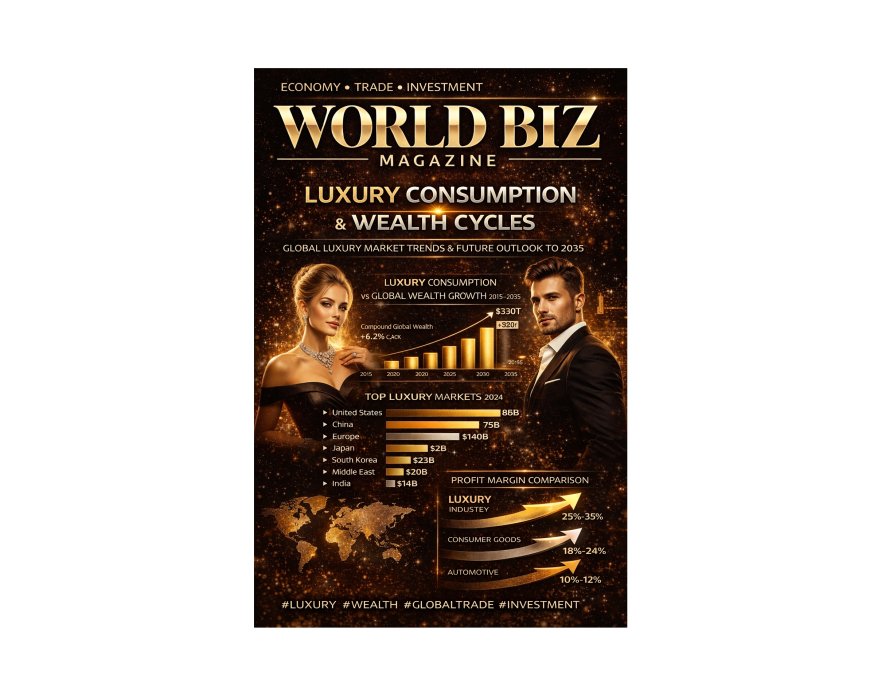
Luxury Consumption & Wealth Cycles
Global Luxury Market Dynamics, Wealth Distribution & Industry Outlook to 2035
World Biz Magazine | Industry Today Special Report
Luxury consumption is deeply tied to global wealth cycles. As wealth expands through economic growth, asset appreciation, and technological innovation, demand for luxury goods from fashion and jewelry to automobiles and real estate rises accordingly. Conversely, economic downturns or financial crises can temporarily slow luxury spending, though the sector historically demonstrates remarkable resilience.
The luxury industry represents a powerful intersection of economics, consumer psychology, global wealth distribution, and cultural identity. High-net-worth individuals (HNWIs) and affluent consumers drive demand for luxury products, but aspirational middle-class consumers also play an increasingly significant role.
This World Biz Magazine Industry Today report analyzes luxury consumption through the lens of wealth cycles, exploring global market size, policy impacts, investment flows, regional consumption patterns, price trends, and long-term forecasts through 2035.
Global Luxury Industry Overview
The global luxury sector includes multiple segments:
- Luxury fashion and accessories
- Jewelry and watches
- Luxury automobiles
- Luxury hospitality and travel
- High-end real estate
- Luxury beauty and lifestyle products
Luxury goods have become an essential component of the global consumer economy, combining brand prestige with emotional and cultural value.
Global Luxury Market Size
|
Year |
Market Value |
|
2015 |
$250 billion |
|
2020 |
$310 billion |
|
2024 |
$360 billion |
|
2030 (forecast) |
$520 billion |
|
2035 (forecast) |
$700 billion+ |
The industry is expected to grow steadily as global wealth increases and luxury consumption expands across emerging markets.
Wealth Cycles and Luxury Demand
Luxury consumption closely follows wealth creation cycles.
Expansion Phase
During economic growth periods:
- stock markets rise
- real estate values increase
- technology sectors expand
- global wealth creation accelerates
Luxury demand typically increases as affluent consumers experience higher disposable wealth.
Contraction Phase
During economic downturns:
- financial markets decline
- consumer confidence weakens
- discretionary spending slows
Luxury consumption may temporarily decline but often recovers faster than many other consumer sectors.
Global Wealth Distribution
Luxury consumption is concentrated among affluent consumers.
High-Net-Worth Individuals (HNWIs)
|
Wealth Category |
Net Worth |
|
Mass Affluent |
$100K-$1M |
|
HNWIs |
$1M-$30M |
|
Ultra-HNWIs |
$30M+ |
Ultra-high-net-worth individuals represent the most important consumer group for luxury brands.
Key Luxury Industry Players
Major luxury conglomerates dominate the global market.
Some of the most influential companies include:
- LVMH
- Kering
- Richemont
- Hermès
- Chanel
These conglomerates own multiple luxury brands spanning fashion, jewelry, and lifestyle sectors.
Regional Luxury Consumption Trends
Luxury consumption varies significantly across regions.
Asia-Pacific
Asia has become the fastest-growing luxury market.
China alone accounts for a large portion of global luxury consumption, driven by rising middle-class wealth and urbanization.
Europe
Europe remains the cultural center of luxury fashion and craftsmanship.
Countries such as France and Italy host many of the world’s most prestigious luxury houses.
North America
The United States is one of the largest luxury consumer markets, with strong demand for high-end fashion, automobiles, and jewelry.
Middle East
Luxury spending is high in the Gulf region due to strong oil wealth and tourism-driven luxury retail.
Policy and Political Influence
Government policies can influence luxury consumption patterns.
Key Policy Factors
- luxury taxation
- import duties
- international trade agreements
- anti-corruption regulations
- currency fluctuations
Some countries impose luxury taxes to reduce income inequality, while others encourage luxury retail tourism.
Investment Trends in the Luxury Industry
Luxury brands attract significant investment due to their strong profit margins and global brand value.
Major Investors
- luxury conglomerates
- private equity firms
- sovereign wealth funds
- global retail investors
Investment is increasingly focused on:
- luxury e-commerce platforms
- digital marketing technologies
- sustainable luxury production
- experiential luxury retail
Price Inflation in Luxury Goods
Luxury prices have increased significantly over the past decade.
Price Growth (2015-2025)
|
Segment |
Price Increase |
|
Luxury fashion |
40-50% |
|
Luxury watches |
35-45% |
|
Luxury handbags |
45-60% |
Luxury brands frequently raise prices as part of brand positioning strategies, reinforcing exclusivity and prestige.
Luxury Consumption and Asset Markets
Luxury demand often correlates with asset market performance.
Key Asset Drivers
- stock market growth
- real estate appreciation
- cryptocurrency wealth creation
- technology sector expansion
When asset prices increase, luxury consumption typically rises as affluent consumers experience greater wealth.
Countries Gaining Luxury Investment
Luxury investment is concentrated in several global hubs.
Key Luxury Markets
- France
- Italy
- United States
- United Kingdom
- China
These countries host major luxury fashion houses and retail destinations.
Countries Losing Luxury Market Momentum
Some regions experience slower luxury growth due to economic or regulatory challenges.
Examples include:
- countries with declining economic growth
- regions with political instability
- markets with restrictive import policies
Luxury brands prefer stable economies with strong consumer purchasing power.
Emerging Trends in Luxury Consumption
Several major trends are shaping the future of luxury.
Digital Luxury
Luxury brands are investing heavily in digital retail and online brand experiences.
Sustainable Luxury
Consumers increasingly demand ethical sourcing and environmentally responsible production.
Experiential Luxury
Luxury spending is shifting toward experiences such as travel, hospitality, and wellness.
Forecast to 2035
The global luxury industry is expected to continue expanding over the next decade.
Growth Drivers
- expanding global wealth
- rising Asian consumer markets
- digital luxury commerce
- experiential luxury trends
Market Forecast
|
Segment |
2035 Forecast |
|
Luxury fashion |
$400B |
|
Luxury jewelry |
$150B |
|
Luxury watches |
$120B |
|
Luxury travel |
$300B |
Total luxury consumption could exceed $700 billion by 2035.
Comparison with Other Consumer Industries
|
Industry |
Market Size |
|
Consumer goods |
$30+ trillion |
|
Automotive |
$4 trillion |
|
Fashion |
$3 trillion |
|
Luxury goods |
$700B (2035 forecast) |
Luxury goods represent a smaller but highly profitable segment of the global consumer economy.
World Biz Magazine Insights
Luxury consumption reflects broader patterns of wealth creation and economic cycles.
Three key forces will shape the luxury market in the coming decades:
- global wealth expansion
- digital transformation of luxury retail
- sustainability and ethical production
Luxury brands that adapt to these trends will maintain their dominance in the global marketplace.
Conclusion
Luxury consumption is closely tied to global wealth cycles, rising during periods of economic expansion and adapting during downturns. Despite economic fluctuations, the luxury industry continues to demonstrate resilience and long-term growth potential.
As global wealth increases and new affluent consumers emerge across Asia and emerging markets, luxury brands will continue expanding their influence in the global consumer economy.
By 2035, the luxury sector is expected to reach new heights, shaped by evolving consumer expectations, technological innovation, and shifting wealth dynamics.
Disclaimer
The information presented in this article is for informational and educational purposes only. Market statistics, projections, and forecasts are based on publicly available industry data and analytical estimates at the time of publication. While every effort has been made to ensure accuracy, World Biz Magazine does not guarantee future market performance or investment outcomes. Readers should consult professional advisors before making financial or strategic decisions based on the information contained in this report. All trademarks and brand names referenced remain the property of their respective owners.
What's Your Reaction?
 Like
0
Like
0
 Dislike
0
Dislike
0
 Love
0
Love
0
 Funny
0
Funny
0
 Angry
0
Angry
0
 Sad
0
Sad
0
 Wow
0
Wow
0