











































































































































































































Global Capital Flows: Types, Trends, Risks, and Their Impact on Economic Growth
A detailed guide to capital flows, their types, drivers, risks, and how global money movements shape economies and financial stability.

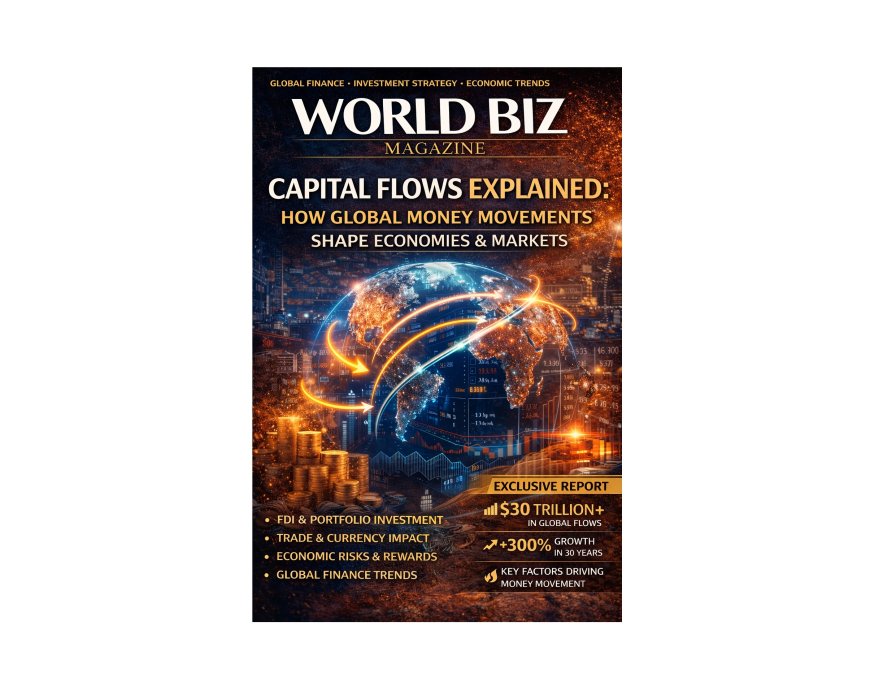
Capital Flows Explained: The Lifeblood of the Global Financial System
World Biz Magazine | Global Finance, Investment & Economic Strategy Report
Understanding the Movement of Money Across Borders
In an interconnected global economy, capital does not stay confined within borders it moves constantly, seeking returns, stability, and opportunity. These movements, known as capital flows, shape exchange rates, influence economic growth, and determine the financial stability of nations.
From multinational corporations investing abroad to hedge funds shifting billions across markets in seconds, capital flows are the invisible force driving global finance.
They are not just financial transactions they are signals of confidence, risk, and global economic direction.
What Are Capital Flows?
Capital flows refer to the movement of money for investment, trade, or business production across countries.
They include:
- Investments in foreign assets
- Loans and financial transfers
- Currency exchanges
In simple terms:
Capital flows represent how money travels globally to maximize returns
Types of Capital Flows
Foreign Direct Investment (FDI)
FDI involves long-term investment in physical assets such as:
- Factories
- Infrastructure
- Businesses
Characteristics:
- Stable
- Long-term commitment
- Strong economic impact
Considered the most beneficial form of capital flow
Portfolio Investment
Portfolio flows involve investment in:
- Stocks
- Bonds
- Financial securities
Characteristics:
- Short-term
- Highly liquid
- Sensitive to market changes
Often referred to as “hot money”
Debt Flows
Includes:
- Loans from international institutions
- Sovereign and corporate borrowing
Impact:
- Supports development
- Can increase financial risk
Remittances
Funds sent by individuals working abroad.
Importance:
- Major income source for developing countries
- Stable and consistent
Why Capital Flows Matter
Economic Growth
Capital inflows finance:
- Infrastructure
- Business expansion
- Job creation
Currency Stability
- Strong inflows strengthen currency
- Outflows weaken it
Financial Market Development
- Improves liquidity
- Enhances market depth
Global Integration
- Connects economies
- Enables trade and investment
Key Drivers of Capital Flows
Interest Rates
Higher rates attract foreign investment.
Economic Growth Prospects
Investors prefer fast-growing economies.
Political Stability
Stable environments attract long-term capital.
Exchange Rate Expectations
Currency appreciation attracts inflows.
Global Risk Sentiment
During uncertainty, capital moves to “safe havens”
Capital Inflows vs Outflows
|
Type |
Impact |
|
Inflows |
Growth, investment, currency strength |
|
Outflows |
Capital flight, currency depreciation |
Balance is critical for economic stability
Risks Associated with Capital Flows
|
Risk |
Impact |
Mitigation |
|
Volatility |
Market instability |
Diversification |
|
Sudden outflows |
Currency crisis |
Strong reserves |
|
Overdependence |
Economic vulnerability |
Domestic investment |
|
Debt burden |
Financial stress |
Fiscal discipline |
Capital Flows in Emerging Markets
Emerging economies:
- Attract capital for growth
- Face higher volatility
Key challenge:
Managing inflows without triggering instability
Role of Governments & Central Banks
Policy Tools:
- Interest rate adjustments
- Capital controls
- Foreign exchange reserves
Aim: Balance growth with stability
Future Trends in Capital Flows
- Rise of digital finance and fintech
- Increased cross-border investments
- Shift toward sustainable investments (ESG)
- Growth of emerging market influence
World Biz Magazine Insights
Capital Flows Define Economic Power
Countries attracting capital gain global influence.
Quality of Capital Matters More Than Quantity
FDI is more valuable than short-term portfolio flows.
Competition for Global Capital is Intensifying
Countries are offering incentives to attract investors.
Technology is Accelerating Capital Movement
Digital platforms enable instant global transfers.
Emerging Markets Will Shape Future Flows
Growth opportunities are shifting toward developing economies.
Conclusion
Capital flows are the lifeblood of the global financial system, driving investment, shaping economies, and influencing geopolitical dynamics.
While they offer immense opportunities for growth, they also introduce risks that require careful management.
The key to success lies in:
- Attracting high-quality investment
- Maintaining financial stability
- Building resilient economic systems
In a world defined by constant financial movement, those who understand and manage capital flows effectively will lead the global economy.
Disclaimer
This article is published by World Biz Magazine for informational and analytical purposes only.
- Financial concepts, trends, and projections are based on current data and may vary due to economic, geopolitical, and market changes.
- This content does not constitute financial, investment, or legal advice.
- Readers are advised to conduct independent research and consult professionals before making financial decisions.
What's Your Reaction?
 Like
0
Like
0
 Dislike
0
Dislike
0
 Love
0
Love
0
 Funny
0
Funny
0
 Angry
0
Angry
0
 Sad
0
Sad
0
 Wow
0
Wow
0