
















































































































































































































How AI Is Transforming Sports Broadcasting and Sports Media
Artificial intelligence is transforming sports broadcasting through automated cameras, real-time analytics, and personalized fan experiences.


How AI Is Transforming Sports Broadcasting
World Biz Magazine | Global Business, Technology, and Sports Industry Insights
“World Biz Magazine provides in-depth analysis of global industries, emerging technologies, sports business, media innovation, infrastructure development, and economic trends shaping the future of international markets”
Artificial Intelligence (AI) is rapidly transforming the global sports broadcasting industry, revolutionizing how sports content is produced, analyzed, distributed, and consumed. From automated camera systems and real-time data analytics to personalized viewing experiences and AI-powered commentary, artificial intelligence is redefining the sports media landscape.
For decades, sports broadcasting relied heavily on large production crews, manual camera operation, and traditional commentary. Today, AI technologies allow broadcasters to automate many aspects of production while delivering richer insights and more engaging viewing experiences for audiences worldwide.
As sports leagues, broadcasters, and streaming platforms compete to capture global audiences, AI has emerged as one of the most powerful tools shaping the future of sports media.
The Role of AI in Modern Sports Broadcasting
Artificial intelligence is being integrated into multiple stages of sports broadcasting, including content production, video analysis, audience engagement, and content distribution.
AI systems can process large volumes of data in real time, enabling broadcasters to deliver deeper insights and more dynamic coverage of sporting events.
Key AI applications in sports broadcasting include:
- automated camera systems
- real-time performance analytics
- AI-generated highlights
- automated commentary systems
- personalized sports viewing experiences
These innovations are helping broadcasters enhance both efficiency and viewer engagement.
Automated Camera Systems
One of the most visible uses of AI in sports broadcasting is automated camera technology. AI-powered camera systems can track players and the ball in real time without the need for human camera operators.
Benefits of Automated Cameras
- reduced production costs
- improved camera tracking accuracy
- coverage of lower-tier leagues and amateur sports
- ability to broadcast multiple games simultaneously
These systems are particularly useful for smaller sports leagues that may not have the budget for large production teams.
AI-Powered Real-Time Analytics
AI allows broadcasters to analyze vast amounts of data during live sporting events. Advanced algorithms process player movement, game strategies, and performance statistics in real time.
Examples of AI Sports Analytics
- player speed and distance tracking
- predictive game analysis
- advanced performance metrics
- injury risk monitoring
These insights provide viewers with a deeper understanding of the game and enhance the overall viewing experience.
Automated Highlight Generation
Artificial intelligence can automatically identify key moments in sporting events and generate highlight reels almost instantly.
AI systems analyze game footage to detect important moments such as:
- goals and scoring plays
- game-changing turnovers
- exceptional player performances
This technology allows broadcasters and sports organizations to distribute highlights across digital platforms within seconds after they occur.
AI-Generated Commentary
Natural language processing and AI voice synthesis technologies are enabling automated sports commentary.
These systems can generate real-time commentary based on live game data and statistics.
Although human commentators remain essential for storytelling and analysis, AI commentary tools can support multilingual broadcasting and coverage of smaller sporting events that might otherwise lack professional commentary.
Personalized Viewing Experiences
AI is also transforming how fans consume sports content by enabling personalized viewing experiences.
Streaming platforms can use AI algorithms to analyze viewer preferences and recommend customized content.
Personalized Features Include
- tailored highlight packages
- preferred camera angles
- customized commentary feeds
- personalized sports statistics dashboards
These innovations allow fans to interact with sports broadcasts in entirely new ways.
AI in Sports Production and Editing
Artificial intelligence is significantly improving the efficiency of sports content production.
AI-powered editing tools can automatically process game footage, identify important moments, and create broadcast-ready clips.
This technology allows sports organizations to produce large volumes of digital content quickly for social media and streaming platforms.
Enhancing Fan Engagement Through AI
AI technologies are also being used to enhance fan engagement through interactive experiences.
Examples of AI-Driven Fan Engagement
- chatbots providing real-time game updates
- AI-powered fantasy sports analysis
- predictive game simulations
- interactive viewing experiences
These technologies allow fans to interact more deeply with sports content.
Global AI Sports Broadcasting Market Growth Chart (2020-2035)
The use of artificial intelligence in sports media is expanding rapidly as broadcasters, leagues, and streaming platforms adopt automation, analytics, and digital production tools.
AI Sports Broadcasting Market Forecast
|
Year |
Estimated Market Size |
|
2020 |
$1.2 Billion |
|
2022 |
$2 Billion |
|
2025 |
$4.5 Billion |
|
2028 |
$7 Billion |
|
2030 |
$10 Billion |
|
2035 |
$18 Billion |
Key Insight
The AI sports broadcasting market could grow more than 15 times between 2020 and 2035, driven by automated production tools, real-time analytics, and AI-powered content distribution.
AI Technologies Used in Sports Media
Artificial intelligence is used across multiple areas of sports broadcasting to improve production efficiency and viewer engagement.
AI Applications in Sports Broadcasting
|
AI Technology |
Function |
Benefits |
|
Automated Camera Systems |
Tracks players and ball movements automatically |
Reduces production costs and improves coverage |
|
Real-Time Data Analytics |
Processes player performance and match statistics |
Provides deeper insights during live broadcasts |
|
AI Commentary Systems |
Generates automated match commentary |
Supports multilingual broadcasting |
|
Automated Highlight Generation |
Detects key moments and produces highlight clips |
Faster content distribution |
|
Video Editing Automation |
AI-assisted content production and editing |
Faster social media content creation |
|
Fan Personalization Algorithms |
Customizes viewing experience |
Higher viewer engagement |
Key Insight
AI allows broadcasters to deliver data-rich and interactive sports coverage, making the viewing experience more immersive.
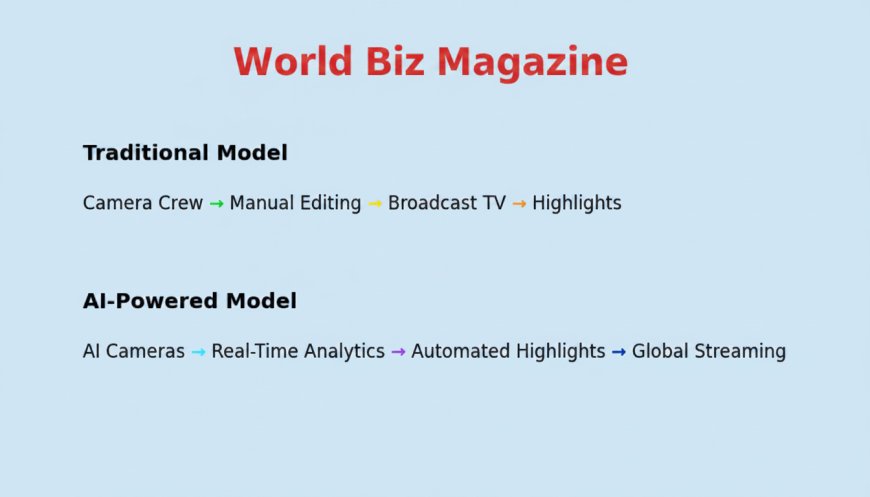
Traditional vs AI-Powered Sports Broadcasting Workflow
Artificial intelligence is significantly improving the efficiency and scalability of sports broadcasting production.
Broadcasting Workflow Comparison
|
Stage |
Traditional Broadcasting |
AI-Powered Broadcasting |
|
Camera Operation |
Human camera operators |
AI automated camera tracking |
|
Game Analysis |
Manual data analysis |
Real-time AI analytics |
|
Highlight Creation |
Manual video editing |
AI automated highlight generation |
|
Commentary |
Human commentators only |
AI-assisted commentary and insights |
|
Content Distribution |
TV broadcasts and delayed clips |
Instant streaming and digital distribution |
|
Fan Interaction |
Limited interaction |
AI-driven personalized viewing experiences |
Workflow Visualization
Key Insight
AI-powered broadcasting significantly reduces production time while enabling real-time data insights and faster digital distribution of sports content.
Challenges and Ethical Considerations
Despite its advantages, the integration of AI into sports broadcasting also raises several challenges.
Data Privacy
AI systems rely heavily on player tracking and performance data, raising questions about data privacy and athlete consent.
Job Displacement
Automation of production tasks could reduce demand for certain traditional broadcasting roles.
Technology Costs
Implementing advanced AI technologies requires significant investment in infrastructure and software development.
Balancing technological innovation with ethical considerations will be important for the future of AI-driven sports broadcasting.
The Future of AI in Sports Media
AI is expected to play an even greater role in sports broadcasting over the coming years.
Future developments may include:
- fully automated sports broadcasting systems
- AI-powered immersive viewing environments
- virtual and augmented reality sports experiences
- advanced predictive analytics for sports commentary
- real-time translation of sports broadcasts into multiple languages
As AI technologies continue to evolve, they will likely become essential components of the global sports media ecosystem.
Conclusion
Artificial intelligence is transforming sports broadcasting by making sports coverage more dynamic, data-driven, and accessible to global audiences. From automated camera systems and real-time analytics to personalized viewing experiences, AI is reshaping how sports content is produced and consumed.
For broadcasters and sports organizations, AI offers powerful tools to improve efficiency, expand audience reach, and enhance fan engagement. For viewers, it promises richer insights, interactive experiences, and more personalized access to sports content.
As technology continues to advance, AI will remain at the forefront of innovation in sports media, shaping the future of sports broadcasting for the digital era.
Disclaimer
The information presented in this article is intended for informational and editorial purposes only. Market values, technology adoption trends, and industry projections are based on publicly available research and industry reports available at the time of publication.
Artificial intelligence technologies in sports broadcasting are evolving rapidly, and adoption levels may vary across leagues, broadcasters, and media platforms.
Readers are encouraged to conduct independent research and consult industry professionals before making business, technology, or investment decisions based on the information provided.
World Biz Magazine and its contributors are not responsible for any outcomes resulting from the use of this information.
What's Your Reaction?
 Like
0
Like
0
 Dislike
0
Dislike
0
 Love
0
Love
0
 Funny
0
Funny
0
 Angry
0
Angry
0
 Sad
0
Sad
0
 Wow
0
Wow
0