




































































































































































How Highest and Best Use Analysis Shapes Modern Real Estate Investment
Understand the role of Highest and Best Use Analysis in global property markets, redevelopment, and institutional investment.

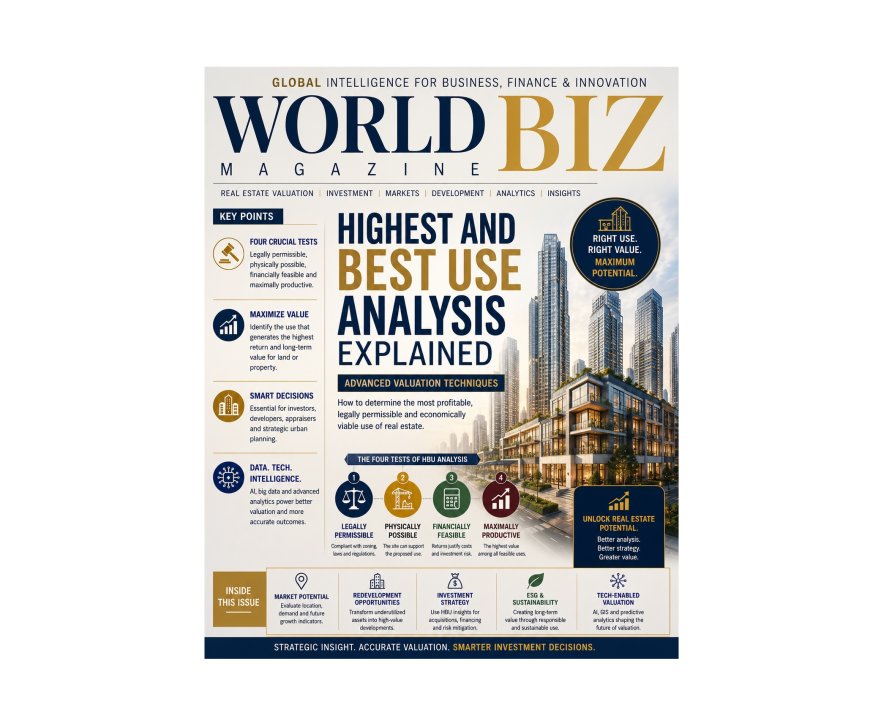
Highest and Best Use Analysis: Advanced Real Estate Valuation Techniques
Advanced Valuation Techniques Reshaping Global Real Estate Strategy
How investors, developers, and valuation professionals determine the most profitable and legally viable use of land in modern real estate markets
World Biz Magazine | Real Estate Valuation, Urban Development & Global Investment Intelligence
The Strategic Core of Real Estate Valuation
In global real estate valuation, determining what a property is worth is only part of the equation.
The more important question is often:
What should the property become?
This is the foundation of Highest and Best Use (HBU) Analysis one of the most advanced and influential methodologies in professional real estate valuation.
Used by:
- Institutional investors
- Developers
- Urban planners
- Appraisers
- Sovereign wealth funds
- Commercial banks
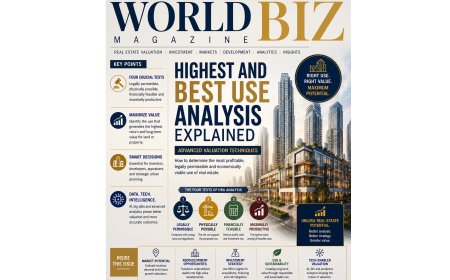
Highest and Best Use Analysis identifies the legally permissible, physically possible, financially feasible, and maximally productive use of land or property.
In today’s rapidly evolving urban economies, HBU analysis has become a strategic tool for capital allocation, redevelopment, and long-term investment forecasting.
What is Highest and Best Use Analysis?
Highest and Best Use Analysis is a valuation methodology used to determine the most economically valuable use of a property.
The concept assumes:
Land value is driven not by its current use but by its most profitable potential use.
For example:
- An aging warehouse may have greater value as a mixed-use development
- Low-rise residential land may become more valuable as high-density urban housing
- Industrial land may transform into logistics infrastructure
The Four Tests of Highest and Best Use
Professional valuation standards globally rely on four core tests.
1. Legally Permissible
The proposed use must comply with:
- Zoning laws
- Land-use regulations
- Environmental restrictions
- Building codes
- Heritage preservation rules
A project may be financially attractive but impossible under current regulations.
Example:
A luxury high-rise project may not proceed if zoning permits only low-density residential construction.
2. Physically Possible
The land itself must support the proposed use.
Key considerations include:
- Site size
- Topography
- Accessibility
- Infrastructure availability
- Environmental conditions
Critical Factors:
- Flood risks
- Soil quality
- Transportation access
- Utility connectivity
3. Financially Feasible
A project must generate sufficient economic return.
Analysts examine:
- Construction costs
- Financing conditions
- Rental demand
- Market absorption rates
- Exit valuation potential
If projected returns fail to justify investment risk, the use is not financially feasible.
4. Maximally Productive
Among all feasible options, the chosen use must produce the highest value.
This final step distinguishes:
- Good investments
from - Optimal investments
Why Highest and Best Use Analysis Matters
HBU analysis directly influences:
- Land acquisition strategies
- Urban redevelopment
- Institutional investment decisions
- Infrastructure planning
- Property taxation
- Mortgage lending
In major global cities, land scarcity makes HBU analysis increasingly important for maximizing capital efficiency.
Applications Across Real Estate Sectors
Residential Development
Developers evaluate whether:
- Low-density housing should become vertical apartments
- Older communities justify redevelopment
- Luxury or affordable housing generates stronger returns
Commercial Real Estate
Office, retail, and hospitality sectors rely heavily on HBU modeling.
Questions include:
- Should outdated malls become mixed-use centers?
- Should office towers convert into residential units?
- Can logistics outperform retail assets?
Industrial & Logistics Assets
The rise of e-commerce transformed HBU dynamics globally.
Former manufacturing zones are increasingly redeveloped into:
- Logistics hubs
- Fulfillment centers
- Data infrastructure corridors
Mixed-Use Urban Development
Modern cities increasingly prioritize:
- Live-work ecosystems
- Transit-oriented development
- Smart urban planning
HBU analysis plays a critical role in determining land optimization strategies.
Global Standards in Highest and Best Use Analysis
United States: Institutional Valuation Sophistication
The United States remains one of the most advanced HBU markets globally.
Professional standards are heavily influenced by:
- Appraisal institutes
- Institutional real estate investment frameworks
- Extensive transaction databases
HBU analysis is deeply integrated into:
- Commercial appraisals
- REIT acquisitions
- Urban redevelopment planning
United Kingdom: Planning-Led Valuation
The United Kingdom emphasizes planning regulation and land-use governance.
Organizations like Royal Institution of Chartered Surveyors establish internationally recognized valuation standards.
In the UK:
- Planning approval risk significantly impacts land value
- HBU analysis often centers around redevelopment permissions
UAE: Rapid Urban Transformation
The United Arab Emirates demonstrates how strategic urban development reshapes land value rapidly.
Cities like Dubai increasingly apply HBU principles in:
- Smart city planning
- Tourism infrastructure
- Luxury mixed-use development
- Logistics corridor expansion
Emerging Markets: Untapped Redevelopment Potential
Emerging economies often contain significant underutilized land value due to:
- Weak zoning enforcement
- Informal development patterns
- Limited valuation sophistication
As infrastructure improves, HBU analysis becomes increasingly important for:
- Foreign direct investment
- Urban modernization
- Capital market growth
Advanced Valuation Techniques Used in HBU Analysis
Discounted Cash Flow (DCF) Modeling
DCF evaluates:
- Future income potential
- Development timelines
- Risk-adjusted returns
This method is central to institutional-grade HBU analysis.
Residual Land Valuation
Residual valuation calculates:
- Future project value
minus - Development costs and profit margins
The remaining amount determines land value.
Scenario Modeling
Analysts compare multiple development possibilities:
- Residential
- Hospitality
- Retail
- Industrial
- Mixed-use
This helps identify the most productive strategy.
Sensitivity & Risk Analysis
Professional investors stress-test projects against:
- Interest rate changes
- Construction inflation
- Regulatory delays
- Market downturns
Technology Transforming Highest and Best Use Analysis
The future of HBU analysis is increasingly data-driven.
Modern tools include:
- AI-powered valuation systems
- GIS mapping and geospatial analysis
- Predictive urban growth modeling
- Big data demographic forecasting
- Infrastructure analytics
Technology allows analysts to evaluate urban transformation with unprecedented precision.
ESG and Sustainability in HBU Analysis
Environmental, Social, and Governance (ESG) considerations are reshaping valuation globally.
Properties increasingly gain value through:
- Green certifications
- Transit accessibility
- Carbon efficiency
- Climate resilience
Future highest and best use models may prioritize:
- Sustainability-adjusted returns
- Net-zero development strategies
- Long-term environmental risk mitigation
Common Pitfalls in Highest and Best Use Analysis
Overestimating Demand
One of the most common valuation errors.
Developers may assume:
- Unrealistic pricing growth
- Excessive market absorption
- Overly optimistic occupancy rates
Ignoring Regulatory Complexity
Permitting delays and zoning restrictions can destroy project feasibility.
Underestimating Infrastructure Risk
Transportation, utilities, and connectivity heavily influence land productivity.
Market Timing Errors
Even correct HBU conclusions can fail if market timing is poor.
Overreliance on Historical Data
Future land value depends on emerging trends not just past transactions.
Institutional Investors and HBU Strategy
Global institutional investors increasingly use HBU analysis to:
- Unlock hidden land value
- Reposition underperforming assets
- Identify urban growth corridors
- Anticipate demographic shifts
For sovereign wealth funds and private equity firms, HBU is now part of strategic macroeconomic forecasting.
The Future of Highest and Best Use Analysis
The next generation of valuation analysis will likely integrate:
- Real-time urban analytics
- AI-driven land optimization
- Smart city infrastructure mapping
- Climate-adjusted valuation models
- Predictive demographic intelligence
Real estate valuation is evolving from static appraisal toward dynamic strategic forecasting.
World Biz Magazine Insights
WBJ Insight 01 - Land Value is Becoming More Strategic Than Structural
Future value increasingly depends on redevelopment potential rather than existing structures.
WBJ Insight 02 - Urban Density Will Drive Capital Allocation
As cities expand vertically, HBU analysis becomes critical for maximizing land efficiency.
WBJ Insight 03 - Data is Reshaping Valuation Precision
AI and predictive analytics are transforming how land potential is measured.
WBJ Insight 04 - Sustainability is Becoming Financially Material
Green infrastructure and ESG alignment increasingly influence highest and best use outcomes.
WBJ Insight 05 - Emerging Markets Hold Massive Untapped HBU Potential
Urbanization and infrastructure growth create substantial redevelopment opportunities across developing economies.
Conclusion
Highest and Best Use Analysis remains one of the most sophisticated tools in global real estate valuation.
It is no longer simply about understanding what a property is worth today but determining what it can become tomorrow.
As cities evolve, infrastructure expands, and investment capital becomes increasingly data-driven, HBU analysis will sit at the center of:
- Urban transformation
- Institutional investment strategy
- Sustainable development
- Long-term economic growth
In modern real estate, the most valuable asset is often not the building itself but the unrealized potential beneath it.
Disclaimer
This article is intended for informational and editorial purposes only and does not constitute financial, legal, appraisal, investment, or real estate development advice. Market conditions, zoning laws, and valuation methodologies vary by jurisdiction. Readers should consult qualified professionals before making investment or development decisions.
What's Your Reaction?
 Like
0
Like
0
 Dislike
0
Dislike
0
 Love
0
Love
0
 Funny
0
Funny
0
 Angry
0
Angry
0
 Sad
0
Sad
0
 Wow
0
Wow
0