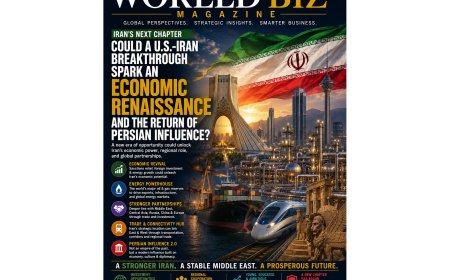
































































Iran's Next Chapter: Could a U.S.-Iran Breakthrough Spark an Economic Renaissance and the Return of Persian Influence?
Can Iran emerge as a leading economic force in the Middle East? World Biz Magazine examines the opportunities, challenges, and geopolitical implications.

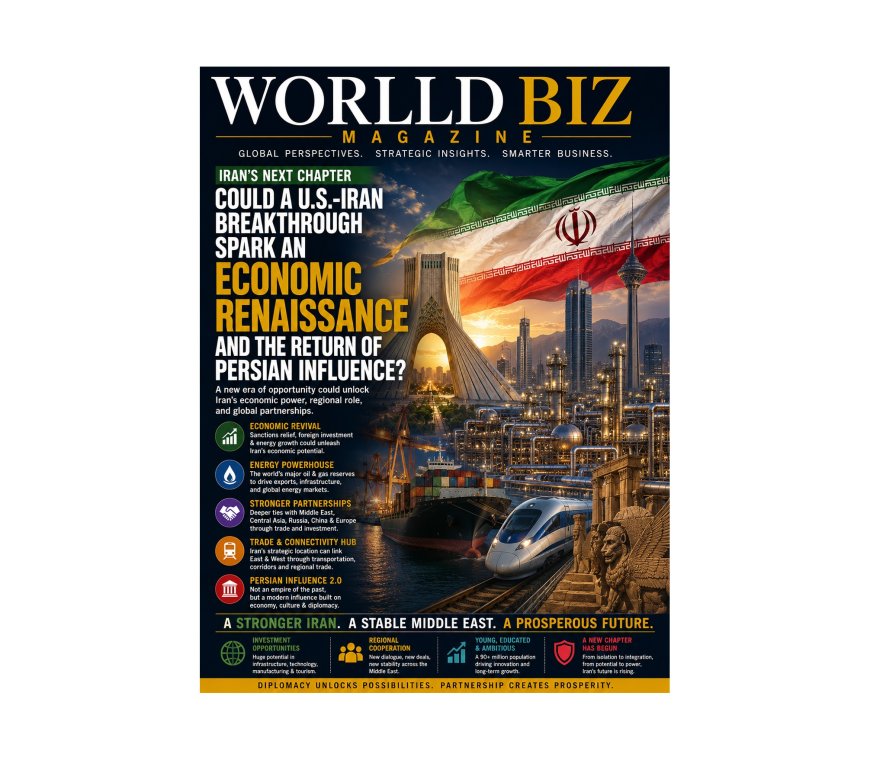
Iran's Next Chapter: Could a U.S.-Iran Breakthrough Spark an Economic Renaissance and the Return of Persian Influence?
How Iran Could Transform from a Sanctioned Economy into a Regional Economic Power
World Biz Magazine | Geopolitics & Economic Analysis
For more than four decades, Iran's economy has operated under varying degrees of sanctions, diplomatic isolation, financial restrictions, and geopolitical pressure. Despite possessing some of the world's largest oil and natural gas reserves, a highly educated population, significant industrial capacity, and a strategic geographic location, Iran has never fully realized its economic potential in the modern era.
A meaningful diplomatic breakthrough between Iran and the United States could mark one of the most significant geopolitical shifts in the Middle East since the end of the Cold War.
The implications would extend far beyond sanctions relief.
Such a transformation could reshape energy markets, redefine regional alliances, attract global investment, modernize industries, and potentially position Iran as one of the Middle East's most influential economic powers over the next decade.
The question facing investors, policymakers, and regional leaders is no longer whether Iran possesses the resources for growth. The question is whether a new era of stability could unlock the economic potential that has remained largely dormant for decades.
A Nation with Untapped Economic Power
Iran possesses many of the ingredients required for long-term economic success.
With a population exceeding 90 million people, Iran represents one of the largest consumer markets in the Middle East. The country maintains a diversified industrial base, advanced scientific institutions, a strong engineering workforce, and substantial natural resource wealth.
Unlike many resource-dependent economies, Iran developed domestic industries during years of sanctions. These industries include:
• Automotive manufacturing
• Petrochemicals
• Pharmaceuticals
• Mining
• Steel production
• Telecommunications
• Technology development
• Defense manufacturing
• Agriculture
This industrial foundation could provide a strong platform for accelerated economic growth if international restrictions are eased.
The Energy Giant Ready to Reawaken
Iran controls some of the largest proven oil and natural gas reserves in the world.
However, sanctions limited foreign investment, technology transfer, financing access, and production capacity expansion.
If international energy companies return, Iran could experience a major energy-sector revival.
Potential developments include:
• Expansion of oil production capacity
• Modernization of refineries
• Growth in petrochemical exports
• New natural gas projects
• LNG infrastructure development
• Pipeline expansion projects
• Renewable energy investments
Global energy markets would closely monitor any increase in Iranian exports, as additional supply could influence regional energy pricing and reshape global trade flows.
For Iran, energy revenues could provide the financial foundation for broader economic modernization.
The Return of Foreign Investment
One of the most immediate impacts of sanctions relief would likely be renewed foreign direct investment.
Global investors have long viewed Iran as one of the world's largest underdeveloped markets.
Investment opportunities could emerge in:
• Infrastructure
• Transportation
• Aviation
• Ports and logistics
• Manufacturing
• Renewable energy
• Telecommunications
• Technology startups
• Financial services
• Tourism
Major international corporations may view Iran as one of the most attractive frontier markets of the coming decade.
A country of Iran's size, population, and resource base would be difficult for global investors to ignore.
Could Tehran Become a Regional Business Hub?
Historically, Iran occupied a central position in regional commerce.
Situated between the Middle East, Central Asia, South Asia, the Caucasus, and Europe, Iran possesses extraordinary geographic advantages.
Improved international relations could transform the country into a major trade corridor connecting:
• The Persian Gulf
• Central Asia
• Türkiye
• South Asia
• The Caucasus
• Europe
Modern transportation networks, ports, rail systems, and logistics hubs could significantly increase Iran's role in regional commerce.
In many respects, geography may become one of Iran's greatest economic assets.
The Rise of Iran's Technology Economy
While energy often dominates discussions about Iran, technology may become one of its most important growth sectors.
Iran possesses a highly educated population with strong capabilities in:
• Engineering
• Artificial Intelligence
• Software Development
• Biotechnology
• Nanotechnology
• Research and Development
Access to international capital, partnerships, and markets could accelerate growth in Iran's innovation ecosystem.
A thriving technology sector would help diversify the economy beyond oil and gas.
Tourism Could Become a Major Economic Engine
Iran possesses some of the world's richest cultural and historical assets.
Ancient cities, UNESCO heritage sites, Islamic architecture, Persian history, mountains, deserts, and coastlines provide extraordinary tourism potential.
If diplomatic normalization improves international perceptions, Iran could emerge as one of the Middle East's fastest-growing tourism destinations.
The economic benefits would extend to:
• Hotels
• Airlines
• Restaurants
• Retail businesses
• Transportation providers
• Cultural institutions
Tourism could become a major source of employment and foreign exchange earnings.
Will the Middle East Accept a Stronger Iran?
Perhaps the most important geopolitical question concerns how neighboring countries would respond to a more economically powerful Iran.
Historically, relations between Iran and many Arab states have fluctuated between cooperation and competition.
A less isolated Iran would likely pursue deeper economic engagement with:
• Saudi Arabia
• United Arab Emirates
• Qatar
• Oman
• Kuwait
• Bahrain
• Iraq
Economic cooperation often creates incentives for stability.
Many regional governments may conclude that trade, investment, and development offer greater benefits than prolonged confrontation.
Saudi Arabia and Iran: From Rivals to Economic Partners?
One of the most significant developments in recent years has been the gradual improvement in Saudi-Iran relations.
Both nations recognize that long-term regional stability supports economic growth and investment.
A future characterized by economic cooperation rather than strategic rivalry could unlock:
• Joint infrastructure projects
• Energy collaboration
• Tourism initiatives
• Trade agreements
• Financial partnerships
Such cooperation would represent a historic shift in Middle Eastern geopolitics.
The UAE's Pragmatic Approach
The UAE has often demonstrated a pragmatic approach to economic diplomacy.
Dubai's position as a global trade and financial hub makes it likely that Emirati businesses would seek opportunities in a growing Iranian market.
Commercial relationships between the UAE and Iran could expand significantly through investment, logistics, shipping, and financial services.
Could the Persian Sphere of Influence Expand Again?
Throughout history, Persia was one of the world's great civilizations.
The Persian Empire once extended across vast portions of the Middle East, Central Asia, and beyond.
However, modern geopolitics differs fundamentally from the imperial eras of the past.
The likelihood of a territorial Persian Empire re-emerging is effectively nonexistent.
Yet influence in the 21st century is measured differently.
Modern power is increasingly built through:
• Economic strength
• Trade networks
• Investment flows
• Technology leadership
• Diplomatic influence
• Energy resources
• Cultural connections
In this sense, Iran could potentially expand its influence across the region not through military expansion but through economic and diplomatic engagement.
The future "Persian influence" would likely be commercial rather than territorial.
Iran and Central Asia: A Natural Partnership
Iran's geographic position provides direct access to Central Asia.
As regional connectivity improves, Iran could become a key transit route for goods moving between Central Asia and international markets.
This would strengthen Iran's role in:
• Logistics
• Energy transportation
• Regional trade
• Infrastructure development
Such connectivity would further enhance Iran's strategic importance.
Challenges Remain
Despite enormous opportunities, significant challenges remain.
Iran would still need to address:
Economic Reform
Modernization of regulations, banking systems, and investment frameworks will be necessary to attract global capital.
Infrastructure Modernization
Transportation, logistics, and energy infrastructure require substantial investment.
Political Stability
Investors prioritize predictability and long-term stability.
Competition
Regional competitors including Saudi Arabia, the UAE, Türkiye, and others will continue pursuing investment and trade opportunities.
Technology Gaps
Many industries require modernization after years of restricted access to global technology.
Is Iran Becoming the Middle East's Next Economic Power?
If diplomatic normalization continues, sanctions ease, foreign investment returns, and economic reforms accelerate, Iran possesses many of the ingredients necessary to become one of the Middle East's most significant economic powers.
Its combination of natural resources, population size, industrial capacity, educated workforce, and strategic geography is difficult to match.
The coming decade could determine whether Iran remains a largely untapped economic giant or emerges as a leading force in shaping the future of the Middle East.
Final Thoughts
The significance of a U.S.-Iran diplomatic breakthrough extends far beyond politics.
It could unlock one of the world's largest underdeveloped economies, reshape regional trade networks, transform energy markets, and create new opportunities across the Middle East.
While the return of an ancient Persian Empire belongs to history, the rise of a modern Persian economic power is a possibility that investors, governments, and businesses around the world will be watching closely.
Iran's future influence may not be built through conquest, but through commerce, connectivity, energy, innovation, and diplomacy.
And in the modern world, those tools often prove more powerful than armies.
Conclusion
Iran stands at a potentially historic crossroads.
For decades, the country has possessed many of the ingredients required for economic success: vast energy reserves, a large domestic market, strategic geography, industrial capabilities, a highly educated population, and deep cultural influence across the region. Yet sanctions, geopolitical tensions, restricted access to international finance, and diplomatic isolation have prevented Iran from fully realizing its economic potential.
A sustained diplomatic breakthrough with the United States could mark the beginning of a new chapter in Iran's modern history.
The opportunities extend far beyond oil exports.
Foreign investment, infrastructure modernization, industrial expansion, technology development, tourism growth, regional trade integration, and stronger diplomatic relationships could collectively transform Iran into one of the Middle East's most influential economic powers.
Perhaps most importantly, Iran could leverage its unique geographic position to become a critical economic bridge connecting the Middle East, Central Asia, South Asia, and Europe.
The revival of major regional energy and trade projects could significantly strengthen Iran's economic position. Increased exports of oil, natural gas, petrochemicals, and industrial products could provide substantial revenue for modernization and long-term development.
Projects such as the Iran-Pakistan Gas Pipeline could also play a significant role in Iran's future strategy. If geopolitical conditions allow, Iran could gain access not only to Pakistan's growing energy market but potentially to broader South Asian markets over time, creating new export opportunities and strengthening regional economic integration.
However, the realization of these opportunities depends on one critical factor:
The durability of peace.
If diplomatic progress evolves into long-term normalization, Iran could experience one of the most significant economic transformations in its modern history.
If tensions re-emerge, sanctions return, or regional conflict escalates again, many of the opportunities discussed in this analysis could remain unrealized.
The future of Iran may ultimately be determined not by its resources which are already substantial but by the stability that allows those resources to be fully utilized.
The return of a territorial Persian Empire belongs to history.
The rise of a modern Persian economic power remains a possibility.
And for Iran, that distinction could shape the next generation.
World Biz Magazine Insights
Key Takeaways
• Iran possesses one of the largest untapped economic opportunities in the Middle East.
• A sustained U.S.-Iran diplomatic breakthrough could unlock significant foreign investment across energy, infrastructure, technology, transportation, tourism, and manufacturing sectors.
• Iran's vast oil and natural gas reserves could once again become major engines of economic growth if sanctions barriers are substantially reduced.
• Increased energy exports could generate substantial revenues for modernization, infrastructure development, and economic diversification.
• Iran's strategic geographic location positions it as a potential trade and logistics hub connecting Asia, the Middle East, Central Asia, and Europe.
• The modernization of ports, railways, highways, logistics corridors, and industrial zones could significantly strengthen Iran's regional influence.
• Iran's technology sector and highly educated workforce could become important drivers of future economic growth.
• Tourism may emerge as one of Iran's most underdeveloped but potentially high-growth industries.
• Improved relations with Gulf countries could create new opportunities for trade, investment, and regional cooperation.
• Economic influence, trade connectivity, energy exports, and diplomacy may become the primary tools of future Persian influence rather than traditional geopolitical competition.
• Projects such as the Iran-Pakistan Gas Pipeline could provide additional export opportunities while strengthening regional economic integration.
• Greater regional stability could accelerate Iran's role within broader trade networks linking China, Central Asia, South Asia, and the Middle East.
Strategic Outlook
• Iran possesses many of the characteristics required to become one of the Middle East's leading economic powers over the next decade.
• The combination of energy resources, industrial capacity, geographic location, and population size provides Iran with unique long-term advantages.
• Successful economic reform and greater integration with international markets could significantly accelerate growth.
• Improved relations with neighboring countries may create opportunities for regional infrastructure, trade, energy, and investment partnerships.
• The future of Persian influence is likely to be measured through economic strength, trade networks, technology, investment, and diplomacy rather than territorial ambitions.
• If peace and economic integration continue, Iran could become one of the most strategically important economic hubs in Eurasia.
Risk Assessment
• The opportunities outlined in this analysis remain highly dependent on the continuation of diplomatic progress between Iran and the United States.
• Any future economic transformation would require sustained political stability, regulatory reforms, and investor confidence.
• Renewed sanctions, diplomatic breakdowns, military confrontations, or regional instability could significantly limit economic progress.
• Foreign investment may remain cautious until long-term geopolitical stability is demonstrated.
• Competition from regional economic powers such as Saudi Arabia, the UAE, Türkiye, and others will remain significant.
• Infrastructure modernization and technology upgrades will require substantial capital and international partnerships.
• Large-scale energy projects and regional trade initiatives remain dependent on geopolitical conditions beyond Iran's direct control.
World Biz Magazine Bottom Line
Iran may represent one of the world's largest underdeveloped economic opportunities.
A successful and lasting diplomatic breakthrough could unlock new investment, expand trade, increase energy exports, modernize infrastructure, strengthen regional partnerships, and accelerate economic growth.
The country's future influence may not emerge through military power or territorial expansion, but through economic connectivity, energy leadership, industrial development, technological innovation, and diplomatic engagement.
However, all projections remain dependent upon one fundamental assumption:
That peace endures.
If the current diplomatic progress evolves into long-term stability, Iran could emerge as one of the most influential economic powers in the Middle East and a key connector between Asia, the Middle East, and Europe.
If regional tensions return and diplomatic momentum collapses, many of the opportunities described in this analysis could remain unrealized.
For Iran, the coming decade may determine whether it becomes a revitalized economic power or remains a nation whose vast potential continues to be constrained by geopolitics.
Editorial Disclaimer
This article is a forward-looking geopolitical and economic analysis based on potential scenarios arising from improved diplomatic relations between Iran and the United States. The views expressed are analytical in nature and should not be interpreted as predictions, guarantees, investment advice, or official policy assessments.
Economic outcomes, energy exports, foreign investment, infrastructure development, trade expansion, regional partnerships, and geopolitical developments discussed in this article remain subject to evolving political, diplomatic, security, and market conditions.
World Biz Magazine recognizes that regional dynamics can change rapidly. Any future benefits described herein are dependent upon the continuation of diplomatic engagement, sustained regional stability, successful implementation of economic reforms, and the willingness of governments, investors, and businesses to pursue long-term cooperation.
Readers should evaluate developments based on official announcements, verified information, and evolving geopolitical circumstances.
Quote
"The future of Persian influence may not be written through borders and empires, but through energy, trade, investment, technology, and economic connectivity. Whether Iran realizes that future depends largely on the durability of peace."
What's Your Reaction?
 Like
0
Like
0
 Dislike
0
Dislike
0
 Love
0
Love
0
 Funny
0
Funny
0
 Angry
0
Angry
0
 Sad
0
Sad
0
 Wow
0
Wow
0