


















































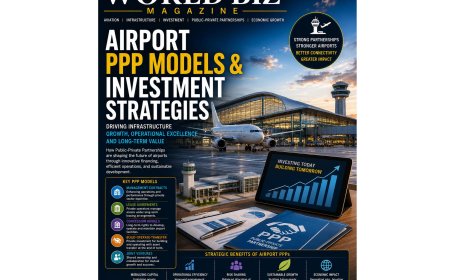






















































































































Global Aviation Market Analysis 2026–2030 | Airlines, Cargo & Policy Insights
In-depth analysis of the global commercial aviation industry covering airlines, aircraft makers, cargo growth, policies, and market forecasts to 2030.


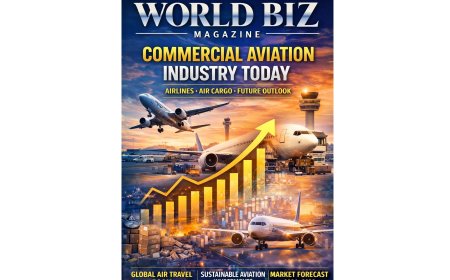
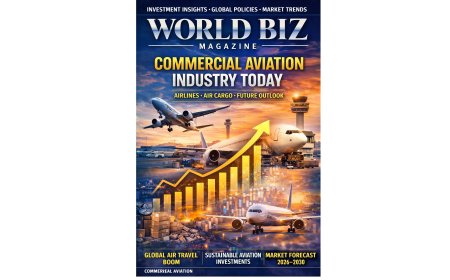
Commercial Aviation Industry Today
Global Market Overview, Policy Impact, Investments, and the Future of Flight
World Biz Magazine - Industry Intelligence Feature
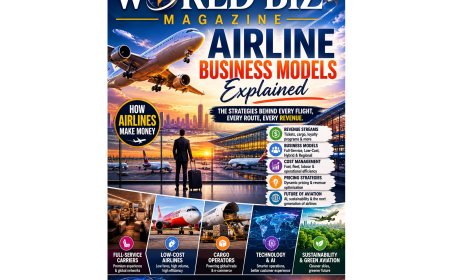
Commercial aviation remains a cornerstone of global economic integration, enabling cross-border trade, tourism, business connectivity, and supply chain activity. The industry encompasses passenger airlines, air cargo carriers, aircraft manufacturers, airport operators, service providers, and ancillary businesses such as maintenance, repair, and overhaul (MRO), ground handling, and digital aviation services.
Despite challenges from pandemic recovery, geopolitical tensions, climate policy shifts, and volatility in fuel costs, commercial aviation has rebounded strongly. Ongoing investments in new aircraft technologies, digital transformation, and sustainability initiatives signal an industry evolving toward greater efficiency and environmental responsibility.
Economic Significance of Commercial Aviation
Commercial aviation contributes significantly to the global economy:
- Facilitates global trade and tourism valued in the trillions.
- Supports millions of jobs direct, indirect, and induced through supply chains.
- Drives connectivity that enables economic growth and foreign investment.
- Air cargo is integral to time-sensitive industries (electronics, pharmaceuticals, manufacturing inputs).
The industry’s growth fosters economic linkages across regions, promotes investment flows, and enhances labor mobility.
Industry Size & Market Trends
After a deep slump in 2020–2021 due to COVID-19 restrictions, demand rebounded sharply:
- Passenger traffic has approached or exceeded pre-pandemic levels in many regions.
- Air cargo volumes remain robust due to supply chain needs and e-commerce growth.
- Industry forecasts project steady passenger growth through 2030, driven by Asia-Pacific demand and long-haul international travel expansion.
- Sustainability and next-generation aircraft investments are reshaping capital expenditure.
Key demand drivers include tourism expansion, business travel resurgence, trade growth, and digital economy logistics.
Key Markets by Region
North America
- Mature market with stable domestic demand.
- Strong cargo operations.
- Home to major carriers like Delta, American Airlines, United Airlines.
Europe
- High connectivity across borders.
- Large low-cost carrier presence (e.g., Ryanair, easyJet).
- Investment in digital hubs and sustainability initiatives.
Asia-Pacific
- Highest growth potential driven by population growth and rising middle class.
- Rapid expansion of domestic and regional travel.
- Significant infrastructure investments in airports and fleet modernization.
Middle East
- Hub airlines (e.g., Emirates, Qatar Airways) connect global traffic flows.
- Strategic investment in luxury long-haul travel infrastructure.
Latin America and Africa
- Growth potential tempered by infrastructure and economic challenges.
- Investment opportunity in domestic connectivity and air cargo networks.
Key Industry Players
Airlines
- American Airlines
- Delta Air Lines
- United Airlines
- Emirates
- Qatar Airways
- Lufthansa Group
- Air France–KLM
- China Southern Airlines
- Singapore Airlines
Aircraft Manufacturers
- Boeing (U.S.)
- Airbus (Europe)
- Embraer (Brazil)
- COMAC (China)
Support & Service Providers
- Rolls-Royce and General Electric (engine manufacturers)
- Honeywell and Thales (avionics and systems)
- MRO specialists - AAR Corp, Lufthansa Technik, SR Technics
Policy Environment & Political Influences
Government policies significantly shape industry economics through:
Aviation Regulation
- Safety standards and certification (ICAO, FAA, EASA)
- Airspace rights and bilateral agreements
- Passenger protection regulations
Trade and Travel Policy
- Open skies agreements expand carrier access.
- Visa policies influence travel demand.
Environmental Policy
- Emissions standards and carbon taxation.
- Sustainable aviation fuel mandates (SAF) and decarbonization targets aim to reduce industry carbon footprint.
- Government incentives exist for next-gen technology investment.
Economic Stimulus and Tax Policy
- Airport infrastructure funding.
- Aviation-specific loans and relief programs during downturns.
Political decisions on regulation, subsidies, and market access directly impact profitability, route networks, and capital investment decisions.
Major Investments & Expansion Projects
Significant investment flows are targeting:
- Fleet modernization - new narrow- and wide-body aircraft, fuel-efficient models.
- Sustainable technologies - SAF, hydrogen propulsion research, hybrid-electric systems.
- Airport infrastructure - new terminals, expanded runways, digital air traffic management.
- Cargo capacity growth - dedicated freighters and integrated logistics hubs.
- Digital transformation - automation, AI in operations, predictive maintenance.
Notable Expansion Highlights
- Large carrier fleet orders from Airbus and Boeing.
- Airport mega-hub programs in Middle East and Asia.
- Green fleet renewal initiatives tied to net-zero commitments.
- E-commerce carriers expanding dedicated belly and freighter capacity.
Key Contacts & Industry Networks
International Air Transport Association (IATA): Global airline trade association shaping policy.
Airports Council International (ACI): Represents airports worldwide.
International Civil Aviation Organization (ICAO): UN agency responsible for standards and regulations.
National aviation authorities: FAA (U.S.), EASA (Europe), CAAC (China), DGCA (India).
These bodies coordinate regulatory frameworks, safety standards, and global aviation policy.
Price Trends & Economic Cycles
Fuel Costs & Inflation
Fuel represents a major operating cost, often 20-30% of airline expenses. Volatile oil prices influence ticket prices and profitability.
Historical Price Movement
- Sharp decline in 2020 due to reduced travel demand.
- Recovery and inflationary pressure through 2022–2025.
- Stabilization anticipated as fuel efficiency improves and SAF adoption increases.
Forecast
Passenger demand and cargo volume growth will likely support moderate pricing power. External factors (fuel price volatility, geopolitical tension) remain key price risk variables.
Cargo & E-Commerce Dependence
Air cargo is integral to time-sensitive distribution especially electronics, medical supplies, high-value goods, and perishable products. The rise of e-commerce has significantly boosted demand for air freight capacity, particularly for intercontinental and express services.
New Players & Industry Disruption
Emerging participants include:
- Regional low-cost carriers in Asia and Africa.
- Tech-led logistics aviation startups.
- Electric and hybrid aircraft innovators.
Cargo start-ups and digital service platforms are reshaping customer experience and network planning.
Countries with Investment Challenges
Some countries have seen weakening aviation investment due to economic or regulatory pressures:
- Economies with limited connectivity growth.
- Markets where infrastructure investment lags or debt burdens are high.
- Regions losing air traffic share to neighboring hubs.
This has implications for tourism and global trade participation.
Future Outlook
Demand Growth
Air travel demand is projected to grow, particularly in emerging markets and intra-regional routes.
Sustainability Transition
Decarbonization efforts will reshape fleets, fuels, and infrastructure investment. Sustainable aviation fuels and emissions reduction initiatives are central to future competitiveness.
Technological Innovation
AI, automation, digitization, and next-generation propulsion systems will increase efficiency and safety.
Market Expansion
New airport investments, route liberalization, and digital logistics will continue to expand network connectivity.
World Biz Magazine Insight:
The next decade promises transformative change from how aircraft are powered to how global networks connect people and goods. Commercial aviation is not just recovering; it is reinventing itself for a more connected and sustainable tomorrow.
World Biz Magazine’s Strategic Insight
The commercial aviation industry is at a remarkable inflection point:
- Passenger traffic recovering and expanding after historical disruptions.
- Air cargo integration with global supply chains accelerating value creation.
- Environmental and digital transformation reshaping capital allocation.
- Asia-Pacific and Middle East hubs becoming growth engines of global connectivity.
Despite challenges from geopolitics, fuel volatility, and regulatory complexity, the industry’s resilience and innovation trajectory position it for sustained expansion.
Conclusion
Commercial aviation is far more than transportation it is a global economic catalyst linking commerce, culture, and communities. Its future will be defined by sustainability goals, technological evolution, policy harmonization, and capital investments that balance growth with environmental responsibility.
As the world continues to urbanize and globalize, air travel and cargo capacity will remain indispensable to economic activity and international cooperation.
Disclaimer
This article is published for informational, analytical, and editorial purposes only. Market data, forecasts, and industry insights are based on publicly available information, industry estimates, and analytical interpretation at the time of publication.
World Biz Magazine does not guarantee the accuracy, completeness, or future performance of projections referenced in this content. Nothing in this article should be construed as financial, investment, legal, or strategic advice. Readers are advised to consult qualified professionals before making investment or business decisions.
All trademarks, company names, organizations, and regulatory bodies mentioned remain the property of their respective owners and are referenced strictly for journalistic and informational purposes.
What's Your Reaction?
 Like
0
Like
0
 Dislike
0
Dislike
0
 Love
0
Love
0
 Funny
0
Funny
0
 Angry
0
Angry
0
 Sad
0
Sad
0
 Wow
0
Wow
0