




































































































































































Understanding Commercial Banking: Functions, Services & Global Impact
A detailed World Biz Magazine analysis explaining commercial banking, business financing, global trade, fintech disruption, and banking innovation.

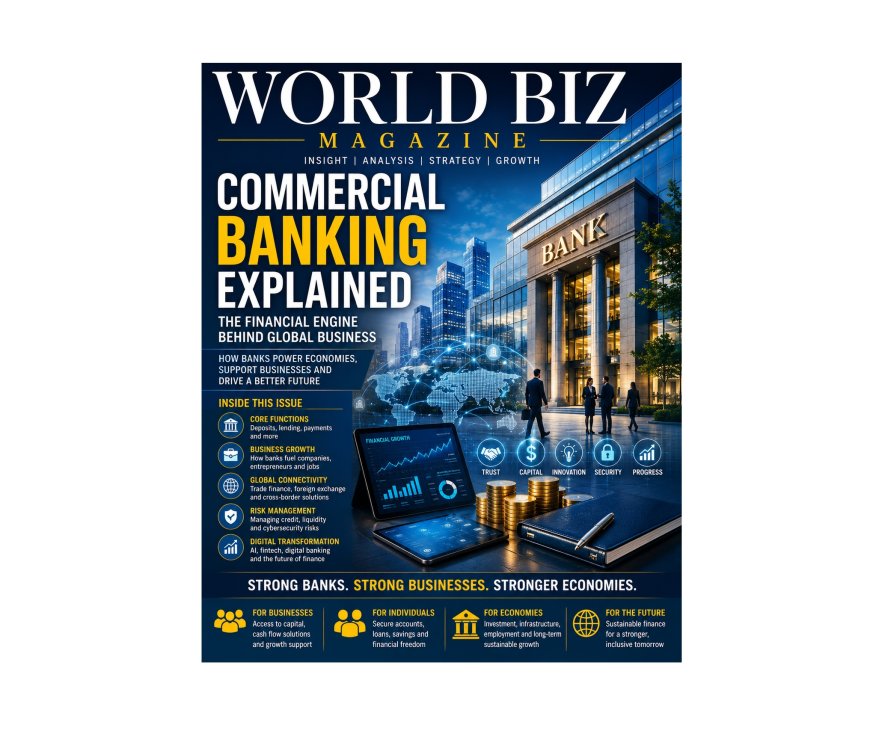
Commercial Banking Explained
Understanding the Financial System That Powers Global Business and Economic Growth
World Biz Magazine | Global Financial Intelligence | Banking & Capital Markets
The Backbone of Modern Economies
Commercial banking is one of the most important pillars of the global financial system. From multinational corporations and governments to small businesses and individual consumers, commercial banks play a central role in managing money, facilitating transactions, supporting economic development, and maintaining financial stability. Without commercial banking institutions, the modern economy as we know it would struggle to function efficiently.
Every day, trillions of dollars move through commercial banking systems worldwide. Businesses rely on banks for loans, working capital, payroll services, trade financing, and operational cash management. Consumers depend on banks for savings accounts, credit cards, mortgages, online payments, and financial security. Governments and central banks also work closely with commercial banking institutions to manage monetary policy, economic growth, inflation control, and national financial infrastructure.
Commercial banking has evolved dramatically over the past century. Traditional banking models focused primarily on physical branches, cash deposits, and manual recordkeeping. Today, the industry is increasingly driven by digital transformation, artificial intelligence, fintech innovation, cybersecurity, mobile banking, blockchain technology, and global financial connectivity. Modern commercial banks are no longer simply financial institutions storing deposits; they are complex economic engines powering business expansion, infrastructure development, international trade, and global investment activity.
As economies become more interconnected and technology-driven, understanding how commercial banking works has become increasingly important for entrepreneurs, investors, corporations, policymakers, and consumers alike. Commercial banks influence everything from interest rates and business growth to employment creation and financial inclusion. Their impact extends far beyond everyday banking services and reaches into nearly every sector of the global economy.
What Is Commercial Banking?
Commercial banking refers to the part of the banking industry that provides financial services to businesses, corporations, governments, and individual consumers. Commercial banks accept deposits, provide loans, facilitate payments, manage cash flow, offer financial products, and support economic activity across multiple sectors.
At its core, commercial banking operates by taking deposits from customers and using a portion of those funds to issue loans and credit facilities to borrowers. The bank earns profit primarily through the difference between the interest paid to depositors and the interest charged on loans, commonly known as the interest spread.
Commercial banks perform several essential functions within the economy:
- Accepting customer deposits
- Providing business and consumer loans
- Processing payments and transactions
- Facilitating domestic and international trade
- Managing financial risk
- Supporting investment and economic growth
- Providing liquidity within financial markets
Commercial banking institutions range from local community banks and regional banks to multinational financial corporations operating across multiple countries and continents.
The Core Functions of Commercial Banks
Accepting Deposits
One of the primary functions of commercial banks is accepting deposits from individuals, businesses, and organizations. Customers deposit money into savings accounts, current accounts, checking accounts, and fixed-term deposits for security, convenience, and interest earnings.
Deposits provide the bank with capital that can be used for lending and investment activities. At the same time, depositors gain access to secure financial storage and payment systems.
Banks typically offer different deposit products depending on customer needs:
- Savings accounts
- Current/checking accounts
- Fixed deposits
- Certificates of deposit
- Business operating accounts
- High-yield savings products
Deposit-taking remains the foundation of commercial banking operations worldwide.
Lending and Credit Services
Commercial banks generate significant revenue through lending activities. They provide loans to businesses, consumers, entrepreneurs, and governments for various purposes including expansion, infrastructure, real estate, operations, and personal financing.
Business Loans
Businesses often rely on commercial banks for:
- Working capital financing
- Equipment financing
- Commercial real estate loans
- Expansion funding
- Inventory financing
- Payroll support
- Trade financing
Consumer Loans
Commercial banks also provide:
- Mortgages
- Auto loans
- Credit cards
- Personal loans
- Student financing
By extending credit, banks stimulate economic activity, business growth, entrepreneurship, and consumer spending.
Payment Processing and Transactions
Commercial banks facilitate financial transactions between individuals, businesses, and governments. Payment systems are essential for the smooth functioning of modern economies.
Banks process:
- Wire transfers
- Online payments
- Mobile banking transactions
- Debit and credit card payments
- International remittances
- Automated clearing house (ACH) transfers
- Merchant payment processing
Modern banking infrastructure allows money to move rapidly across domestic and international financial systems.
Trade Finance and International Banking
Global trade depends heavily on commercial banking institutions. Banks help businesses manage international transactions, currency exchange, import-export financing, and cross-border payment risks.
Trade finance services include:
- Letters of credit
- Export financing
- Import financing
- Currency exchange
- Foreign trade guarantees
- International settlement services
Without commercial banking support, international commerce would face major operational and financial barriers.
Cash Management and Treasury Services
Large corporations often rely on banks for sophisticated treasury and liquidity management services. Commercial banks help businesses optimize cash flow, manage operational liquidity, and reduce financial risk.
Services may include:
- Payroll management
- Liquidity forecasting
- Corporate payment systems
- Investment management
- Currency hedging
- Risk mitigation strategies
Corporate banking divisions within commercial banks specialize in serving large enterprise clients with complex financial needs.
How Commercial Banks Make Money
Commercial banks operate as profit-driven financial institutions. Their revenue comes from multiple sources.
Net Interest Income
The largest source of revenue for many banks is net interest income. Banks pay interest to depositors and charge higher interest rates to borrowers. The difference between these rates creates profit margins.
For example:
- A bank may pay 2% interest on savings accounts
- The same bank may charge 7% on business loans
The spread between borrowing and lending rates becomes income for the bank.
Fees and Service Charges
Commercial banks also generate revenue from:
- Account maintenance fees
- ATM charges
- Transaction fees
- Wire transfer fees
- Credit card fees
- Foreign exchange fees
- Advisory services
Fee-based income has become increasingly important as banking competition intensifies globally.
Investment and Asset Management
Some commercial banks invest in financial markets, government securities, bonds, and other investment vehicles to generate additional returns.
Larger banking institutions may also operate:
- Wealth management divisions
- Asset management services
- Investment advisory departments
Types of Commercial Banks
The commercial banking industry includes multiple categories of institutions serving different market segments.
Retail Banks
Retail banks focus primarily on individual consumers and small businesses. They provide everyday banking services such as savings accounts, personal loans, and mortgages.
Corporate Banks
Corporate banks serve large companies and multinational corporations with specialized financial products including treasury management, syndicated loans, and trade finance.
Investment Banks
Although distinct from traditional commercial banks, some financial institutions combine commercial and investment banking services.
Investment banking activities may include:
- Capital raising
- Mergers and acquisitions
- IPO underwriting
- Financial advisory services
Digital Banks and Neobanks
Technology-driven banking platforms are transforming the financial industry. Digital-only banks operate without physical branches and focus heavily on mobile banking and fintech innovation.
These institutions emphasize:
- Lower operational costs
- Faster digital services
- AI-driven banking tools
- Mobile-first customer experiences
The Role of Commercial Banks in Economic Growth
Commercial banks play a central role in economic development and financial stability.
Supporting Business Expansion
Access to financing allows businesses to:
- Hire employees
- Expand operations
- Purchase equipment
- Launch new products
- Enter international markets
Without commercial bank lending, many businesses would struggle to grow.
Infrastructure Development
Banks finance major infrastructure projects including:
- Transportation systems
- Energy facilities
- Telecommunications networks
- Commercial construction
- Industrial development
These investments contribute to national economic growth and modernization.
Job Creation
By supporting businesses and entrepreneurship, commercial banks indirectly contribute to employment creation and economic productivity.
Financial Inclusion
Banking access helps individuals participate in the formal economy, build savings, access credit, and improve financial security.
Digital banking technologies are expanding financial inclusion in emerging economies worldwide.
Risks Faced by Commercial Banks
Despite their importance, commercial banks face numerous financial and operational risks.
Credit Risk
Borrowers may fail to repay loans, leading to financial losses.
Interest Rate Risk
Changes in interest rates can affect profitability and lending margins.
Liquidity Risk
Banks must maintain enough liquidity to meet customer withdrawal demands.
Cybersecurity Threats
Digital banking systems face increasing threats from cybercrime, hacking, and data breaches.
Economic Recession
Economic downturns can reduce lending activity, increase loan defaults, and weaken financial stability.
Digital Transformation in Commercial Banking
Technology is rapidly reshaping the banking industry.
Mobile Banking
Consumers increasingly manage finances through smartphones and digital applications.
Artificial Intelligence
AI is improving:
- Fraud detection
- Credit scoring
- Customer service
- Risk analysis
- Personalized financial products
Blockchain and Digital Payments
Blockchain technology may transform payment systems, transaction security, and cross-border banking infrastructure.
Fintech Competition
Financial technology companies are challenging traditional banks with faster, cheaper, and more user-friendly financial services.
As competition intensifies, commercial banks are investing heavily in innovation and digital modernization.
The Future of Commercial Banking
The future of commercial banking will likely be shaped by:
- Artificial intelligence
- Open banking systems
- Digital currencies
- Embedded finance
- Sustainable finance
- ESG investing
- Real-time global payments
- Financial automation
Banks are expected to become increasingly technology-driven while balancing regulatory compliance, cybersecurity, and customer trust.
Environmental and social considerations are also becoming more important as banks finance renewable energy projects, sustainable infrastructure, and climate-focused investments.
The next generation of commercial banking may operate through highly integrated digital ecosystems connecting businesses, consumers, governments, and global financial markets in real time.
World Biz Magazine Insights
At World Biz Magazine, we view commercial banking as one of the foundational systems supporting modern civilization and global economic development. Commercial banks are not merely financial intermediaries; they are strategic economic institutions that influence business growth, infrastructure investment, international trade, and technological progress.
The commercial banking industry is currently undergoing one of the most significant transformations in its history. Artificial intelligence, fintech innovation, digital payments, blockchain systems, and cybersecurity are reshaping how financial institutions operate and compete globally.
As digital economies expand and financial systems become increasingly interconnected, commercial banks are expected to play an even greater role in powering global commerce, innovation, and long-term economic resilience.
Conclusion
Commercial banking remains one of the most important pillars of the global economy. From accepting deposits and issuing loans to facilitating international trade and powering digital payments, commercial banks support nearly every aspect of modern financial activity.
Their influence extends beyond traditional banking services into infrastructure development, economic growth, technological innovation, and global financial stability. As the banking industry continues evolving through digital transformation and fintech disruption, commercial banks are expected to remain central to the future of business, investment, and international commerce.
Understanding commercial banking is essential for entrepreneurs, investors, policymakers, and consumers seeking to navigate the increasingly complex world of global finance.
Disclaimer
This article is published for informational, educational, and editorial purposes only and does not constitute financial, investment, legal, tax, or banking advice. Readers should consult licensed financial advisors, banking professionals, or legal experts before making financial or investment decisions. World Biz Magazine and its affiliates are not responsible for financial losses, banking decisions, or outcomes resulting from the information presented in this publication.
What's Your Reaction?
 Like
0
Like
0
 Dislike
0
Dislike
0
 Love
0
Love
0
 Funny
0
Funny
0
 Angry
0
Angry
0
 Sad
0
Sad
0
 Wow
0
Wow
0