





































































































































































The Rise of Digital Property Platforms in Global Real Estate Markets
A detailed World Biz Magazine analysis of digital property platforms, PropTech innovation, and the future of global real estate.

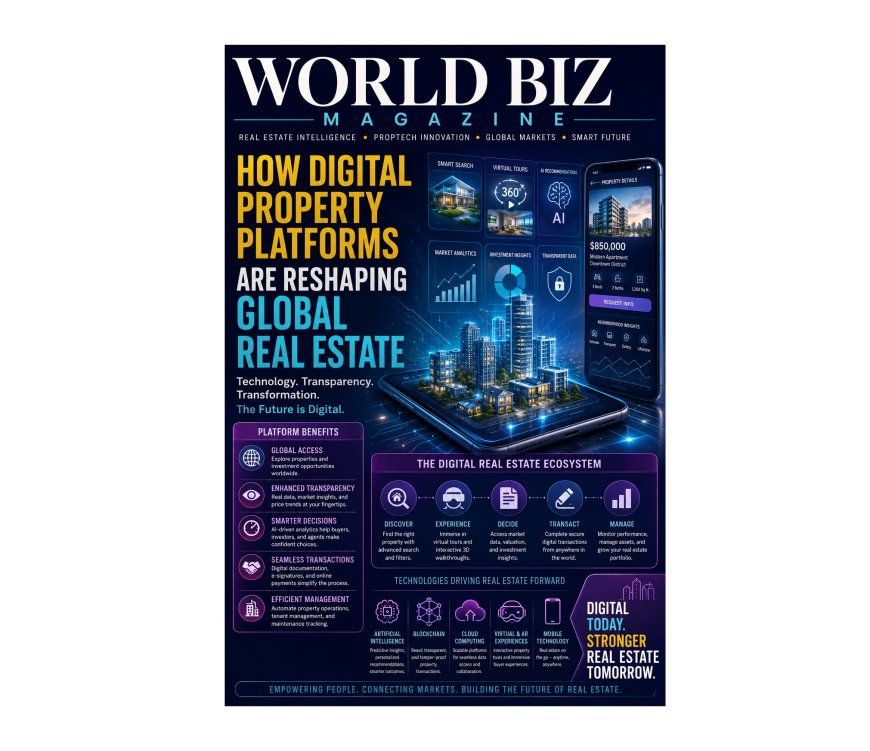
How Digital Property Platforms Are Reshaping Global Real Estate
The Rise of PropTech, Online Property Ecosystems, and the Digital Transformation of Real Estate Markets Worldwide
World Biz Magazine | Global Real Estate Intelligence, PropTech Innovation, Digital Property Markets
The Digital Revolution in Real Estate
For centuries, real estate transactions relied heavily on physical interactions, local market knowledge, paper-based documentation, and traditional brokerage networks. Buyers visited properties in person, sellers depended on local agents for exposure, and investors often faced significant information barriers when evaluating opportunities in unfamiliar markets. While the fundamental nature of real estate as a physical asset remains unchanged, the way properties are marketed, analyzed, financed, managed, and transacted is undergoing one of the most significant transformations in industry history.
Digital property platforms have emerged as powerful forces reshaping the global real estate landscape. These platforms are changing how buyers search for homes, how sellers reach potential customers, how investors evaluate opportunities, how landlords manage assets, and how developers market projects. By combining technology, data analytics, artificial intelligence, cloud computing, digital marketing, virtual experiences, and online transaction capabilities, property platforms are creating a more connected, transparent, and efficient real estate ecosystem.
The growth of digital real estate platforms has accelerated due to several factors:
- Increasing internet penetration
- Smartphone adoption
- Artificial intelligence advancements
- Digital payment systems
- Cloud computing
- Remote work trends
- Global investment activity
- Demand for market transparency
Today, property transactions increasingly begin online. Buyers explore neighborhoods digitally, investors analyze market trends through data dashboards, tenants submit applications electronically, and developers market projects globally through virtual platforms. The result is a real estate industry becoming increasingly data-driven, accessible, and technology-enabled.
As digital transformation continues accelerating, property platforms are not merely supporting real estate transactions they are fundamentally redefining how global real estate markets operate.
What Are Digital Property Platforms?
Digital property platforms are technology-based systems that facilitate real estate activities through online interfaces.
These platforms may support:
- Property listings
- Buying and selling
- Rental management
- Property valuation
- Investment analysis
- Virtual tours
- Mortgage services
- Asset management
By centralizing information and services, these platforms create streamlined experiences for market participants.
Digital property platforms have become essential tools for modern real estate transactions.
The Evolution of Property Search
Historically, property searches relied on:
- Newspaper advertisements
- Local agencies
- Physical property visits
- Word-of-mouth referrals
Today, digital platforms allow users to:
- Search thousands of properties instantly
- Filter by location and price
- Compare neighborhoods
- Analyze market trends
This shift has dramatically increased market efficiency and transparency.
Consumers now expect immediate access to property information.
Global Access to Real Estate Markets
One of the most important contributions of digital platforms is global accessibility.
Investors can now:
- Explore international markets
- Compare property opportunities
- Access market data remotely
- Communicate with stakeholders globally
Digital platforms have reduced geographic barriers that once limited real estate participation.
Cross-border investment activity continues benefiting from enhanced digital connectivity.
Increased Market Transparency
Transparency has traditionally been a challenge in real estate.
Digital platforms improve transparency by providing:
- Property histories
- Market comparisons
- Pricing information
- Neighborhood insights
- Transaction data
Greater transparency helps buyers and investors make more informed decisions.
It also promotes market confidence and efficiency.
Artificial Intelligence and Property Search
Artificial intelligence is transforming property discovery.
AI-powered systems can:
- Recommend suitable properties
- Analyze buyer preferences
- Predict market trends
- Personalize user experiences
Machine learning algorithms continuously improve search accuracy and user engagement.
AI increasingly serves as a digital advisor within real estate platforms.
Big Data and Real Estate Intelligence
Digital property platforms generate enormous amounts of data.
This information includes:
- Buyer behavior
- Search trends
- Pricing activity
- Market demand
- Geographic preferences
Data analytics enables:
- Better forecasting
- Market trend identification
- Investment opportunity analysis
Real estate is becoming increasingly driven by data rather than intuition alone.
Virtual Tours and Digital Property Viewing
One of the most visible innovations is the growth of virtual property tours.
Technology now allows buyers to:
- Explore homes remotely
- View detailed interiors
- Examine floor plans
- Experience neighborhoods digitally
Virtual viewing reduces time and travel requirements while expanding market reach.
International buyers particularly benefit from these capabilities.
Digital Marketing and Property Exposure
Property marketing has evolved significantly through digital platforms.
Developers and sellers can now reach:
- Local buyers
- National audiences
- International investors
Digital marketing tools include:
- Search optimization
- Social media campaigns
- Video presentations
- Interactive property showcases
Enhanced visibility improves sales opportunities and market efficiency.
Online Rental Market Transformation
Rental markets have been significantly impacted by digital platforms.
Tenants can now:
- Search listings online
- Submit applications electronically
- Sign digital agreements
- Make online payments
Landlords benefit through:
- Automated management
- Vacancy reduction
- Improved tenant communication
Digital platforms have simplified the rental process considerably.
Property Management Technology
Property management has become increasingly digital.
Modern platforms assist with:
- Maintenance tracking
- Tenant communication
- Financial reporting
- Lease administration
- Performance monitoring
These tools improve operational efficiency for both small and large property owners.
Technology is reducing administrative burdens across the industry.
Online Mortgage and Financing Integration
Many digital property platforms now integrate financing services.
Users can:
- Compare mortgage options
- Submit loan applications
- Calculate affordability
- Receive financing recommendations
Integrated financial services create more seamless transaction experiences.
The result is faster and more convenient property purchasing processes.
Digital Transactions and Paperless Real Estate
Real estate transactions increasingly utilize digital workflows.
Examples include:
- Electronic contracts
- Digital signatures
- Online documentation
- Secure transaction platforms
Paperless systems improve:
- Efficiency
- Accuracy
- Accessibility
Digital transaction infrastructure continues expanding globally.
PropTech: The Technology Driving Change
The broader technology sector supporting real estate innovation is often referred to as PropTech.
PropTech encompasses:
- Property marketplaces
- Smart buildings
- AI solutions
- Blockchain applications
- Construction technology
- Asset management systems
Investment in PropTech has grown rapidly as technology reshapes every stage of the property lifecycle.
Blockchain and Real Estate Innovation
Blockchain technology is emerging as a potential disruptor within real estate.
Potential applications include:
- Property records
- Smart contracts
- Ownership verification
- Transaction security
While adoption remains gradual, blockchain may contribute to greater transparency and efficiency in future real estate transactions.
Smart Buildings and Digital Communities
Digital property platforms increasingly connect with smart building technologies.
Features may include:
- Energy monitoring
- Security management
- Access control
- Smart home automation
The integration of digital infrastructure and residential assets continues creating new opportunities for property owners and occupants.
Real Estate Investment Platforms
Digital platforms have expanded access to property investment.
Investors can now:
- Analyze opportunities online
- Monitor asset performance
- Access market research
- Diversify geographically
Technology is making real estate investing more accessible than ever before.
This trend continues attracting new categories of investors.
Benefits for Developers
Developers increasingly rely on digital platforms for:
- Project marketing
- Lead generation
- Customer engagement
- Market analysis
Digital tools help developers:
- Reach wider audiences
- Reduce marketing costs
- Accelerate sales cycles
Technology has become an essential component of modern project development strategies.
Benefits for Consumers
Consumers benefit through:
- Greater property choice
- Enhanced transparency
- Faster transactions
- Improved convenience
- Better market information
Digital platforms empower buyers and renters with unprecedented access to data and opportunities.
Challenges Facing Digital Property Platforms
Despite their advantages, challenges remain.
These include:
- Data privacy concerns
- Cybersecurity risks
- Information accuracy
- Regulatory compliance
- Digital access inequality
Platform operators must continually address these issues to maintain user trust.
The Future of Digital Real Estate
The future of property platforms will likely involve:
- Advanced artificial intelligence
- Predictive market analytics
- Immersive virtual experiences
- Blockchain-enabled transactions
- Smart city integration
Technology will continue reshaping how real estate is bought, sold, rented, financed, and managed.
The industry is moving toward increasingly interconnected digital ecosystems.
Global Market Impact
Digital property platforms are influencing real estate markets across:
- North America
- Europe
- Middle East
- Asia-Pacific
- Africa
The impact is particularly significant in rapidly urbanizing regions where technology adoption and housing demand are expanding simultaneously.
Digital transformation is becoming a global real estate phenomenon.
World Biz Magazine Insights
At World Biz Magazine, we view digital property platforms as one of the most significant innovations in modern real estate. Much like e-commerce transformed retail and digital banking transformed finance, PropTech platforms are redefining how real estate markets operate globally.
Technology is reducing information asymmetry, increasing transparency, improving efficiency, and expanding access to investment opportunities. The integration of artificial intelligence, big data, digital transactions, and virtual experiences is creating a more connected and responsive real estate ecosystem.
As urbanization, global investment activity, and digital adoption continue accelerating, property platforms are likely to become increasingly central to every aspect of the real estate industry.
The future of real estate may no longer be defined solely by location, location, location—but increasingly by technology, technology, technology.
Conclusion
Digital property platforms are transforming the global real estate industry by increasing transparency, improving accessibility, enhancing efficiency, and enabling data-driven decision-making. Through artificial intelligence, virtual experiences, integrated financing, digital transactions, and advanced analytics, these platforms are reshaping how buyers, sellers, investors, developers, and property managers interact with real estate.
As technology continues evolving, digital platforms will play an increasingly important role in defining the future of housing, investment, urban development, and global property markets.
Disclaimer
This article is published for informational, educational, and editorial purposes only and does not constitute financial, legal, investment, technological, or professional real estate advice. Technology adoption, market conditions, and regulatory frameworks vary by region and may change over time. Readers should consult qualified professionals before making investment, business, or technology-related decisions. World Biz Magazine and its affiliates are not responsible for actions taken based on the information presented in this publication.
What's Your Reaction?
 Like
0
Like
0
 Dislike
0
Dislike
0
 Love
0
Love
0
 Funny
0
Funny
0
 Angry
0
Angry
0
 Sad
0
Sad
0
 Wow
0
Wow
0