
































































































































































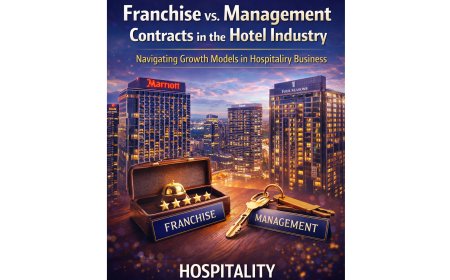



















Franchise vs Management Contracts in Hotels - Choosing the Right Growth Model
differences between franchise and management contracts in hotels, including benefits, risks, and global investment trends in the hospitality industry.


Franchise vs. Management Contracts in Hospitality
Choosing the Right Growth Model in a Global Hotel Industry
World Biz Magazine | Hospitality & Investment Strategy
The hospitality sector continues to shift toward asset-light operating structures, driven by capital efficiency, globalization of travel, and institutional investment flows. Franchising and management agreements now dominate the development pipeline across most global markets, representing the backbone of expansion strategies among multinational hotel operators.
From multinational giants such as Marriott International and Hilton Worldwide to regional operators and independent investors, choosing between these models can determine profitability, control, and risk exposure in a competitive travel market.
This article explores how each model works, their advantages and limitations, and how investors and developers can decide which path aligns with their long-term strategy.
Understanding the Two Core Models
Hotel Franchising
In a franchise agreement, the hotel owner (franchisee) operates the property under a recognized brand name owned by the franchisor.
Major global chains including
- InterContinental Hotels Group
- Accor
- Wyndham Hotels & Resorts
have built large portions of their global portfolios through franchising.
How It Works
- Owner builds or acquires property
- Owner handles hiring, operations, and daily management
- Brand provides:
- Trademark usage
- Reservation systems
- Marketing reach
- Operational standards
- Owner pays franchise fees (initial + ongoing royalties)
Advantages
For Owners
- Lower ongoing fees compared to management contracts
- Greater operational control
- Flexibility in cost management
For Brands
- Rapid expansion with limited capital investment
- Reduced operational risk
Disadvantages
- Owner must possess operational expertise
- Brand standards compliance costs
- Risk of inconsistent service affecting brand reputation
Hotel Management Contracts
In this model, the property owner hires a hotel company to operate the hotel on their behalf.
This approach is common in luxury or upscale segments led by operators like
- Hyatt Hotels Corporation
- Four Seasons Hotels and Resorts
- Mandarin Oriental Hotel Group
How It Works
- Owner funds development and retains asset ownership
- Operator manages daily operations
- Operator supplies:
- Executive management
- Brand positioning
- Service expertise
- Operational systems
- Owner pays management and incentive fees
Advantages
For Owners
- Professional expertise
- Brand consistency
- Reduced operational burden
For Operators
- Portfolio growth without owning assets
- Performance-based revenue streams
Disadvantages
- Higher fees
- Less operational control for owners
- Potential conflicts over strategy or profitability
Strategic Comparison
|
Factor |
Franchise Model |
Management Contract |
|
Operational Control |
High (Owner-led) |
Low (Operator-led) |
|
Required Expertise |
High |
Low |
|
Financial Cost |
Lower fees |
Higher fees |
|
Brand Support |
Moderate |
Extensive |
|
Risk Exposure |
Higher operational risk |
Lower operational risk |
|
Expansion Speed (Brand) |
Fast |
Moderate |
Market Trends Shaping Model Adoption
Asset-Light Expansion
Major global chains increasingly pursue “asset-light” strategies focusing on branding and management rather than ownership enabling scalable growth with reduced capital exposure.
Emerging Market Growth
Developers in Asia, the Middle East, and Africa often prefer:
- Management contracts for luxury positioning
- Franchises for midscale and budget expansion
Investor Sophistication
Institutional investors are increasingly evaluating:
- Fee structures
- Brand performance analytics
- Revenue optimization technology
before selecting partnership structures.
Decision Framework for Hotel Investors
Choose Franchising If:
- You possess strong operational experience
- Cost control is a priority
- You want greater autonomy
Choose Management Contracts If:
- You lack operational expertise
- Brand-driven positioning is critical
- Service quality consistency is essential
Key Players in the Global Hospitality Contract Landscape
Franchise-Heavy Operators
These companies derive significant portions of revenue from franchise-based expansion:
- Marriott International
- Hilton Worldwide
- Wyndham Hotels & Resorts
- Choice Hotels International
- InterContinental Hotels Group
Industry Role
- Massive global room footprints
- Strong distribution systems
- Scalable midscale and economy segments
Franchising dominates North American markets where owners often possess advanced operational experience.
Management Contract Leaders
Companies known for operating properties on behalf of owners:
- Four Seasons Hotels and Resorts
- Hyatt Hotels Corporation
- Mandarin Oriental Hotel Group
- Accor
- Shangri-La Hotels and Resorts
Industry Role
- Luxury and upper-upscale specialization
- Operational expertise
- Brand reputation maintenance
Management contracts are especially common in emerging tourism markets and luxury developments.
Real-World Contract Examples
Franchise Model Example
- A regional developer builds a midscale hotel under a global brand from Hilton Worldwide
- Owner hires staff and runs daily operations
- Pays royalty and marketing fees
- Gains access to reservation systems and loyalty programs
Outcome
- Faster market entry
- High autonomy
- Profitability tied to owner expertise
Management Contract Example
- Institutional investor funds luxury resort development
- Signs operating agreement with Four Seasons Hotels and Resorts
- Brand provides executive leadership and full operational control
Outcome
- Premium brand positioning
- Higher operating costs
- Reduced operational risk
Success Rates & Performance Tendencies
(Industry-observed patterns rather than fixed metrics)
Franchise Agreements
Typical success factors:
- Experienced ownership groups
- Efficient cost management
- Market demand alignment
Observed industry outcomes:
- Higher ROI potential
- Higher variance in performance
- Strong results in standardized segments
Management Contracts
Typical success factors:
- High-end market positioning
- Strong operator reputation
- Stable tourism demand
Observed industry outcomes:
- Consistent brand performance
- Lower volatility
- Premium ADR (average daily rate) gains
Investment Flow Trends
Franchise Model Investment Dynamics
- Favored by private investors and local developers
- Lower entry barriers
- Scalable multi-property portfolios
Common investment drivers:
- Midscale hotel expansion
- Domestic travel growth
- Secondary city developments
Management Contract Investment Dynamics
- Preferred by institutional investors
- Sovereign wealth and real estate funds
- Luxury destination developments
Common investment drivers:
- Destination branding
- Premium asset valuation
- Long-term capital appreciation
Risk & Opportunity Analysis
Franchise Model
Risks
- Operational mismanagement
- Brand compliance penalties
- Market demand fluctuations
Opportunities
- Greater profit retention
- Operational flexibility
- Entrepreneurial growth potential
Management Contracts
Risks
- Fee structure reducing margins
- Strategic misalignment with operator
- Limited owner decision power
Opportunities
- Brand-driven demand generation
- Professional management efficiency
- Investor confidence and asset prestige
Strategic Industry Outlook
The industry is evolving toward hybrid and flexible arrangements including:
- Performance-linked fees
- Shorter contract terms
- Co-investment partnerships
- Technology-integrated revenue management
As digital booking ecosystems, AI pricing, and global travel recovery accelerate, contract structures are becoming increasingly customized to balance risk, brand power, and capital deployment.
The Future Outlook
The hospitality sector is entering a hybrid era where flexible agreements and performance-linked partnerships are becoming common. Technology-driven analytics, AI pricing tools, and global distribution systems are reshaping both models allowing brands and owners to negotiate more customized structures.
As tourism demand rebounds globally and investment diversifies, the strategic choice between franchising and management contracts will remain central to sustainable hotel expansion and profitability.
Conclusion
Franchising and management contracts represent two complementary pathways within modern hospitality expansion neither universally superior, but each suited to specific strategic contexts.
Franchising empowers capable owners seeking control and financial upside, while management contracts offer expertise, stability, and brand prestige for investors prioritizing risk mitigation.
For developers, institutions, and hospitality entrepreneurs, the optimal choice lies in aligning operational capabilities, capital strategy, and market positioning with the structural strengths of each model.
As global tourism investment deepens, these partnership models will continue shaping the architecture of hotel growth worldwide.
Disclaimer
This article is published for informational and analytical purposes by World Biz Magazine. The content reflects industry observations, publicly available insights, and strategic interpretations and should not be considered investment, legal, or financial advisory guidance. Readers are encouraged to consult professional advisors and conduct independent due diligence before entering hospitality agreements or investments.
What's Your Reaction?
 Like
0
Like
0
 Dislike
0
Dislike
0
 Love
0
Love
0
 Funny
0
Funny
0
 Angry
0
Angry
0
 Sad
0
Sad
0
 Wow
0
Wow
0