


































































































































































































Industrial Automation Market Outlook: Robotics and Smart Factory Technologies
How robotics and automation are transforming global manufacturing through smart factories, AI-driven production, and Industry 4.0 technologies.

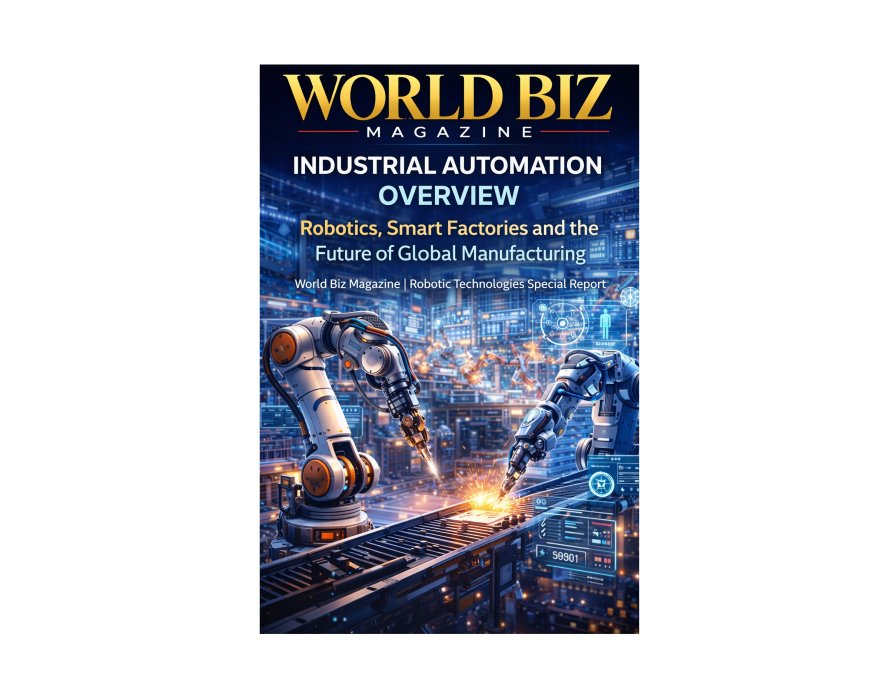
Industrial Automation Overview
Robotics, Smart Factories and the Future of Global Manufacturing
World Biz Magazine | Robotic Technologies Special Report
Industrial automation has become one of the most transformative forces shaping modern manufacturing and global production systems. By integrating robotics, artificial intelligence, sensors, and advanced control systems, factories are evolving into highly efficient smart manufacturing environments capable of producing goods faster, safer, and with greater precision.
Automation technologies now power industries ranging from automotive manufacturing and electronics production to pharmaceuticals, logistics, and food processing. As labor costs rise and global supply chains become more complex, businesses increasingly rely on robotics and automation to maintain competitiveness.
This World Biz Magazine Robotic Technologies report explores the industrial automation ecosystem, including market size, key technologies, industry players, policy influence, investment trends, regional markets, and the outlook for automation technologies through 2030.
What Is Industrial Automation?
Industrial automation refers to the use of control systems, robotics, and digital technologies to operate machinery and industrial processes with minimal human intervention.
Automation systems can include:
· industrial robots
· programmable logic controllers (PLCs)
· computer numerical control (CNC) machines
· industrial sensors and vision systems
· artificial intelligence software
· smart factory platforms
Automation allows factories to increase productivity while reducing human error and operational risks.
Evolution of Industrial Automation
Industrial automation has evolved through several technological phases.
Phase 1: Mechanization
Early automation relied on mechanical systems and basic machinery to replace manual labor.
Phase 2: Computerized Automation
The introduction of computers and digital control systems allowed factories to automate complex manufacturing processes.
Phase 3: Smart Manufacturing
Today’s automation systems integrate AI, data analytics, and IoT technologies to enable intelligent decision-making within factories.
This transformation is often described as Industry 4.0.
Global Industrial Automation Market
The industrial automation market has grown rapidly as companies adopt digital manufacturing technologies.
Market Size
|
Year |
Market Value |
|
2015 |
$160B |
|
2020 |
$215B |
|
2025 |
$310B |
|
2030 (forecast) |
$450B+ |
Industrial automation is now one of the fastest-growing sectors within the robotics and manufacturing industries.
Industrial Robotics Market
Industrial robots represent the core component of automation systems.
Global Industrial Robot Installations
|
Year |
Robots Installed |
|
2015 |
254,000 |
|
2020 |
384,000 |
|
2024 |
550,000 |
|
2030 forecast |
1 million+ annually |
Factories increasingly deploy robots to perform repetitive and high-precision tasks.
Key Automation Technologies
Industrial automation relies on a combination of technologies.
Robotics
Industrial robots perform tasks such as welding, assembly, packaging, and material handling.
Artificial Intelligence
AI systems analyze production data and optimize manufacturing processes.
Internet of Things (IoT)
Connected devices allow factories to monitor equipment performance in real time.
Digital Twins
Digital simulations of production systems help engineers test and optimize factory operations.
Collaborative Robots (Cobots)
Cobots work safely alongside human workers, improving productivity and flexibility.
Key Industry Players
Several global companies dominate the industrial automation sector.
Leading Automation Companies
· Siemens
· ABB
· Rockwell Automation
· Schneider Electric
· Mitsubishi Electric
These companies provide automation platforms, robotics systems, and digital manufacturing software.
Countries Leading Industrial Automation
Automation adoption varies significantly across countries.
Top Automation Markets
|
Country |
Strength |
|
China |
largest robot market |
|
Japan |
robotics innovation |
|
Germany |
advanced manufacturing |
|
United States |
AI and automation technology |
|
South Korea |
highest robot density |
Asia dominates industrial robot deployment globally.
Industrial Automation by Sector
Automation is widely used across multiple industries.
Automotive Manufacturing
Automotive factories have some of the highest levels of robot deployment.
Electronics Manufacturing
Automation enables precision assembly of semiconductors and electronic devices.
Logistics and Warehousing
Robotics systems automate sorting, packaging, and warehouse operations.
Food and Beverage
Automation improves efficiency in food processing and packaging.
Economic Impact of Automation
Automation significantly affects industrial productivity and global competitiveness.
Benefits
· increased production efficiency
· reduced manufacturing costs
· improved product quality
· enhanced workplace safety
Automation also helps companies operate factories with fewer errors and higher output.
Investment Trends in Automation
Investment in automation technologies has increased dramatically.
Major Investors
· manufacturing corporations
· technology companies
· venture capital firms
· government innovation programs
Many governments promote automation as part of national industrial strategies.
Policy and Government Initiatives
Governments worldwide support automation adoption.
Key Initiatives
· Germany’s Industry 4.0 strategy
· China’s Made in China 2025 program
· U.S. advanced manufacturing initiatives
· Japan’s robotics development programs
These policies aim to strengthen national manufacturing competitiveness.
Labor Market Impact
Automation has sparked debate about its impact on employment.
Potential Challenges
· displacement of repetitive jobs
· need for workforce retraining
· skill shortages in robotics and AI
However, automation also creates new roles in engineering, robotics programming, and digital manufacturing.
Price Trends and Technology Costs
The cost of automation technologies has gradually declined.
Key Drivers
· advances in robotics hardware
· improved semiconductor technology
· increased competition among manufacturers
Lower costs are accelerating adoption across industries.
Comparison with Other Technology Sectors
|
Sector |
Market Size |
|
industrial automation |
$300B+ |
|
robotics industry |
$70B+ |
|
AI industry |
$500B+ |
Automation increasingly overlaps with AI and digital technologies.
Future Trends in Industrial Automation
Several trends will shape the next generation of automation technologies.
Autonomous Factories
Fully automated factories could operate with minimal human involvement.
AI-Driven Manufacturing
Artificial intelligence will optimize production processes in real time.
Human-Robot Collaboration
Cobots will allow humans and robots to work together safely.
Smart Supply Chains
Automation will extend beyond factories to logistics and global supply chains.
Industry Outlook to 2030
Key Growth Drivers
1. labor shortages in manufacturing
2. rising production costs
3. global competition in manufacturing
4. digital transformation initiatives
5. advances in robotics and AI
Market Forecast
|
Segment |
2030 Forecast |
|
industrial automation |
$450B+ |
|
industrial robotics |
rapid expansion |
|
smart factory technology |
strong growth |
Automation will continue transforming global manufacturing systems.
World Biz Magazine Insights
Industrial automation represents one of the most important technological revolutions shaping the future of manufacturing. As factories become more digital and interconnected, robotics and AI will increasingly drive productivity, efficiency, and industrial competitiveness.
Countries that successfully adopt automation technologies will likely gain significant advantages in the global manufacturing economy.
Conclusion
Industrial automation is reshaping how goods are produced across the world. From robotics and artificial intelligence to smart factories and digital supply chains, automation technologies are transforming industries and redefining global manufacturing competitiveness.
As automation continues evolving, businesses, governments, and workers must adapt to a rapidly changing industrial landscape driven by innovation and technological advancement.
Disclaimer
The information presented in this article is intended for informational and educational purposes only. Market statistics, projections, and forecasts are based on publicly available industry data and analytical estimates at the time of publication. While every effort has been made to ensure accuracy, World Biz Magazine does not guarantee future market performance or investment outcomes. Readers should consult professional advisors before making business or financial decisions based on the information contained in this report. All trademarks and company names referenced remain the property of their respective owners.
What's Your Reaction?
 Like
0
Like
0
 Dislike
0
Dislike
0
 Love
0
Love
0
 Funny
0
Funny
0
 Angry
0
Angry
0
 Sad
0
Sad
0
 Wow
0
Wow
0