







































































































































































































Market Risk in Property: Understanding Real Estate Cycles, Bubbles, and Market Corrections
A comprehensive guide to property market cycles and investment risk, covering market peaks, downturns, bubble indicators, and long-term investing strategies.

Market Risk in Property: Cycles, Bubbles, and Corrections
Understanding How Real Estate Markets Rise, Peak, Decline, and Recover and What Investors Can Do to Navigate the Cycle
World Biz Magazine | Real Estate & Investment
Property markets have long been viewed as one of the most resilient and wealth-generating asset classes in the global economy. Residential housing, commercial buildings, industrial facilities, logistics assets, hospitality properties, and mixed-use developments collectively represent trillions of dollars in value worldwide. Yet despite their perceived stability, property markets are inherently cyclical and subject to significant fluctuations driven by economic, financial, demographic, regulatory, and behavioral forces.
History has repeatedly demonstrated that real estate values do not move in a straight line. Periods of rapid growth are often followed by market slowdowns, corrections, or even severe downturns. From Japan's property bubble of the late 1980s and the U.S. housing crisis of 2008 to more recent market adjustments driven by rising interest rates and economic uncertainty, property cycles have shaped investor fortunes and national economies alike.
For investors, developers, lenders, policymakers, and asset managers, understanding market risk is essential for preserving capital and making informed investment decisions. Recognizing the warning signs of overheating markets, identifying bubble conditions, and preparing for corrections can significantly improve long-term investment outcomes.
This article explores the nature of property market cycles, the formation of real estate bubbles, the mechanics of market corrections, and the strategies investors can use to manage risk across changing market conditions.
What Is Market Risk in Property?
Market risk refers to the possibility that changes in broader real estate market conditions may negatively affect property values, rental income, occupancy rates, liquidity, or overall investment returns.
Unlike property-specific risks such as maintenance issues or tenant defaults, market risk originates from external forces that affect large segments of the market simultaneously.
Examples include:
- Economic recessions
- Interest rate increases
- Oversupply conditions
- Declining demand
- Credit tightening
- Regulatory changes
- Demographic shifts
- Investor sentiment changes
Because market risk cannot be entirely eliminated, successful investors focus on understanding and managing its impact.
Understanding Real Estate Market Cycles
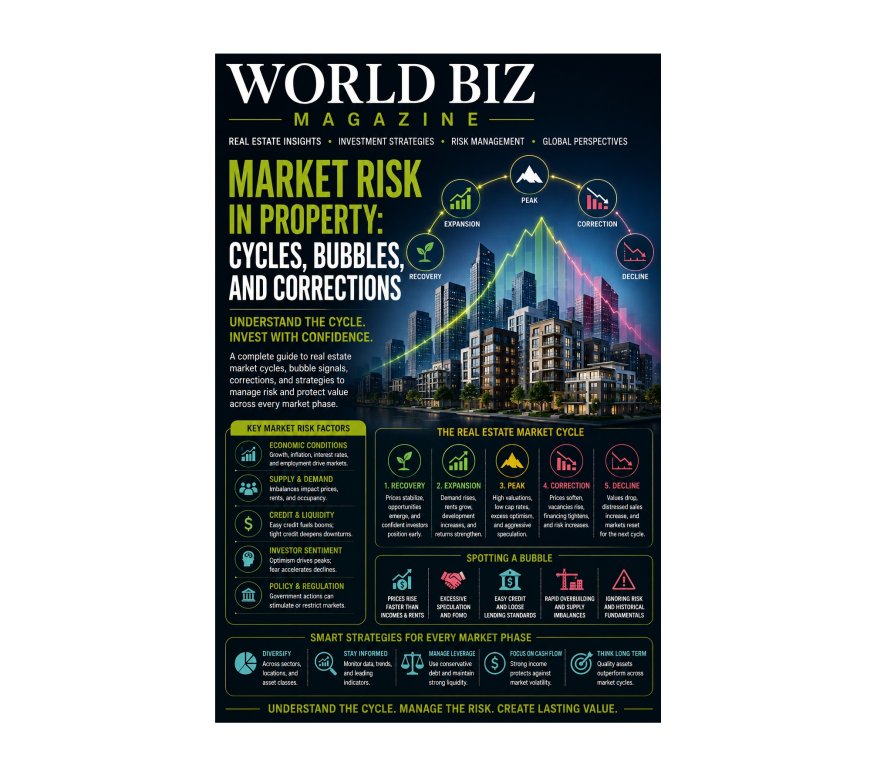
Real estate markets typically move through recurring cycles characterized by expansion, peak, contraction, and recovery.
Although the duration and intensity of cycles vary across regions and property types, the underlying patterns remain remarkably consistent.
Understanding these phases helps investors anticipate opportunities and potential risks.
Phase One: Recovery
The recovery phase begins after a market downturn or correction.
During this period:
- Vacancy rates remain elevated
- Property values stabilize
- Construction activity remains limited
- Investor confidence gradually improves
- Demand begins to recover
Early recovery periods often provide attractive acquisition opportunities because prices remain relatively low while growth prospects improve.
Many experienced investors achieve their strongest long-term returns by investing during recovery phases.
Phase Two: Expansion
As economic conditions strengthen, the market enters an expansion phase.
Characteristics include:
- Rising property values
- Increasing rental rates
- Declining vacancy levels
- Strong demand growth
- New development activity
- Improved financing availability
Investor optimism typically increases during expansion periods, attracting additional capital into the market.
Expansion phases often generate strong returns but can also sow the seeds of future market imbalances.
Phase Three: Peak
The peak phase represents the highest point of the cycle.
Indicators may include:
- Record property valuations
- Aggressive development activity
- Compressed capitalization rates
- Elevated transaction volumes
- Strong speculative behavior
- Relaxed lending standards
While market conditions often appear favorable, underlying risks may be increasing.
Many investors become overly optimistic during peak periods, assuming growth will continue indefinitely.
History shows that such assumptions can be dangerous.
Phase Four: Contraction
The contraction phase begins when market fundamentals weaken.
Common signs include:
- Slowing demand
- Rising vacancy rates
- Falling transaction volumes
- Reduced lending activity
- Declining property values
- Investor uncertainty
Market contractions vary in severity. Some involve modest price declines, while others evolve into significant corrections or crises.
The ability to identify early warning signals is critical for protecting capital.
What Is a Real Estate Bubble?
A real estate bubble occurs when property prices rise significantly above levels justified by underlying economic fundamentals.
Bubbles are typically driven by excessive optimism, speculative buying, easy credit conditions, and expectations of continued price appreciation.
During bubble periods:
- Buyers purchase assets primarily for future resale gains.
- Valuations disconnect from rental income fundamentals.
- Debt levels increase rapidly.
- Investors underestimate risk.
- Market participants assume prices can only rise.
While bubbles may persist for years, they are ultimately unsustainable.
When confidence weakens, prices often decline rapidly.
Common Causes of Property Bubbles
Several factors contribute to bubble formation.
Excessive Credit Availability
Easy access to financing often fuels rapid property price growth.
Low interest rates and relaxed lending standards encourage borrowing and speculative investment.
Investor Speculation
Speculative behavior increases when investors focus primarily on short-term price appreciation rather than long-term fundamentals.
Supply Constraints
Limited housing supply can amplify price growth and create scarcity-driven market conditions.
Economic Optimism
Periods of strong economic growth often reinforce confidence and encourage aggressive investment activity.
Behavioral Factors
Fear of missing out (FOMO), herd behavior, and unrealistic expectations frequently contribute to bubble dynamics.
Historical Examples of Property Bubbles
Real estate history provides numerous examples of market bubbles.
Japan (1980s)
Property values in major Japanese cities reached extraordinary levels before collapsing in the early 1990s.
United States Housing Crisis (2008)
Excessive mortgage lending and speculative buying contributed to one of the most significant financial crises in modern history.
Spain and Ireland
Rapid construction booms and credit expansion fueled severe property market corrections following the Global Financial Crisis.
China Property Market Challenges
Recent concerns surrounding debt levels and developer stress have highlighted the risks associated with prolonged property market expansion.
These examples demonstrate the importance of disciplined risk management.
Understanding Market Corrections
A market correction refers to a decline in property values following a period of growth.
Unlike major crashes, corrections are often viewed as healthy adjustments that restore balance between prices and fundamentals.
Corrections may be triggered by:
- Rising interest rates
- Economic slowdowns
- Oversupply conditions
- Regulatory intervention
- Credit tightening
- Geopolitical uncertainty
While corrections can create short-term challenges, they often generate opportunities for long-term investors.
Key Indicators Investors Should Monitor
Successful investors closely track indicators that may signal changing market conditions.
Affordability Ratios
Rapid increases in home prices relative to income levels may indicate overheating markets.
Price-to-Rent Ratios
When property values rise significantly faster than rental income, valuations may become stretched.
Vacancy Rates
Increasing vacancies often signal weakening demand.
Construction Activity
Excessive development may create future oversupply risks.
Interest Rate Trends
Higher borrowing costs can reduce demand and pressure property values.
Lending Standards
Aggressive lending practices frequently precede market downturns.
Monitoring these indicators helps investors make more informed decisions.
How Professional Investors Manage Market Risk
Sophisticated investors employ multiple strategies to manage property market risk.
Diversification
Investing across locations, sectors, and asset classes reduces concentration risk.
Conservative Leverage
Maintaining moderate debt levels improves resilience during downturns.
Long-Term Investment Horizons
Long-term strategies help investors navigate short-term volatility.
Fundamental Analysis
Focusing on cash flow, occupancy, and market fundamentals reduces reliance on speculative price growth.
Stress Testing
Evaluating investments under adverse scenarios improves preparedness.
Liquidity Planning
Maintaining adequate reserves provides flexibility during uncertain periods.
Risk management often proves more important than return maximization during volatile market conditions.
Emerging Risks Shaping Future Property Cycles
Several factors are influencing modern property markets.
These include:
- Rising global interest rates
- Climate-related risks
- Remote work adoption
- Demographic shifts
- Housing affordability challenges
- Geopolitical uncertainty
- Technological disruption
- ESG investment requirements
Future market cycles may differ from historical patterns as these forces reshape property demand and investment behavior.
Lessons for Property Investors
The most important lesson from real estate history is that cycles are inevitable.
Markets do not rise indefinitely, and downturns are a normal part of the investment landscape.
Successful investors focus on:
- Understanding market fundamentals
- Avoiding speculative excesses
- Maintaining financial discipline
- Managing leverage carefully
- Preparing for multiple market scenarios
Those who respect market cycles often emerge stronger when conditions change.
World Biz Magazine Insights
The greatest real estate investment risks often emerge during periods of maximum optimism. Property cycles, bubbles, and corrections are recurring features of every major market, yet investors frequently underestimate their impact. The most resilient investors are those who prioritize fundamentals over speculation, maintain disciplined risk management practices, and view market corrections not solely as threats but also as opportunities to acquire quality assets at attractive valuations.
Conclusion
Market risk remains one of the most important factors affecting property investment performance. Understanding the dynamics of market cycles, recognizing bubble conditions, and preparing for corrections can significantly improve investment outcomes and capital preservation.
While real estate continues to offer substantial long-term opportunities, successful investing requires more than identifying growth potential. It requires a deep appreciation of risk, a commitment to disciplined decision-making, and the ability to adapt to changing market conditions. By understanding how cycles, bubbles, and corrections shape property markets, investors can position themselves to navigate uncertainty and build more resilient portfolios over time.
Disclaimer
This article is published for informational, educational, and industry analysis purposes only and does not constitute investment, financial, legal, tax, or professional advice. Real estate investments involve risk, including the potential loss of capital. Market conditions, economic factors, regulatory changes, and property performance may vary significantly. Readers should conduct independent research and consult qualified financial, legal, tax, and real estate professionals before making investment decisions.
What's Your Reaction?
 Like
0
Like
0
 Dislike
0
Dislike
0
 Love
0
Love
0
 Funny
0
Funny
0
 Angry
0
Angry
0
 Sad
0
Sad
0
 Wow
0
Wow
0