












































































































































































































How Public-Private Partnerships Are Transforming Global Infrastructure Investment
Public-Private Partnerships are reshaping infrastructure investment through innovative financing, private capital, and long-term development strategies.

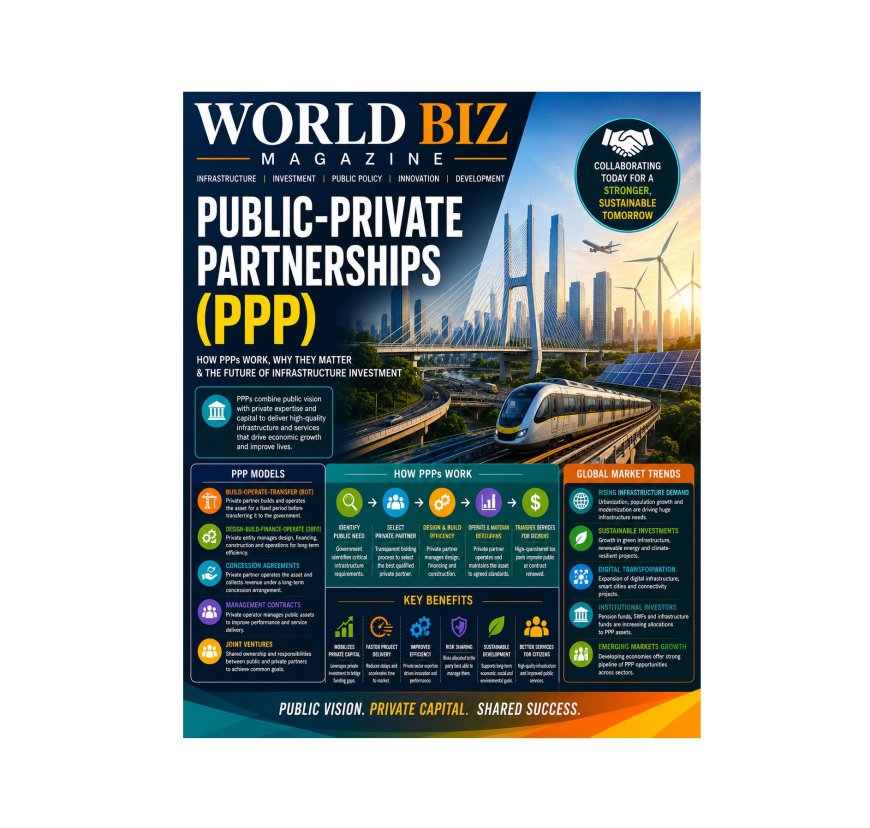
What Is Public-Private Partnership (PPP), How It Works, and Global Market Trends
Understanding the Financing Model Transforming Infrastructure Development Worldwide
World Biz Magazine | Infrastructure Finance, Public Policy & Economic Development
As governments around the world face growing infrastructure demands, budget constraints, and increasing expectations for efficient public services, Public-Private Partnerships (PPPs) have emerged as one of the most influential financing and development models in the global infrastructure sector. By combining public oversight with private sector investment and expertise, PPPs are helping deliver critical infrastructure projects while supporting economic growth and long-term development.
Understanding Public-Private Partnerships
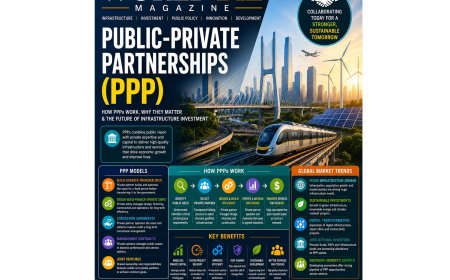
A Public-Private Partnership (PPP) is a long-term collaborative agreement between a government entity and a private sector organization for the development, financing, operation, management, or maintenance of public infrastructure and services.
Unlike traditional government procurement models where public authorities fully fund and manage projects, PPPs allocate responsibilities, risks, and rewards between public and private partners. The objective is to leverage the strengths of both sectors to deliver infrastructure and services more efficiently and effectively.
Governments contribute regulatory support, public oversight, policy direction, and sometimes financial participation, while private companies provide capital, technical expertise, innovation, project management capabilities, and operational efficiencies.
PPP models are commonly used for transportation networks, airports, seaports, rail systems, highways, hospitals, schools, energy projects, water utilities, telecommunications infrastructure, and smart city developments.
Why PPPs Have Become So Important
Infrastructure development is essential for economic growth, yet governments often face significant fiscal limitations. Population growth, urbanization, digital transformation, climate adaptation, and modernization requirements have dramatically increased infrastructure investment needs.
Traditional public funding alone is frequently insufficient to meet these demands. PPPs provide an alternative approach by mobilizing private capital while accelerating project implementation.
In addition to financing benefits, PPPs often improve project delivery through private sector innovation, specialized expertise, and performance-based management. This combination enables governments to develop critical infrastructure while reducing pressure on public budgets.
As a result, PPPs have become a central component of infrastructure strategies in both developed and emerging economies.
How Public-Private Partnerships Work
The structure of a PPP depends on the specific project, financing requirements, and policy objectives. However, most PPP arrangements follow a similar framework.
The government identifies a public infrastructure need and establishes project objectives. Private companies or consortiums then compete through a transparent procurement process to become project partners.
Once selected, the private partner typically assumes responsibility for some combination of:
- Project financing
- Design and engineering
- Construction
- Operations
- Maintenance
- Technology implementation
- Asset management
The government retains oversight responsibilities and ensures compliance with public service standards, regulatory requirements, and contractual obligations.
Revenue generation mechanisms vary by project and may include user fees, government payments, commercial revenues, or hybrid financing structures.
Key PPP Models Used Worldwide
Build-Operate-Transfer (BOT)
Under a BOT model, the private partner finances, designs, builds, and operates the infrastructure asset for a specified concession period. At the end of the contract term, ownership transfers back to the government.
BOT models are widely used for airports, highways, rail projects, power plants, and water treatment facilities.
Design-Build-Finance-Operate (DBFO)
In DBFO agreements, private entities assume responsibility for project design, construction, financing, and operation while governments establish performance standards and oversight mechanisms.
This model encourages long-term efficiency because private operators remain responsible for asset performance throughout the contract period.
Concession Agreements
Concessions grant private operators the right to manage and operate public infrastructure for a defined period while collecting revenues generated by the asset.
Common examples include toll roads, airports, rail networks, ports, and utility services.
Management Contracts
Management contracts involve private companies operating public assets while ownership and major investment responsibilities remain with the government.
These arrangements focus on improving operational performance rather than transferring significant financial risk.
Joint Ventures
Joint ventures create shared ownership structures between governments and private investors. Both parties participate in financing, governance, and decision-making while sharing project risks and returns.
Risk Allocation: The Core Principle of PPP Success
One of the defining features of successful PPPs is effective risk allocation. Risks should be assigned to the party best positioned to manage them.
Private partners commonly assume:
- Construction risks
- Cost overruns
- Operational performance risks
- Maintenance responsibilities
- Technology deployment risks
Governments often retain:
- Regulatory risks
- Political risks
- Land acquisition responsibilities
- Public policy obligations
- Force majeure events
Balanced risk-sharing arrangements improve project outcomes and enhance investor confidence.
Sectors Benefiting Most from PPP Investments
Transportation Infrastructure
Transportation remains the largest PPP sector globally. Highways, airports, railways, metro systems, logistics corridors, and ports frequently utilize PPP structures to accelerate development and improve operational efficiency.
Energy Infrastructure
Power generation facilities, transmission networks, renewable energy projects, and smart grid systems increasingly rely on PPP financing to support energy security and sustainability goals.
Water and Utilities
Governments often utilize PPP models to improve water supply systems, wastewater treatment facilities, and utility infrastructure while enhancing service quality and operational performance.
Healthcare and Education
Hospitals, medical facilities, universities, and educational infrastructure are increasingly being developed through PPP frameworks designed to improve service delivery and infrastructure quality.
Digital Infrastructure
Broadband networks, data centers, telecommunications infrastructure, and smart city projects represent rapidly growing PPP investment categories.
Benefits of Public-Private Partnerships
PPP models offer several significant advantages.
Private investment expands infrastructure funding capacity and reduces immediate fiscal pressures on governments. Projects often benefit from faster delivery schedules, improved efficiency, advanced technologies, and stronger performance management.
Long-term contracts encourage lifecycle asset management, helping ensure infrastructure remains well-maintained throughout its operational life.
Private sector innovation can also introduce new technologies, digital solutions, and operational practices that improve service quality and reduce costs.
When properly structured, PPPs create value for governments, investors, businesses, and citizens alike.
Challenges Associated with PPP Projects
Despite their benefits, PPPs are not without challenges. Poorly structured agreements can lead to disputes, cost overruns, political controversy, and performance issues.
Key challenges include:
- Complex contract negotiations
- Regulatory uncertainty
- Long project timelines
- Revenue forecasting risks
- Financing challenges
- Political changes
- Public acceptance concerns
Successful PPP implementation requires strong governance frameworks, transparent procurement processes, clear contractual obligations, and effective stakeholder management.
Global PPP Market Trends
The global PPP market continues to expand as governments seek innovative solutions to address infrastructure funding gaps. Several key trends are shaping the future of PPP development.
Increasing Infrastructure Demand
Rapid urbanization, population growth, and modernization requirements are driving substantial demand for infrastructure investment worldwide. PPPs are increasingly viewed as essential tools for meeting these needs.
Growth in Sustainable Infrastructure
Climate-focused infrastructure investments are creating new PPP opportunities in renewable energy, green transportation, sustainable water systems, and climate-resilient infrastructure.
Digital Infrastructure Expansion
Governments are increasingly utilizing PPP models to develop telecommunications networks, broadband systems, smart cities, data centers, and digital public services.
Greater Institutional Investor Participation
Pension funds, sovereign wealth funds, infrastructure funds, insurance companies, and development finance institutions are increasing their allocation to infrastructure assets.
These investors are attracted by long-term cash flows, inflation protection characteristics, and portfolio diversification benefits.
Focus on Smart Infrastructure
Technology integration is becoming a key priority across PPP projects. Artificial intelligence, IoT systems, digital twins, predictive analytics, and smart asset management platforms are improving infrastructure performance and investment outcomes.
Emerging Markets Driving Future Growth
Emerging economies are expected to account for a significant share of future PPP activity. Many developing nations face substantial infrastructure deficits and limited public funding capacity, making PPPs particularly attractive.
Asia, Africa, the Middle East, and Latin America are experiencing growing demand for transportation networks, utilities, energy systems, healthcare infrastructure, and digital connectivity projects.
As institutional frameworks mature and investment environments improve, PPP activity in these regions is expected to accelerate significantly.
World Biz Magazine Insights
Public-Private Partnerships have evolved from alternative financing mechanisms into strategic instruments for national development. The ability to combine public policy objectives with private sector capital, expertise, and innovation makes PPPs one of the most effective tools available for addressing global infrastructure challenges. As infrastructure demands continue to grow and governments seek more efficient investment solutions, PPPs are likely to play an increasingly central role in shaping transportation networks, energy systems, smart cities, healthcare facilities, and digital infrastructure worldwide.
Conclusion
Public-Private Partnerships represent one of the most important developments in modern infrastructure finance and public policy. By leveraging the strengths of both public and private sectors, PPPs provide a framework for delivering critical infrastructure more efficiently, sustainably, and effectively. As infrastructure investment requirements continue to rise globally, PPPs will remain a vital mechanism for mobilizing capital, accelerating development, and supporting long-term economic growth. Governments, investors, and infrastructure developers that successfully embrace PPP strategies will be better positioned to meet the demands of an increasingly connected and rapidly evolving world.
Disclaimer
This article is published by World Biz Magazine for informational and educational purposes only. The content reflects general industry perspectives related to public-private partnerships, infrastructure finance, economic development, and investment strategies. It does not constitute financial, legal, investment, engineering, or policy advice. Readers should conduct independent research and consult qualified professionals before making decisions regarding PPP agreements, infrastructure investments, financing structures, or public policy initiatives. World Biz Magazine assumes no responsibility for actions taken based on the information presented in this publication.
What's Your Reaction?
 Like
1
Like
1
 Dislike
0
Dislike
0
 Love
0
Love
0
 Funny
0
Funny
0
 Angry
0
Angry
0
 Sad
0
Sad
0
 Wow
1
Wow
1